

























































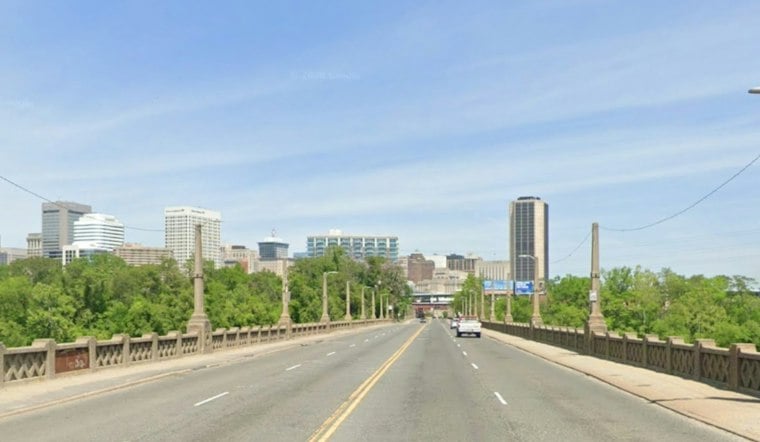
Virginia's transportation department has unveiled an updated concept for replacing the 113-year-old Mayo Bridge, cutting the span's vehicle capacity from four lanes to two while adding protected bike lanes, wider sidewalks and river overlooks. The estimated price tag has climbed past $190 million, and officials still haven't locked down when construction will actually begin.
A Bridge Built in 1913 Finally Showing Its Age
The Mayo Bridge connects Shockoe Bottom to Manchester, with a stop on Mayo Island in between, and it has carried Richmond traffic since 1913, according to the Richmonder. Its pavement condition index now sits at zero, as reported by WRIC. Even so, the Virginia Department of Transportation has been careful about how it frames the bridge's condition. “It is not what we would call ‘unsafe,’ but it is in need of replacement based on its condition,” a VDOT representative told WRIC in a separate report on cycling advocates' concerns.
The new design, reported by Axios reporter Sabrina Moreno, marks VDOT's first updated concepts since 2024. It calls for 11-foot sidewalks and 6-foot bike lanes, historic-style railings, and new pedestrian connections to the future Mayo Island park. The speed limit on the bridge would also drop from 35 mph to 25 mph, according to the Richmonder.
Two Lanes, A Bend, and a Barrier for Cyclists
The new span would be 66 feet wide and sit east of the current bridge's location, with a bend built in partway across specifically to slow drivers down, the Richmonder reports. The proposal includes a raised 3-inch barrier separating cyclists from vehicle traffic, though it's designed with a workaround: Dale Totten, VDOT's Richmond district engineer, said emergency vehicles could cross that low barrier into the bike lane if a crash blocks the roadway. WRIC's report on cycling advocates notes the barrier offers first responders the opportunity to mount it and get into the bike lane should the need arise.
Design details have shifted over the two-year process. Earlier concepts included a two-lane version with shared walking and biking space, as well as four-lane designs with varied pedestrian and cycling layouts, before officials settled on the current two-lane direction. Some published versions of the plan have described sidewalks as 14 feet wide on the west side and 8 feet wide on the east, per the Richmonder, while a separate published design described two protected bike lanes with six-foot sidewalks on each side and a 14-foot shared-use path, according to Richmond BizSense. A blog post from Sports Backers adds that the latest official design shown to Richmond's Urban Design Committee and Planning Commission did not feature protected bike lanes, underscoring how unsettled the specifics remain.
Cost Estimates and a Live Traffic Test
The project's estimated cost has been pegged at more than $190 million, with the Richmonder reporting that figure includes an $88 million funding gap still to be closed. VDOT engineers say they've had to weigh traffic flow, emergency access and the bridge's historic character all at once while finalizing the concept, according to Axios.
This month, Richmond restriped the existing bridge from four lanes down to two, launching a real-world traffic test that officials say will help shape the replacement's final design. The move follows a broader shift Richmond BizSense traced to Mayor Danny Avula, who last year directed the city's Department of Public Works to redesign the bridge around two vehicle lanes plus bike lanes and wider sidewalks. The city plans to collect data from that pilot program before locking in the rebuild, the Richmonder reports.
The proposed shared-use path tied to the project could also connect the Virginia Capital Trail with the under-construction Fall Line Trail, according to Richmond BizSense. Richmond residents have raised safety concerns about crossings as the design has evolved, and VDOT says the goal is a bridge that improves pedestrian and cyclist safety without making traffic worse.
Timeline and Closures Still Up in the Air
VDOT expects to seek Planning Commission approval in 2027, with additional environmental work, another public hearing and construction procurement to follow, per Axios. The conceptual design phase itself isn't expected to wrap up until early 2027, when officials anticipate final approval, the Richmonder reports.
Published construction timelines don't agree. Richmond BizSense has reported that final design work would finish in late 2026, with construction running from fall 2027 to spring 2031. Axios, citing a separate report, says construction could instead start in August 2028 and wrap up in 2033. VDOT plans to build the new bridge alongside the existing one so it can stay open for most of the project, Totten said, though he added that the bridge will need to close at points to connect the new structure to the roadway — and VDOT has not yet determined the timing or duration of those closures.
Residents can weigh in on the latest designs through November 1. VDOT held an open-house style meeting from 5 to 7 p.m., and written comments can be submitted there, online or by mail ahead of the deadline.


