

























































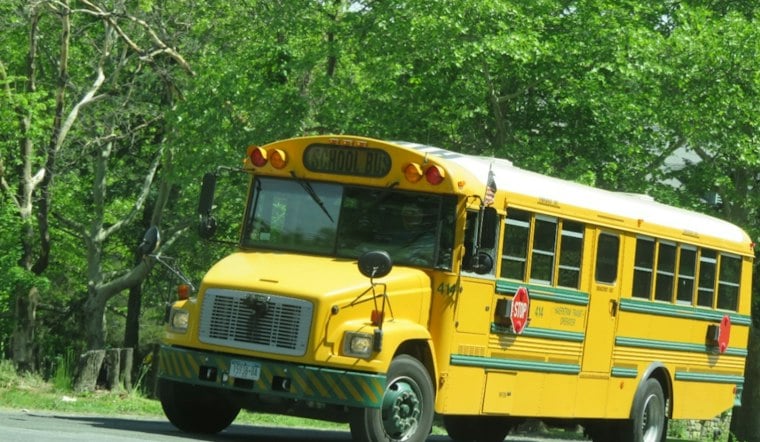
A Rockland County Supreme Court judge has ordered county officials to hand over records they spent more than two years withholding about the BusPatrol school bus camera program, rejecting arguments that the documents were protected trade secrets or internal communications. Associate Justice Djinsad Desir ruled that the county failed to justify its refusal to disclose contract records, financial reconciliations, and communications tied to the stop-arm camera vendor.
The ruling came in an Article 78 proceeding filed by Aron Law PLLC, a Brooklyn-based firm that had been seeking BusPatrol-related documents from the county for more than two years, according to Rockland County Business Journal. The firm filed its lawsuit challenging the county's FOIL refusal on March 26, seeking documents on contracts, cost-sharing arrangements, and correspondence between the county and BusPatrol. Desir found the county's trade-secret claims conclusory and unsupported, and determined officials failed to give a particularized and specific justification for denying access, while also finding the county failed to establish that the intra-agency exemption applied to the withheld records.
The county must produce the disputed records immediately, though it was granted a narrower window for materials it claims are protected by attorney-client privilege, which must be turned over within 14 days. The county must also submit a certification within 10 days describing its diligent search for any other responsive documents, and the court will consider whether that search was adequate once it reviews the certification. The court separately allowed the county to submit certain withheld documents for in-camera review where attorney-client privilege or work product is claimed, and will issue a further disclosure order after that review. A decision on whether Aron Law is entitled to attorney fees was deferred.
A Program With Conflicting Numbers
BusPatrol is the Virginia-based company that contracts with governments and school districts nationwide to install stop-arm cameras on school buses, and it has equipped buses in all Rockland County school districts through a voluntary agreement with the county and districts. But even basic figures about the local program are in dispute. RCBJ reported that 1,232 Rockland County school buses are equipped with BusPatrol cameras, while Rockland County separately reported 1,179 in-service buses carried the cameras, up from 1,109 at the end of 2024 — a discrepancy the available record does not explain.
The same mismatch shows up in citation counts. RCBJ, citing New York State Assembly data tied to BusPatrol's own reporting, said 22,744 notices of violation were issued in 2025, with nearly 25 percent of those notices ignored by recipients. Rockland County's own account, by contrast, put the 2025 figure at 19,563 citations, down from 24,986 in 2024 — numbers that may or may not be measuring the same thing, since the underlying records do not reconcile the two counts. The county has pointed to the decline as evidence the program is working, citing a 23 percent year-over-year reduction in stop-arm violations from 2024 to 2025, and a roughly 30.5 percent drop in violation notices between the start and end of the 2024–25 school year.
Where the Ticket Money Goes
BusPatrol reported collecting $3,131,500 from 12,526 paid citations during 2025, at $250 per paid citation, per RCBJ's review of the figures. Of that total, BusPatrol remitted $450,528.52 to Rockland County — 14.4 percent of the revenue collected. That falls well short of what the county had previously represented as its entitlement: a 45 percent share, which would have produced $1,410,750 based on the same collection total. BusPatrol did not provide a reconciliation or explanation for the reduced share, the outlet reported. Technical and administrative fees ate up roughly $1 million of the program's revenue in 2025, or about $800 per camera-equipped bus, leaving the county netting around $36 per citation before accounting for its own costs. The pattern isn't new — in 2024, BusPatrol distributed $1,996,218 to the county, but Rockland netted just $986,288 after more than $1 million in technology and administrative deductions.
Thousands of Rockland County residents are still waiting for BusPatrol citation hearings, with some waiting more than two years, RCBJ reported. Of the 1,920 citations contested in 2025, only six drivers were found liable. The county has said the Rockland County Sheriff's Office reviews every alleged violation before a notice is issued, and has announced plans for a Traffic Camera Violations Bureau intended to speed case processing, reduce pressure on local courts, and provide a more specialized forum for stop-arm camera disputes. A county release said the bureau would give motorists a clear and efficient path to due process and make the program fairer for everyone.
A Pattern Beyond School Buses
The BusPatrol case is not the only recent instance of a Rockland County-area public body losing a records fight. In July, the Rockland County Supreme Court ordered Rockland Green, the county's solid waste management authority, to release documents about its animal shelter construction bidding process, after Justice John P. Collins Jr. found in a 15-page ruling that the authority failed to meet its burden to establish FOIL exemptions and made conclusive arguments without merit for withholding the documents. Collins wrote in that ruling that a free press is not an ornament of democratic government, calling it one of its load-bearing walls.
RCBJ noted it received its own heavily redacted documents in response to similar FOIL requests concerning BusPatrol records, though the outlet said it declined to file its own Article 78 lawsuit, instead relying on Aron Law's litigation team. The Aron Law lawsuit alleged that BusPatrol camera programs carry systemic reliability, notice, and motorist-fault issues — allegations that echo scrutiny the company has faced elsewhere. An investigation by Type Investigations found that in Montgomery County, Maryland, more than 375,000 BusPatrol tickets and $92 million in fines produced little reported reduction in violations and no evidence of fewer collisions near stopped buses. In Florida, Miami-Dade's school-bus camera program issued more than 100,000 violation notices in its first six months before being suspended following complaints, an investigation, and a backlog of motorists challenging notices, according to the Miami Herald. Under Miami-Dade's original contract, BusPatrol kept 70 percent of citation revenue; a revised deal now has the district pay $225 per bus monthly, with BusPatrol receiving $65 of each $225 ticket.
Closer to home, Westchester County has reported that fewer than 7 percent of its school-bus-passing tickets went to repeat offenders, according to lohud. Supporters of the stop-arm camera programs point to the underlying safety concern driving their adoption: Traffic Safety Marketing, based on NHTSA data, reported 61 fatalities nationwide from 2000 through 2023 caused by drivers illegally passing stopped school buses, an average of 2.5 deaths per year, with nearly half involving children aged 18 and younger. BusPatrol says it serves more than 400 school districts across 24 states, with its cameras recording still images and video of vehicles allegedly passing buses while red stop lights are activated. Citations carry escalating fines of $250, $275, and $300 for first, second, and third offenses, respectively.





