

























































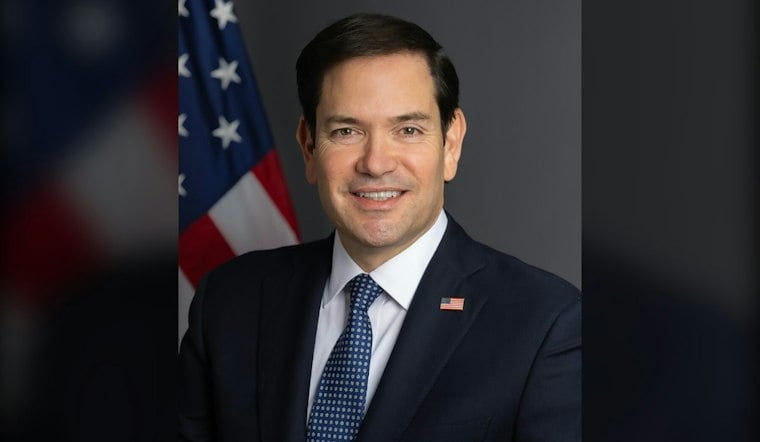
Secretary of State Marco Rubio touched down at Keflavík Airport on Monday to open a four-day tour of three NATO allies, arriving in a country that has no army of its own but plenty of unease about the Trump administration's designs on the Arctic. Rubio called Iceland a good friend as he began the trip, which will also take him to Greece and Portugal before he returns to Washington on Thursday.
The stop comes just weeks after Iceland's foreign minister summoned U.S. Ambassador Billy Long over a social media post from President Trump showing a map with U.S. flag colors spreading across North America and extending into Greenland and Iceland. As reported by the Associated Press, Foreign Minister Thorgerdur Katrín Gunnarsdóttir called the post unacceptable. Iceland sits roughly 180 miles from Greenland, and Trump named Iceland four times while discussing his ambitions for the much larger island, according to the same report.
Rubio offered no public hint of tension as he arrived, instead framing the visit around what he described as a secure Arctic, stronger commercial and energy ties, and closer defense cooperation. He was welcomed at the airport by Gunnarsdóttir and Ambassador Long, the AP noted, even as the diplomatic temperature around the visit remained warm to the touch.
An Ambassador Still Living Down His Own Jokes
Long's arrival in Iceland this past August was rocky from the start. Icelanders circulated a petition urging the prime minister to reject him after he joked about Iceland becoming the 52nd U.S. state and making himself governor, a remark for which he later apologized, per the AP's reporting. Long had briefly served as Commissioner of Internal Revenue in 2025 before his nomination to Reykjavík, and the Senate confirmed him on a 46-43 vote in May, according to Missourinet. He formally presented his credentials to Icelandic President Halla Tómasdóttir in August.
Long is not the first U.S. envoy to unsettle a country that CBS News notes consistently ranks among the most peaceful nations in the world. Jeffrey Ross Gunter, who held the post from 2019 to 2021, requested permission to carry a firearm, sought door-to-door armored transport, and advertised for local bodyguards, leaving residents of Reykjavik concerned, CBS reported at the time.
Iceland's reliance on outside protection is structural, not just diplomatic. The country maintains no standing military and has leaned on the United States and NATO for defense since the two nations signed their bilateral agreement in 1951, according to U.S. Sixth Fleet Public Affairs, which marked the treaty's 75th anniversary during the Northern Viking 2026 exercise this past August. The U.S. disestablished its permanent Iceland Defense Force and withdrew from Keflavík Air Base back in September 2006, ending 55 years of continuous American presence, as RÚV has reported, leaving air policing to rotating NATO allies, including Belgian F-16s that began a month-long deployment at Keflavík in August under NATO's Arctic Sentry framework, per NATO Allied Air Command.
Greece Leg Shadowed by Ethics Questions Around Guilfoyle
From Iceland, Rubio heads to Athens to lead the American delegation for the Sixth U.S.-Greece Strategic Dialogue, a forum focused on defense cooperation and Mediterranean energy, as outlined by Radio Free Europe/Radio Liberty. The administration views Greece as central to exporting U.S.-produced liquefied natural gas into southeastern and central Europe, a strategy anchored by the Alexandroupolis Floating Storage and Regasification Unit, which began commercial operations in October 2024 as part of the Vertical Gas Corridor, according to Balkan Green Energy News.
That energy diplomacy arrives alongside a brewing controversy involving Ambassador Kimberly Guilfoyle, who the Senate confirmed to the Athens post in September 2025 after Trump nominated her in December 2024. Guilfoyle has been accused of suggesting the U.S. could undermine the Greek government, promoting the business interests of a Greek construction and energy company, and allowing that company's lobbyist into private diplomatic meetings, according to the AP. Greek opposition parties have called for an inquiry, and Guilfoyle has denied any wrongdoing.
Representative Gregory Meeks, the ranking member of the House Foreign Affairs Committee, said he would investigate the allegations of misconduct and impropriety, and his letter indicates he would call for Guilfoyle's dismissal if the reported behavior is substantiated, the AP reported. Rubio has defended her publicly, calling her an incredible advocate for the president's agenda in Greece and across Europe, and saying that he and Trump value her pivotal work and leadership on energy issues.
Portugal's Final Stop Carries Its Own Friction
Rubio's trip wraps in Portugal, where prosecutors opened an investigation this month into the legality of U.S. military transit flights through Lajes Air Base in the Azores during Middle East military actions, following a complaint from Portuguese lawmakers, according to DAWN. Lajes Field operates under a bilateral agreement that allows U.S. military staging only with host-nation approval during armed conflicts, the outlet noted, adding a layer of domestic political resistance to the trip's final leg.
Taken together, the three stops reflect what Rubio has described as a tour built around strong allies important for protecting U.S. national interests. But from an Icelandic map controversy to ethics questions in Athens to prosecutorial scrutiny in the Azores, the secretary's reassurance tour is running headlong into exactly the kind of friction it was meant to smooth over.





