

























































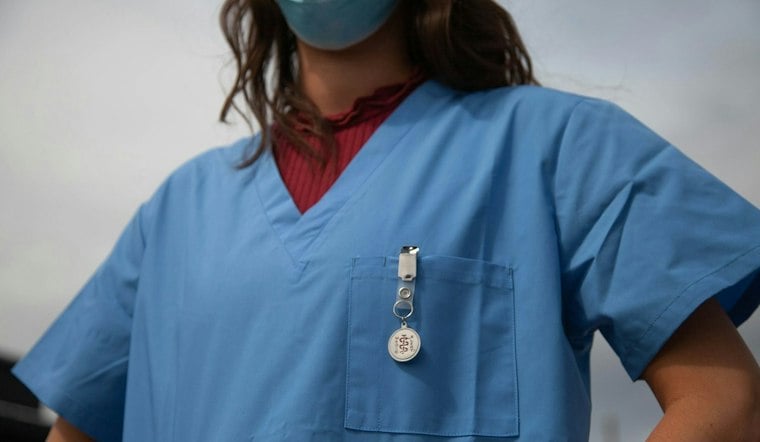
Healthcare workers in Sacramento walked off the job this week in a contract dispute that includes a demand rarely seen on a picket line a few years ago: protections against artificial intelligence. According to ABC10, the striking healthcare workers are seeking protections against AI tools in their workplaces.
The strike lands just weeks after California lawmakers moved to rein in so-called AI bossware across the state. According to KQED, Gov. Gavin Newsom signed five labor-backed bills regulating AI in the workplace at the end of September. Two of those measures speak directly to the kind of concerns now surfacing on the picket line: AB 1979 bars health facilities from letting AI alone perform work reserved for licensed professionals and requires them to protect clinicians’ independent judgment when AI informs care, while AB 1883 restricts employers from using AI-powered surveillance tools to read workers’ emotions or collect their neural data, per the outlet’s reporting.
A Nurse’s Experience With AI Monitoring
The anxiety behind these new laws isn’t abstract for some workers. KQED’s report describes Kaiser Permanente telephone triage nurse Pa Vue, who said she returned from maternity leave to find a sentiment score embedded in the metadata attached to each of her recorded calls. Kaiser Permanente told the station it does not use AI tools to recognize, predict or infer the emotional states of its nurses, a statement that sits alongside Vue’s account without resolving the discrepancy.
The broader workplace context is not limited to healthcare: KQED, citing The New York Times, reported that by 2022, eight of the 10 biggest private employers in the United States were tracking individual workers’ productivity metrics. KQED also reported that the European Union has banned emotion recognition at work since 2025.
What reporting documents about healthcare monitoring
Separately, CalMatters reported that Kaiser call-center nurses said workplace surveillance tools and AI prioritize speed and cost savings over quality and safety. This reporting documents nurses’ accounts, not a nationwide estimate or official dataset on electronic monitoring or algorithmic management, and it does not establish a connection to the Sacramento strike.
A Separate Rally Ties Healthcare Workers to Proposition 40
Union-backed healthcare workers have also been mobilizing around a statewide ballot measure. The Sacramento Bee reported that healthcare workers from across California rallied outside Mercy General Hospital in East Sacramento to support Proposition 40 while also drawing attention to staffing cuts.
Among those who showed up was Andrea Tuma, who told the Bee she was one of 56 people who traveled from Redding to Sacramento to take part. Union spokesperson Jennifer Kelly said SEIU-UHW members in attendance came from Dignity Health, Kaiser Permanente, Sharp HealthCare, Tenet Healthcare and HCA Healthcare.
What the New Law Actually Requires
Legally, the fight over AI’s role in patient care has specific contours. A California Assembly analysis of AB 1979 states that a health facility, clinic, physician’s office, or group-practice office shall not use or deploy an AI tool, system, or device to replace a licensed health care professional’s use of professional judgment. The excerpt from that analysis is partial, so it does not spell out the bill’s full scope, but it underscores the core concern driving demands like those raised in the Sacramento strike: that AI stays a tool clinicians use, not one that overrides their judgment.
For now, the specifics of the Sacramento strike — which union or unions are involved, which employers or facilities are affected, and how many workers are participating — have not been detailed beyond ABC10’s initial report. What is clear is that California’s new AI workplace protections are about to take effect, and the Sacramento strike has put algorithms on the bargaining table.





