

























































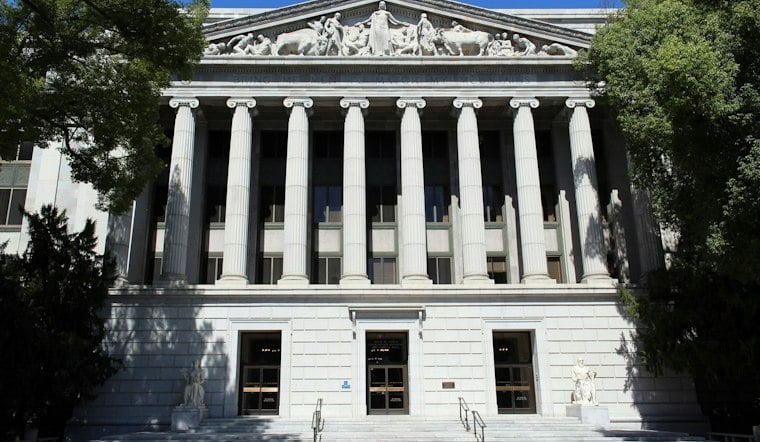
Tyler Mickschl, a 28-year-old senior studio art major at Sacramento State, is facing a university disciplinary case that could end in expulsion over chalk messages that appeared on the walls of Kadema Hall during a silent protest about neglected art department facilities. He denies chalking the building himself, and he says the university came after him only after he spoke publicly about why the protests happened in the first place.
The case has stretched into an open investigation while Sacramento State reviews whether Mickschl violated campus policy, according to the Sacramento Bee. A disciplinary notice obtained by the paper said he could be denied access to campus, suspended or even expelled if found responsible, and could be liable for thousands of dollars in repair costs. Mickschl told the Bee the process has caused him significant stress, including fear that his diploma could be withheld; he is a studio art major specializing in ceramics.
Two Chalk Protests at Kadema Hall
The protests trace back to an email about Arts and Letters funding and building conditions, according to the State Hornet. Students held a first demonstration and then returned for a second protest that same night, at about 11:09 p.m. on September 29, the student paper reported. University crews power-washed the chalk messages the following morning and later painted over the walls; the Bee reported separately that all the chalk graffiti had been washed off Kadema Hall by Thursday afternoon.
Sacramento State's rules, adopted in 2016, bar chalking on walls and vertical surfaces but permit it on walkways, concrete and asphalt areas at least 30 feet from building entrances, per the Bee's reporting. The university has since said that renovation funds for Kadema Hall have not been revoked but instead placed on hold for review. The State Hornet reported that a budget document had authorized $640,000 for renovations to Kadema Hall, the library and an existing lab in Amador Hall, while the Bee reported that the university allocated $240,000 in one-time reserve funds in 2022 specifically to finish Kadema Hall renovations — accounts that describe different funding figures the available reporting does not reconcile. The Bee also reported that roughly $94,000 of that allocation had been spent, leaving a balance of $146,000.
A Student Who Says He Was Targeted
Mickschl denies that he personally chalked the building, and he told the Bee he believes he was singled out after speaking to the State Hornet about the reasons behind the protests. The investigation remains ongoing.
Other students described a climate of caution on campus. Stefani Figueroa said she feared voicing her opinion because of possible punitive action from administrators and felt paranoid about punitive action, the Bee reported.
Statewide Rules Born From 2024 Unrest
Mickschl's case is unfolding against a backdrop of statewide policy change. The California Legislature required the University of California and California State University systems to develop uniform protest policies in 2024, after rallies and encampments protesting the war in Gaza swept campuses. Those systemwide rules prohibited encampments, restricted masking to conceal identity while violating policy, and established disciplinary actions for violations; sanctions can include restitution, loss of financial aid, denial of campus access, disciplinary probation, suspension and expulsion.
During the 2024-2025 academic year, the CSU system recorded 201 proven violations of conduct creating a hostile environment or limiting participation in campus life, the Bee reported. The Foundation for Individual Rights and Expression defines a chilling effect as people refraining from expression for fear of getting into trouble — a framework now being applied to Mickschl's case and others like it.
National Backdrop of Shrinking Protest Activity
A report published in September by the American Civil Liberties Union and Amnesty International USA found a steep decline in protests and a less visible protest movement on campuses nationwide, tied to fears of punishment, retaliation or deportation. The report, covering events at 46 public and 34 private campuses across 28 states and Washington, D.C., is cited by Amnesty International USA.
Not everyone agrees the rules go too far. Supporters of the policies have said they make campuses safer for all students, while critics counter that the rules create a chilling effect and limit freedom of speech — a divide reflected in Sacramento State's own 2024 presidential memorandum, which described student protests and political action as cornerstones of higher education and democracy, according to CapRadio.
Other Campuses Are Reconsidering Similar Rules
Sacramento State is not alone in grappling with where to draw the line. Many colleges revised or adopted new time, place and manner restrictions after the 2024 Gaza-war encampments, and some are now revisiting those rules two years later, according to Inside Higher Ed. The outlet reported that the University of Hawai‘i withdrew an interim policy that had included 25-foot building buffer zones and restrictions on chalking, sit-ins and posting written materials, after students raised concerns. University of Hawai‘i President Wendy Hensel directed the withdrawal of the interim policy and a return to the system's 2014 pre-interim guidelines, according to the Honolulu Star-Advertiser.
Elsewhere, the University of Washington has proposed making concealed identity during a protest an aggravating factor in disciplinary decisions and allowing external contractors to handle disciplinary appeals, Inside Higher Ed reported. At Sacramento State, a campus addendum and a prior encampment have also figured in debates over protest rules.
For now, Mickschl's case remains open while Sacramento State investigates the chalk incident.



