

























































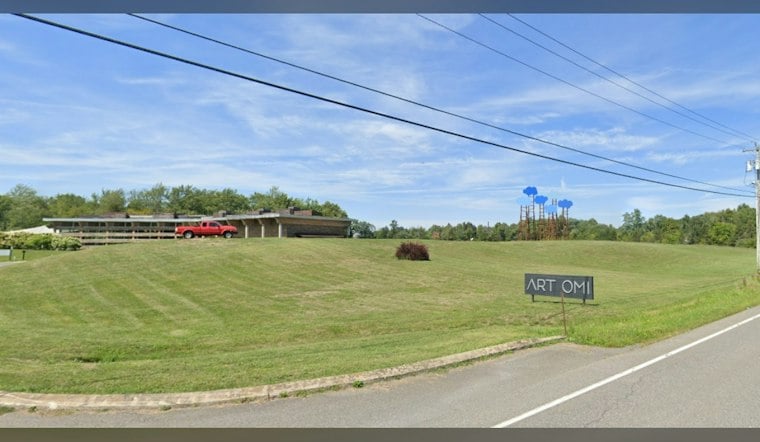
A pavilion woven from steel frames and strips of salvaged billboard material has landed in the fields of Ghent, New York, after first taking shape attached to an unfinished concrete building in Accra, Ghana. The installation, called Limbo Engawa, opened at Art Omi's Sculpture & Architecture Park on September 19, and it carries the same modular bones that defined its original site thousands of miles away, even as its form has changed entirely.
Limbo Engawa is a two-part, site-specific installation by TAELON7, led by architect Juergen Benson-Strohmayer, according to Art Omi. The project was co-commissioned by Art Omi and Limbo Museum, and it debuted in Accra on March 12 before traveling to Art Omi's 120-acre Sculpture & Architecture Park in New York's Hudson Valley, per the same source. As Cultured reports, the two institutions began their first partnership through this commission, with Limbo Accra having existed as an architecture and research practice before expanding with the founding of Limbo Museum in Accra in 2024.
From a Concrete Skeleton to an Open Field
In Accra, the installation was woven directly into the skeletal, unfinished concrete structure of Limbo Museum, Art Omi notes. Steel profiles form rectangular frames that hold woven strips cut from salvaged billboard material, according to Designboom. The design also includes handwoven daybeds meant to support lounging, leisure, and conversation, as The Architect's Newspaper reported in March.
At Art Omi, the same system was reconfigured as a freestanding landscape pavilion, reimagined in response to the fields, wetlands, and woods of the Hudson Valley, the organization says. Cultured describes the Accra version as having functioned as a facade providing shade for an internal structure, while the Art Omi iteration instead provides shade and shelter out in the open landscape. Despite the shift in form, the two presentations are conceived as parallel interpretations of a single modular system rather than separate works, Art Omi notes, and the installation's modular construction and reusable components remain consistent even as configuration responds to each site's scale, climate, vegetation, and patterns of movement, according to ArchDaily.
The People Behind the Project
Limbo Engawa was co-commissioned by Art Omi and Limbo Museum and created by TAELON7, led by architect Juergen Benson-Strohmayer. He is a chartered architect in Austria and Ghana and the founder of TAELON7, according to TAELON7, a studio founded in Accra in 2017.
Petit-Frère, who also described the project to Cultured as having been installed attached to the exterior of the unfinished building housing Limbo Museum, said the Limbo Museum building includes an inner courtyard with wild vegetation, crops, and plants, and that Limbo Accra plans to work with that landscape through activities like harvesting or creating a park-like space. She noted that Accra lacks public spaces and public parks, and said she hopes visitors will simply rest and relax with the installation.
A Shared Intention
Chef Fatmata Binta is listed as a collaborator on the project. Cultured reports that the two iterations of Limbo Engawa share intentions of providing a gathering place and celebrating handcraft and cultural traditions, even as each responds to its own site, climate, landscape, and patterns of use.
Art Omi, founded by Francis J. Greenburger and run as an arts center and sculpture park in Ghent, New York, co-commissioned Limbo Engawa with Limbo Museum specifically to create dialogue between them, according to Art Omi. Cultured describes the piece as an adaptable, transportable, and reinterpretable system for exchange, built from salvaged billboard material.
Rethinking What Counts as Unfinished
The project is part of a broader push to challenge entrenched perceptions of unfinished buildings, according to AD Middle East, which also reports that Limbo Museum aims to establish an annual architectural commissioning programme inviting architects from Africa and beyond.
The installation's name borrows from engawa, a Japanese spatial concept describing the threshold between interior and exterior, per e-flux, which also describes the project as inaugurating a new model for architectural commissioning in Africa. The Accra installation was dismantled, transported, and adapted for Art Omi; the project now shelters visitors in an open field in the Hudson Valley, with both presentations built from the same reusable steel-and-billboard system.




