

























































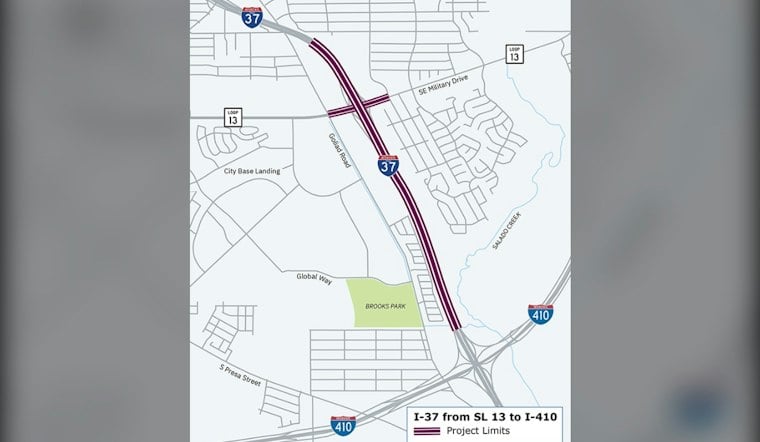
San Antonio drivers who are still getting used to the city's first diverging diamond interchange on the far North Side now have a second one to prepare for. The Texas Department of Transportation is moving ahead with a roughly $40 million project to build a diverging diamond interchange at Interstate 37 and Southeast Military Drive, reshaping a stretch of highway that funnels traffic through the city's Southeast Side.
The project will rework I-37 from Southeast Military Drive, also called State Loop 13, up to Loop 410, according to News 4 San Antonio, covering a roughly 2-mile corridor near the Brooks master-planned development. The station reports the work is meant to improve traffic flow, reduce travel times and enhance safety, and that it involves TxDOT, the Alamo Area Metropolitan Planning Organization, the city of San Antonio and Brooks. MySA reports that Charles Benavidez said the project reflects years of collaboration among transportation and community partners and will improve traffic flow, safety and mobility while supporting growth on the Southeast Side.
A Timeline With Some Fuzzy Edges
TxDOT expects the Southeast Military Drive work to be complete in 2029, per KSAT. That timeline doesn't perfectly match an earlier report: the Express-News had reported that TxDOT expected to award a construction contract in 2026, with the project likely wrapping up in 2028 or 2029. Either way, drivers on this stretch of I-37 should expect years, not months, of construction.
Most of the disruption is designed to happen while most San Antonians are asleep. The same KSAT report notes that most temporary lane closures will occur overnight on weekdays, between 9 p.m. and 5 a.m., though daytime and weekend work may still happen at times.
How a Diverging Diamond Actually Works
The design itself is the real novelty here. A diverging diamond interchange shifts traffic to the opposite side of the roadway through the intersection, which lets drivers turning left do so without waiting for oncoming traffic to stop, according to the same KSAT account. Drivers turning left simply veer onto ramps that carry them to the other roadway instead of having to cross oncoming cars, the Express-News reported in its coverage of the city's first such interchange.
That configuration also cuts down on how long drivers sit at red lights. Because a diverging diamond doesn't need dedicated left-turn signals, it only requires two cycles at its stoplights rather than four, the Express-News reported. TxDOT has said the broader safety case rests on reducing the number of places where traffic streams cross paths, which the agency argues makes diverging diamonds safer than conventional intersections. A TxDOT factsheet separately states that the design has reduced crashes by 50 percent in some areas, though the agency's materials don't specify which locations or how that figure was calculated.
Lessons From San Antonio's First Diverging Diamond
San Antonio got its first taste of the design at Blanco Road and Loop 1604 on the far North Side, where TxDOT completed the interchange on Aug. 22. The reaction from drivers has been mixed, to put it gently. One driver told KSAT, “Just driving through it the first time for me was pretty confusing, and it felt a little scary,” and a North Side homeowner said the confusion at the interchange nearly caused a crash.
TxDOT had tried to get ahead of that reaction. Spokeswoman Jennifer Serold told the Express-News back in March that she expected a learning curve since it was the first diverging diamond in San Antonio, adding, “It looks a little daunting, but it's really easy to navigate.” Readers commenting on MySA's coverage of the Southeast Side project echoed the North Side driver's unease, with one reader writing that a lot of drivers are confused and that driving through the intersection feels close to causing an accident.
The Blanco Road interchange is part of the larger Loop 1604 North Expansion Project, a $279 million effort, per Segment 3 cost estimates reported by KSAT, that is widening the highway from four to 10 lanes across a 23-mile stretch of the North Side. Diverging diamonds remain relatively rare in Texas outside San Antonio's two projects — Austin has four of them, while College Station, El Paso and Dallas each have one, according to the Express-News.
What's Planned for the Southeast Side
MySA's reporting lays out several specific features planned for the I-37 project, including a bypass ramp, a southbound frontage road, shared-use paths and an extra lane for exit and entrance ramps. TxDOT's own project materials describe the effort as bringing operational improvements to I-37 from Southeast Military Drive to I-410, including the diverging diamond interchange itself, though the agency's public materials don't offer a full breakdown of the project's roughly $40 million cost or a complete map of the final lane configuration.
State traffic models project a 90 percent reduction in travel times for drivers exiting southbound I-37 onto Southeast Military Drive, KSAT reported, citing TxDOT's own projections. For Southeast Side commuters who already navigate a tangle of highway ramps near Brooks, that's the selling point TxDOT is banking on — even as the North Side's first attempt at the design shows that selling drivers on it may take more than paint and signage.


