

























































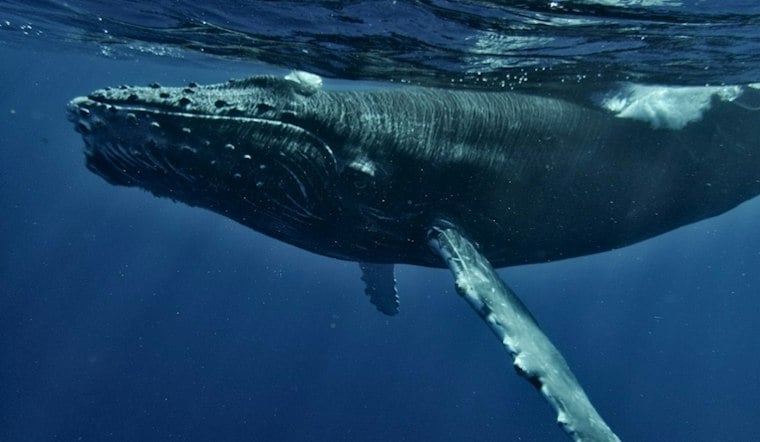
A young humpback, roughly 29 feet long, was freed off San Clemente on Sunday after responders spent much of the day assessing and cutting fishing line tangled around its tail. The whale was first spotted about five miles offshore at 9:30 a.m. on October 18. By late afternoon, near the pier, it had shed most of the roughly 100 feet of line.
The Pacific Marine Mammal Center, Entangled Whale Response Orange County and SeaWorld San Diego joined the response, according to NBC Los Angeles. The Laguna Beach-based Pacific Marine Mammal Center reported that crews located the whale near the San Clemente Pier and used drones and underwater cameras to assess the entanglement.
The footage showed several layers of line across the whale’s underside, fluke and peduncle. Responders had to assess where the gear was caught before attempting to cut it.
Cutting the Whale Free
Shortly before 3:30 p.m., responders cut sections of the twisted line. After several deep dives, the whale shook free of most of what remained. Underwater video reviewed the following day confirmed the operation had succeeded, NBC reported; the station described it as the first such rescue off the Southern California coast in 2026.
The whale appeared healthy after it was freed, apart from a scar on its peduncle, the report noted. Keith Yip, a NOAA Level 4 responder with SeaWorld San Diego — a partner in the NOAA Fisheries West Coast stranding network — said the response offered the whale a chance to survive. He warned that entanglements can eventually be fatal and said it was a privilege to work with a trained team to free the animal.
A Rising Tide of Entanglements
The San Clemente case lands amid what the Pacific Marine Mammal Center describes as a troubling spike: whale entanglements on the West Coast are rising in 2026, with 46 confirmed cases so far this year compared with 95 documented nationwide in all of 2024. NOAA scientists told the outlet the increase may be tied to this year's extreme El Niño conditions, which can push whales and their prey closer to the gear-heavy waters near shore.
That pattern tracks with what researchers have already documented elsewhere on the coast. According to the Inside Climate News, a study spanning 25 years of data found that habitat compression driven by warming ocean conditions is an underlying cause of rising humpback entanglements, with fixed gear used in the Dungeness crab fishery identified as the primary source of risk. Before 2014, fewer than 10 humpback entanglements were reported annually on the West Coast; that changed sharply during the 2015–2016 marine heatwave, the outlet reported.
Nationally, NOAA recorded 76 cases of large whales entangled in castoff lines and nets off U.S. coasts in 2025, according to the Los Angeles Times, with fishing gear responsible for 46 percent of those cases. The newspaper also reported that a separate humpback whale was found entangled in commercial fishing gear off the Los Angeles coast on October 1, an incident where wildlife experts trying to remove the net were stymied by choppy water.
Other Rescues Have Ended Less Happily
Not every entanglement response this year has gone as smoothly as San Clemente's. In late July, a response team freed a young humpback whale from derelict gear roughly 20 miles offshore of Newport, Oregon, pulling in more than 3,000 feet of line along with five sablefish pots and individual Dungeness crab traps, according to Oregon Public Broadcasting. That whale's jaw had been left permanently open by the entanglement, leaving it unable to feed and unlikely to survive. Separately, 10News reported that rescuers were unsuccessful in their initial efforts to cut entangling gear from a gray whale calf traveling with its mother off Southern California.
NOAA notes that entanglements can impair a whale's vital functions, including swimming, feeding and breathing, and that severe cases can result in death. Anyone who sees an entangled whale or other sea mammal should call the Entanglement Reporting Hotline at 1-877-SOS-WHAL or contact the U.S. Coast Guard on VHF Channel 16, NOAA Fisheries advises.





