

























































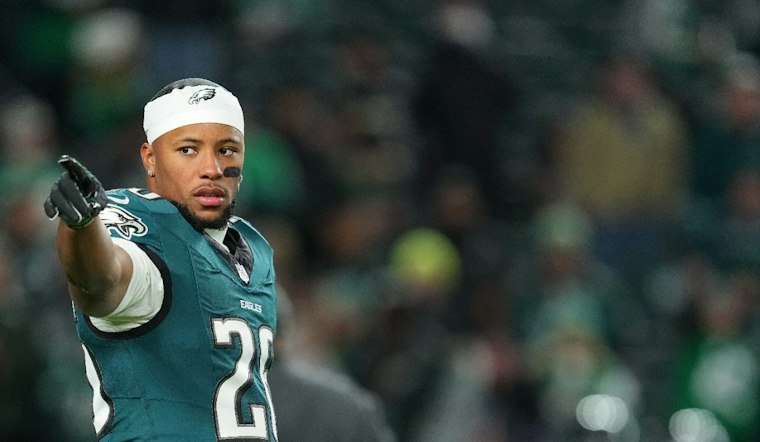
Philadelphia Eagles running back Saquon Barkley says the NFL forced him to divest his equity stake in Polymarket, the prediction-market platform, because league rules bar players from investing in or endorsing gambling or prediction-market companies. Barkley said he was told the arrangement was simply off-limits for an active player, regardless of how the investment came about.
“I am not allowed to be in that,” Barkley said, describing the situation as cut and dried once the league weighed in, according to Front Office Sports. Barkley told the outlet that the NFL informs players before the start of each season about exactly what they can and cannot endorse or invest in, and that his understanding is now clear: involvement with prediction markets is no longer allowed for him.
A 2025 report by The Profile, cited by 6abc Philadelphia, said Barkley had built a broader startup portfolio beyond Polymarket, having invested in companies including Anthropic, Anduril, Ramp, Cognition, Neuralink and Strike.
Why the NFL Draws the Line
The league's policy is unambiguous on paper. There's a ban on doing business with prediction markets, the same report notes, and the NFL confirmed on Wednesday that it prohibits players from investing in or promoting sportsbooks and prediction markets alike — though the league declined to comment specifically on Barkley's case.
An NFL Players Association spokesperson told the outlet that the league views prediction markets as gambling entities, which bars players from endorsing or serving as brand ambassadors for companies like Kalshi or Polymarket under its gambling policy. That framing puts prediction markets in the same bucket as traditional sportsbooks, even though the platforms themselves describe their products differently.
The federal commodities regulator offers a more technical description of how these platforms work. According to the Commodity Futures Trading Commission, traders can buy “yes” or “no” positions on the outcome of an event, with the contract price reflecting the market's expectation and a payout available once the contract settles.
Other Leagues Are Moving the Opposite Direction
Barkley's forced exit stands out because much of the sports world has been racing toward these platforms, not away from them. It has become far more common for players to endorse or invest in prediction markets over the past year, the same Front Office Sports report notes, even as the NFL holds the line.
The NBA named Kalshi and Polymarket its preferred prediction-market partners, though that deal does not extend to the WNBA. MLB struck an exclusive agreement with Polymarket reported to be worth up to $300 million over four years, finalized in March. MLS announced its own Polymarket agreement in January, and the NHL announced deals with both Kalshi and Polymarket last October.
Individual athletes have cashed in too. NBA star Giannis Antetokounmpo is an investor in Kalshi, while LeBron James signed a Polymarket deal reported to pay him $15 million per year, per the same account.
NFL's Gambling Policy Enforcement
According to NFL.com, no players had been suspended for gambling violations in the preceding 13 months, and the league said it had taken steps to keep that trend going.
Two rules sit at the center of that policy: players must never bet on NFL games, and they must not gamble in any capacity while with the team, whether at team facilities or stadiums, while traveling for road games, or while staying at team hotels, the league states. In-person gambling-policy education and training was made mandatory for all players in 2024, and the NFL says Genius Sports and IC360 continue to monitor every game and key league event for betting activity that could signal game manipulation or a leak of nonpublic information.
A Bigger Legal Fight Looms
Barkley's situation surfaces as the NFL pursues a much larger legal question about who regulates prediction markets in the first place. The league has asked the U.S. Supreme Court to review whether sports-event prediction-market contracts fall under the purview of state gambling regulators, a request made this month.
A league source told ESPN's David Purdum that the NFL is seeking quick clarity from the court on how prediction markets should be regulated, and that the league would accept a federal framework if it applied the same regulatory approach that states currently use. How that fight resolves could shape whether the current patchwork of state-by-state rules — and bans like the one that pushed Barkley out of Polymarket — remains the standard across professional sports.




