

























































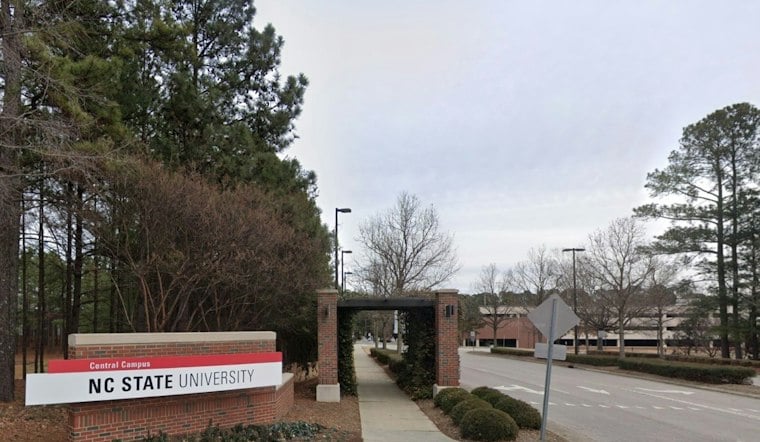
SAS Institute is teaming up with North Carolina State University to launch an artificial intelligence think tank aimed at speeding up health research, with an early focus on predicting how diseases and potential treatments behave in the human body. The effort, called the SAS Think & Do Tank, was announced Wednesday as a two-year pilot program that connects the analytics giant's data and AI tools with NC State's biological research.
According to a release from the companies, the partnership will apply trusted data and AI to challenges spanning human health, nutrition and environmental resilience, and it's being carried out through NC State's College of Agriculture and Life Sciences. The initial research effort will focus on what's known as translational predictive biology — essentially, using AI to better forecast how diseases and potential treatments might play out in humans before they ever reach a clinical trial. As Axios first reported, the project is designed as a scalable pilot that could eventually extend beyond health research into other disciplines and additional institutions.
Pairing Lab-Grown Organs With AI Models
Central to the project is an attempt to sync studies of living organisms with organoids — small, simplified versions of organs grown from cells — and organ-on-chip technology, per the same release. NC State researchers hope that linking those lab-grown models with broader studies in living systems can give scientists a clearer window into how a disease or drug might actually behave once it reaches a human patient. SAS, for its part, will serve as a technical partner across the research working groups, providing data and AI software along with technical expertise and guidance on responsible AI use, the release states.
The stakes of getting that modeling right are significant: better predictive models could help researchers identify promising treatments earlier, potentially cutting the time and cost of moving therapies toward clinical use, according to the release. But the release also notes that conventional AI models can struggle in this environment, since biological datasets often contain extensive detail drawn from a relatively small number of subjects — and the patterns those models detect don't always hold up across different studies or biological systems. The Think & Do Tank's broader hope, per the release, is to create analytical systems built to account for those exact limitations, and eventually a model that other universities or companies could use as well.
A Company Born in NC State's Labs
SAS Institute is now a multibillion-dollar analytics company, but it didn't start that way. The company originated in North Carolina State University's labs, where its original analytical model was created to analyze agricultural data, according to the release. In March 1976, the university's Institute of Statistics granted the newly formed SAS Institute a comprehensive, worldwide license to use, publish, manufacture and sell the SAS software and documentation, as the News & Observer has detailed. Fifty years after that spinout, SAS has evolved into building analytics software for industries far beyond the farm and has invested heavily in new AI capabilities, the release notes.
SAS CEO Jim Goodnight framed the new partnership as a continuation of that founding relationship. “Connecting NC State's interdisciplinary research with SAS data, AI and industry expertise can help build trusted approaches to important problems,” Goodnight said, according to the release. He also struck a cautionary note about the technology his company has spent decades building: the next generation of innovators, he said, will need “the judgment to use it responsibly.”
Part of a Broader SAS-NC State Pattern
The health research pilot isn't SAS's only active collaboration with NC State. Researchers from NC State and East Carolina University have also been working with SAS on a separate pilot project deploying affordable agricultural sensors, according to a release from sas.com. That effort, based in Hyde County, uses sensors to measure water depth, soil moisture and salinity in real time, and it grew out of a presentation on flood prediction modeling at the 2025 SAS Innovate conference, per the same release. An earlier partnership announced in April 2024 brought SAS together with NC State and North Carolina A&T State University to advance analytics-driven agricultural research statewide, according to a separate prnewswire.com release.
North Carolina's agricultural sector carries real economic weight behind those efforts — SAS has described it as contributing $111 billion annually to the state's economy, while an earlier release pegged the figure at more than $100 billion, underscoring why both the company and the university keep returning to that sector even as this newest initiative turns toward human health.




