

























































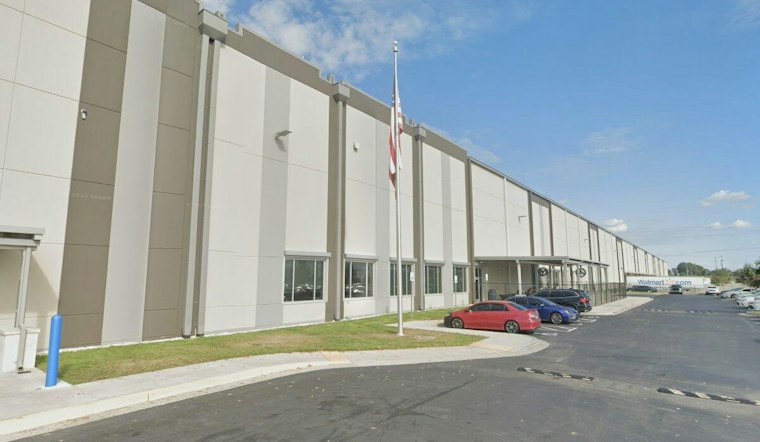
A four-building warehouse complex totaling 369,000 square feet is headed for Davenport, tucked between U.S. 27 and the Walmart and FedEx distribution centers that already anchor the area's logistics hub. Scannell Properties has filed plans for the project, called the Davenport Business Park, on 24 acres along the Interstate 4 access road.
The filing, reported by GrowthSpotter, lays out four buildings ranging from 72,000 to 104,000 square feet apiece — specifically 82,500, 72,000, 104,000 and 104,000 square feet — all planned as a single construction phase. The project is being developed by Scannell Properties, with KPM Franklin serving as civil engineer, landscape architect and surveyor. As of the filing, Scannell Properties had not submitted any building permits, and the outlet's report notes the developer had not disclosed whether the buildings would be built on spec or already have tenants lined up.
Land Deals Set the Stage
Scannell Properties paid $9.9 million for 24 acres of vacant land in the Davenport distribution hub, according to the same GrowthSpotter report, assembling the site across two transactions completed in May. The purchase lands the developer in a submarket where available ground is thinning out. Polk County Planning Administrator Erik Peterson told the outlet that land is scarce in the Davenport submarket, and the area has just one remaining 15-acre industrial-zoned parcel, while the Davenport Business Park itself has no more acreage available.
Peterson, whose office reviewed the first set of engineered site plans, pointed to the same forces driving developers to keep building in the corridor. “The main factors attracting industrial developers to Davenport Business Park and the surrounding area are the close access to I-4 and its location between Tampa and Orlando,” he said, per GrowthSpotter's report.
A Developer Already Entrenched in the Corridor
Scannell’s Central Florida work is part of a much larger development platform: the company was founded in 1990 by Bob Scannell and Doug Snyder and is headquartered in Indianapolis. It operates 17 offices and has completed projects across the United States, Canada and Europe, with past clients including FedEx and Amazon. That national reach gives the Davenport proposal context beyond a local land purchase: Scannell has experience developing industrial properties for major logistics and distribution companies. The company’s history and operating footprint point to a developer with a broad industrial portfolio.
Scannell Properties is no stranger to Central Florida's warehouse boom. The firm has completed the NorthPoint Industrial Park in Sanford and the nearly million-square-foot Turnpike Logistics Center in Groveland, which it sold to Goldman Sachs Alternatives for just over $97 million in June 2025. Separately, JLL's account of that same transaction describes the Groveland property as a 977,441-square-foot, Class A cross-dock facility constructed in 2023 and fully leased to Duke Energy as its Florida headquarters and distribution hub — while GrowthSpotter's earlier 2021 coverage had described the project at the planning stage as a proposed 977,466-square-foot warehouse on roughly 94 acres bought for $10.5 million.
Scannell is not the only developer active in the immediate area. Park Industrial LLC is separately constructing its own 220,000-square-foot industrial project in Davenport at 450 Deen Still Road, which GrowthSpotter has reported includes a 10,000-square-foot construction equipment rental store alongside a 210,000-square-foot spec warehouse with 52 loading bays.
Why Davenport Keeps Drawing Builders
The Davenport submarket was home to 2024's most expensive industrial sale, GrowthSpotter has reported, underscoring how sought-after space in the corridor has become. Polk County overall had more than 1.8 million square feet of industrial space under construction, the outlet's reporting on the new filing noted, a pipeline that reflects the county's position between the Orlando and Tampa Bay markets. Florida Trend has reported that demand for industrial warehouse space in Polk County should remain strong given that location, its proximity to I-4 and the county's overall growth — Polk's population increased 20% between 2010 and 2020, according to the same Florida Trend report.
Recent market data show why the county’s industrial outlook is not uniform. Polk County’s overall industrial vacancy stood at 7% in the second quarter of 2026, but West Polk vacancy was 9%, compared with 3.9% in East Polk. About 1.8 million square feet was under development countywide, and just 14.2% of that pipeline was preleased. The Davenport-area project would enter a market adding space even as demand and availability differ by submarket. JLL’s second-quarter figures capture that divergence.
The broader Orlando industrial market has also shown staying power. JLL reported that the market recorded 15 consecutive years of positive absorption as of June 2025, a run that helps explain why institutional buyers keep circling Polk County warehouses. A CommercialCafe listing put available Davenport industrial space at 185,900 square feet, as Scannell's filing adds another entrant competing for tenants in one of Central Florida's busiest logistics corridors.
Warehouse growth also carries a transportation-planning dimension. Polk County’s 2025 transportation-impact-fee study examined warehouse trips using locally collected data, including trip length and heavy-vehicle factors, after the county found that earlier national data did not include Florida studies. The county’s framework directs transportation impact-fee revenue toward eligible roads in its transportation network. Those rules make truck-related road demand part of the county’s infrastructure funding calculations as industrial projects move through review. The county’s study and ordinance materials describe the local data behind that process.





