

























































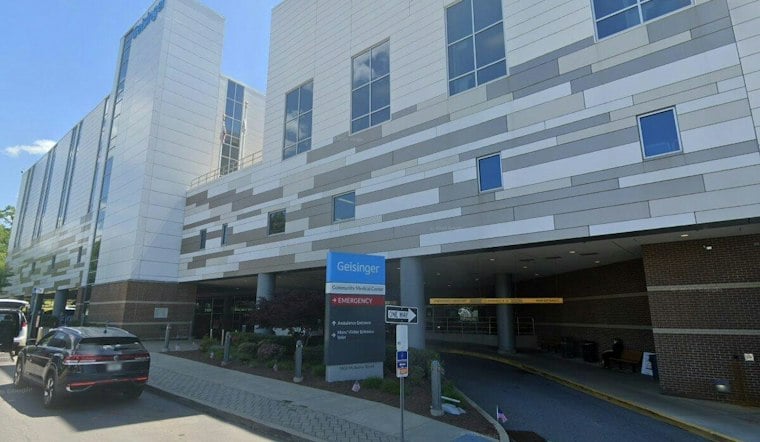
Geisinger Community Medical Center has finished the second phase of a postpartum care expansion and is already seeing patients in the newly opened space. The project adds six more postpartum beds, a family waiting room, an education room, and a pre- and post-operative bay for expectant families, bringing the Scranton hospital's total to 18 rooms dedicated to new parents.
The milestone caps a buildout that began in December 2025, when the hospital opened 12 postpartum beds on its third floor, according to Geisinger. That first phase also upgraded the hospital's well-baby nursery into a continuing care nursery capable of delivering specialized treatment to babies with minor health issues, per the Scranton Chamber. At the time, Geisinger's initial release described the completed project as more than doubling the hospital's postpartum-care capacity, and separately said a second phase would open seven more postpartum beds in the summer of 2026 — though the project that just wrapped is described as adding six beds, a discrepancy the available materials don't explain.
New Space Meant to Ease Bed Crunches
Hospital leaders say the added rooms aren't just about comfort — they're about keeping the whole maternity pipeline moving. The expanded postpartum capacity helps care teams prepare labor and delivery beds for incoming mothers who are in labor, the Scranton Chamber's report notes, a detail that speaks directly to bottlenecks that can form when recovering patients have nowhere to go after delivery.
Lucinda Mirra, chief of the division of obstetrics and gynecology in Geisinger's northeast region, said growing postpartum care resources is critical to providing more labor and delivery access to mothers, babies and families in the region. The unit is intended to give mothers and infants, in the hospital's words, a peaceful, modern space to recover and bond before heading home.
NICU Renovation Running Alongside the Expansion
The postpartum work is unfolding alongside a separate effort to add a Level II neonatal intensive care unit at the medical center, which the hospital has described as part of a parallel push to improve neonatal care. That NICU, still under renovation, is designed to care for babies as young as 32 weeks gestation and as small as about 3.3 pounds, according to the Citizens' Voice.
The $7.7 million NICU project is building a 7,100-square-foot unit with seven neonatal specialty care beds, and completion is targeted for the fourth quarter of this year, the same outlet reports. Scranton currently has just one NICU, a Level III unit at Regional Hospital of Scranton's Moses Taylor Hospital campus, and Geisinger has said its new Level II unit is meant to integrate with the Level III NICU at Geisinger Wyoming Valley Medical Center and the Level IV NICU at Geisinger Medical Center in Danville.
Part of a Broader Lackawanna County Investment
Both the postpartum unit and the NICU renovation fall under Geisinger's recent and ongoing $50 million investment in Lackawanna County health care, the hospital has said. That spending comes as maternity care access tightens across the state more broadly — a backdrop that helps explain why hospital officials are framing bed capacity as a regional priority rather than a routine upgrade.
Pennsylvania has lost 38 labor and delivery units since 2005, and 23 of the state's 67 counties now have no hospital where a baby can be born, according to Local 21 News. The outlet points to fixed costs, unpredictable patient volume, reimbursement pressures, workforce shortages and hospital consolidation as major factors behind the closures, and notes that longer travel distances to maternity care can become especially consequential during emergencies.
Statewide data from the March of Dimes 2026 report found that 10.4% of Pennsylvania counties qualify as maternity care deserts — meaning they have no hospital or birth center offering obstetric care and no obstetric clinicians — while another 16.4% have only low or moderate access rather than full access. Separately, Geisinger has also told Scranton City Council it plans a five-story, 75-foot-tall clinical building and parking garage with 400 parking spaces on the 400 block of Colfax Avenue, according to the Times-Tribune, though that larger project's zoning and legal status has not been resolved in available reporting.





