

























































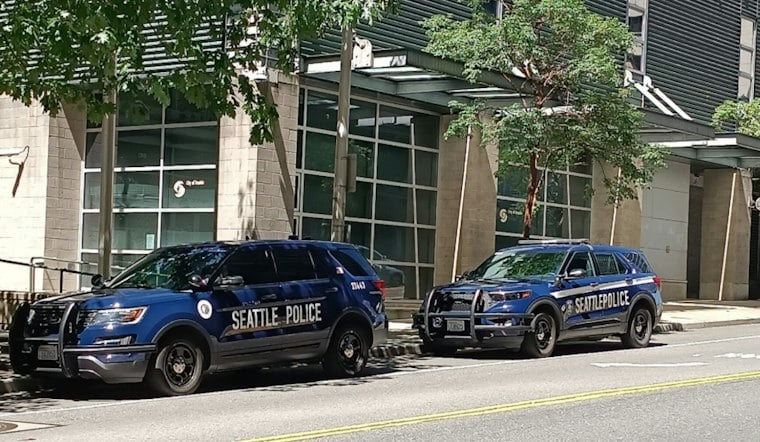
Seattle police arrested seven men ranging in age from 22 to 64 in a prostitution sting along Aurora Avenue North on Tuesday, with police saying the majority of those detained were in their twenties. More than 20 personnel were deployed to the corridor for the operation, and several of the seven men had driven from surrounding cities.
The arrests came amid longstanding community concerns over high levels of prostitution along the arterial. According to a Seattle Police Department Blotter report published Thursday, more than 20 personnel were deployed to the corridor, and several men had driven from surrounding cities.
A separate shooting was reported at 4:48 a.m. in a gas station parking lot on the 10500 block of Aurora Avenue North, where a 44-year-old man suffered scratches.
A Street Reshaped by Barricades and Buyer Stings
Those shootings pushed frustrated neighbors to act on their own earlier this year, installing homemade barriers on several side streets before the city formalized the response. Seattle Mayor Katie Wilson said the makeshift barricades sent a clear message that something needed to be done, according to KIRO 7's reporting. In June, Wilson formally directed the Seattle Department of Transportation to install barriers closing four residential streets — North 102nd, 100th, 98th, and 96th — that connect to Aurora Avenue North; they would remain in place through the summer, with their impact monitored, according to the Office of the Mayor, a move designed to disrupt the traffic loops buyers use to cruise the corridor.
This week's bust is not an isolated event. It fits a buyer-focused enforcement strategy that the city codified back in September 2024, when the Seattle City Council passed legislation creating a Stay Out of Area Prostitution exclusion zone, according to the Seattle City Council. The ordinance prohibited loitering for buying, selling, or promoting prostitution and allowed judges to issue SOAP orders for buyers and/or promoters.
Oversight Review of Prostitution Enforcement
In June, the Seattle Office of Inspector General for Public Safety released a preliminary review.
That pattern has also included trauma-informed outreach. A multi-agency initiative in June called Operation Circuit Breaker contacted 60 sex workers along the corridor, offering social services to 10 of them, recovering three juveniles, and arresting four buyers or pimps, according to FOX 13 Seattle. The sweep illustrated how enforcement on Aurora now runs alongside efforts to connect vulnerable people with services rather than jail time.
Organized Trafficking and a Push for Felony Penalties
In April, federal grand jury indictments charged Seattle gang leader Leanthony Palmer and alleged associate Branden Barnett with running an interstate sex-trafficking operation involving adult victims in off-the-books rooms at a SeaTac motel, the Department of Justice announced. Hoodline previously reported on the case and discussed Aurora Avenue as a broader exploitation corridor.
During the 2025–2026 legislative session, Washington state lawmakers introduced House Bill 1265, according to FastDemocracy.



