

























































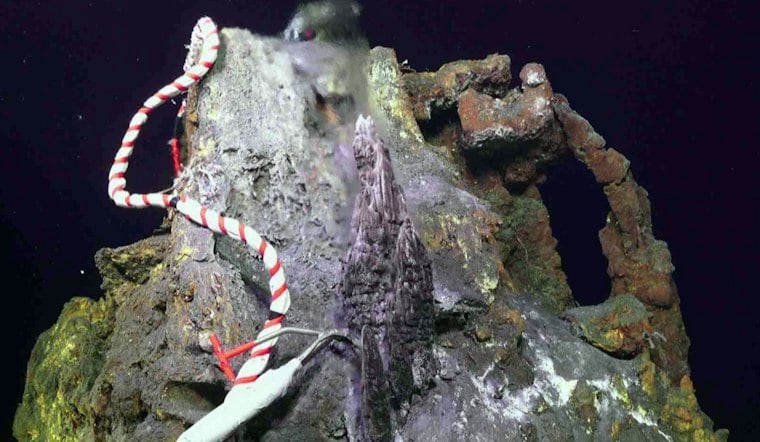
Nearly a mile beneath the Pacific Ocean, roughly 300 miles off the Oregon coast, a 3-ton power plant sitting atop an active underwater volcano generated more electricity than it consumed for 8.7 seconds last month. The company behind it, Seattle-based Endurance Energy, says the brief run marks the first time anyone has drilled a subsea geothermal well and used it to produce net-positive power on the seafloor.
Endurance announced the milestone in a release this week, saying its Adélie power plant reached a median net output of about 2 kilowatts and peaked at 16.5 kilowatts during the test at Axial Seamount, according to a company announcement distributed via PR Newswire. The three-week test involved landing the plant on the seafloor and operating it in real time from Seattle over subsea fiber, the announcement states. Endurance founder and CEO Andrew Redd said the company put a power plant on an active underwater volcano and generated power, describing the end-to-end test as a way to see what works at depth, what needs improvement, and how to build the next system for sustained commercial generation.
The test, completed on September 27, combined drilling a well, deploying the seafloor plant, generating electricity, and communicating with the system from shore — all in one continuous operation, per Interesting Engineering's account. Engineers used a robotic drilling machine resting on the seabed to bore into the volcano's caldera roughly 5,000 feet below the ocean surface, boring two closely spaced holes that both reached hydrothermal fluid before installing steel pipe casing, cement, and a valve to control the hot-fluid flow.
A Well Too Tight to Run the Plant
The newly drilled well reached 52 feet below the seabed and, after cementing, flowed hot fluid at roughly 500°F, or 260°C — but it proved too restrictive to actually power the plant, according to the PR Newswire announcement. Instead, Endurance connected its system to a nearby, already-existing hydrothermal vent, which discharged water at 281°C and spun the plant's turbine at 26,000 rpm, more than 430 revolutions per second, per Interesting Engineering's reporting.
It was that vent connection — not the new well — that ultimately produced the net-positive run. The net-positive run ended when battery overcurrent protection shut the system down, and a subsequent attempt to restart it ended after a power cable failed, the company's announcement says.
Remote Control From a Seattle Office
During the deployment, Endurance remotely controlled the system from Seattle through the Regional Cabled Array — a network of undersea fiber-optic cables owned by the National Science Foundation, according to Interesting Engineering. Endurance, founded in January 2025, says it has raised $63 million from investors and employs roughly three dozen people, per a report from GeekWire.
Endurance has described Adélie as a test article. Battery overcurrent protection ended the net-positive run, while mineral buildup and heat transfer are broader engineering concerns for subsea geothermal systems. The company says deep-sea geothermal systems, once commercialized, could eventually deliver continuous, weather-independent electricity for coastal grids, industrial sites, and even data centers around the Pacific and beyond.
Next Steps: A Bigger Unit and a Tongan Grid
Endurance plans to deploy a refurbished and upgraded version of Adélie, called Gentoo, this winter in pursuit of higher output and longer operating periods, GeekWire's report notes. Beyond that, the company is working toward a 2-megawatt commercial generator known as Leopard and is developing its first commercial subsea geothermal project in Tonga, with a goal of delivering first electricity there in 2027, according to the same GeekWire account.
GeekWire has previously described Endurance as the first commercial venture pursuing undersea geothermal sources, distinguishing it from companies like Fervo and Sage Geosystems that focus on land-based geothermal projects. The scale of the broader opportunity is considerable: a Viridien conference paper cited by Heatmap News estimated that offshore geothermal resources worldwide could yield about 6 terawatts of recoverable electric power — though for now, Endurance's own numbers remain measured in single-digit kilowatts and single-digit seconds.


