

























































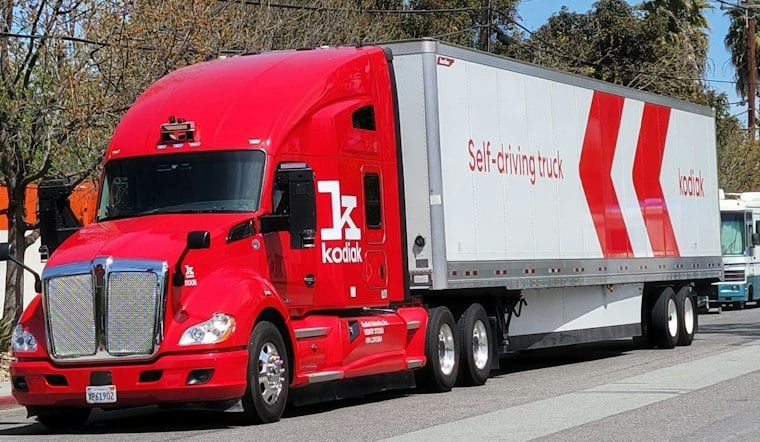
A big rig rolled out of Fresno two weeks ago loaded with perishable California produce, bound for a distribution center 225 miles away in Los Angeles — except this truck was driving itself, with a human riding along only as a backup. The run, which began September 22, marks the first time an autonomous truck has hauled freight on California public roads under the state's newly opened heavy-duty testing rules.
The pilot pairs Mountain View-based Kodiak AI with Fresno-based DTL Transport, which specializes in cross-country team runs hauling produce, according to Kodiak AI. The route runs mostly along State Route 99 and Interstate 5, carrying time-sensitive goods from Fresno to a Los Angeles distribution hub. As truckinginfo.com reports, the companies completed their first produce deliveries using the autonomous truck earlier this month.
A human safety driver remains behind the wheel for now — a requirement, not a choice. California’s DMV approved regulations on April 28 allowing heavy-duty autonomous vehicles onto public roads for testing, and Kodiak received its testing permit on August 13, per the same account. That permit lets Kodiak run autonomous trucks only with a safety driver in the cab; it does not clear the company for fully driverless testing or deployment.
Why The Safety Driver Stays Put
The distinction matters because California’s permitting system is built in stages. The process progresses from driver-in testing to driver-out testing and, ultimately, to driver-out deployment, the Kodiak AI announcement notes. Separate state guidance, per the California DMV, confirms that later phases require a Driverless Testing Permit and then a Deployment Permit before any company can remove the human from the cab.
Getting there isn’t quick. Manufacturers must complete 500,000 miles of heavy-duty testing at each phase and prepare a structured safety case demonstrating the safety of vehicle hardware, software and operations, according to the DMV. Kodiak has said it plans to launch driverless highway operations in Texas by the end of 2026, but nothing in the current California permit authorizes that step here.
What DTL Is Actually Testing For
For DTL, the appeal isn’t about replacing drivers outright — it's about flexibility. The company is evaluating whether autonomous trucks can help it handle freight volumes when demand exceeds its own fleet capacity, truckinginfo.com reports. DTL and Kodiak also plan to assess effects on transit times, shipping costs and produce shelf life, though the companies have not yet reported results from those measures, the outlet notes.
That lack of results is itself notable given how fast the broader market is moving. Aurora Innovation says it plans to operate more than 30,000 driverless trucks by 2030 and generate more than $5 billion in revenue that year, according to FreightWaves. The company says it was fully allocated to exit 2026 with 200 driverless trucks in operation and an $80 million revenue run rate, and expects more than 1,000 trucks and roughly $200 million in revenue by the end of 2027.
Rivals Chase Scale While California Stays Cautious
Elsewhere, Gatik says it has become the first company in North America to deploy fully driverless trucks in commercial operations at scale, with no human driver or safety observer aboard, per a Gatik announcement. Gatik says its freight-only operations have completed 60,000 fully driverless orders without incident since launching in mid-2025, running nearly 24 hours a day across Texas, Arkansas, Arizona, Nebraska and Ontario, Canada. Volvo Autonomous Solutions, meanwhile, plans to begin its own driverless operations in the first quarter of 2027, with more than 300 Volvo VNL Autonomous trucks expected on the road by that year's end, FreightWaves reports.
California's rollout has not gone unchallenged. Teamsters California has sued over the state's new autonomous-vehicle rules, arguing regulators rushed their decision, according to the Los Angeles Times. The same report notes that Kodiak AI and San Francisco-based Humble Robotics are among the companies working to deploy autonomous freight trucks in the state.
For now, the Fresno-to-L.A. run stands as a small, closely watched test case rather than a finished product. As the New York Post reported on the launch, the pilot represents an early step toward a driverless freight future in California — one where, for the moment, a human still has a hand near the wheel every mile of the way.


