

























































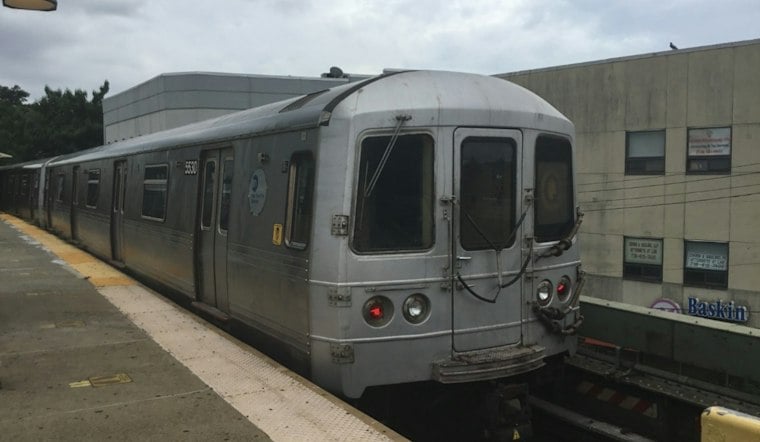
A 68-year-old woman was slashed in the face with a knife Saturday morning at the Sheepshead Bay B and Q station after a dispute with a man who was holding open the subway's emergency exit door. The confrontation began around 9 a.m., and the attacker fled on a southbound Q train before NYPD Transit officers took a 70-year-old man wearing a hoodie into custody at the station.
According to the New York Post, the man had propped open the emergency exit door when he had a run-in with the woman, who was nearby. He allegedly held the knife against her face, cutting her and causing her to bleed, before escaping onto the platform and boarding a train. The woman refused medical attention at the scene, and a person of interest was taken into custody, with charges still pending as of the report.
The dynamic described in the incident — someone propping open an emergency exit and getting into it with a rider — is not unusual at subway access points, where people sometimes hold the doors open and ask incoming riders for money to enter, per the Post's reporting. Those doors are meant strictly for egress, not entry, but enforcement has long been inconsistent across the system.
Cutting Someone's Face Carries Serious Felony Exposure
Under New York Penal Law § 120.05, cutting a victim's face with a knife or other dangerous instrument constitutes second-degree assault, a Class D violent felony punishable by two to seven years in state prison, according to Fast Law Firm, P.C. The charge applies when physical injury is intentionally or recklessly inflicted with a deadly weapon, which is consistent with how the Sheepshead Bay attack has been described by police sources.
The Sheepshead Bay slashing follows a separate, unprovoked stabbing exactly a week earlier in the same neighborhood, when a 34-year-old man was stabbed in the chest outside a lounge on Avenue U, as Hoodline previously reported. The two incidents are unrelated, but they land within days of each other in the same stretch of southern Brooklyn.
Transit Assaults Climbing Even As Arrests Fall
Police data cited in the Post's report shows serious assaults in New York City's transit system rose 12% over the previous year. Felony assault complaints in transit climbed 12%, from 470 to 525 incidents so far in 2026 as of October 13, while misdemeanor assault complaints rose 16%, from 1,120 to 1,304 incidents over that same stretch, per NYPD data referenced in the report. Felony assault in city transit is also up 18% compared with two years earlier, and 94% compared with seven years earlier, though the department's figures did not include exact numbers for those older comparison periods.
Misdemeanor assault has climbed 11% from two years earlier and 25% from seven years earlier, the same data shows. Overall transit crime is up 2% so far in 2026, even as transit arrests have fallen 5% over the same period, dropping from 23,977 to 22,847.
A Citywide Pattern Even As Overall Crime Falls
The uptick in subway violence is unfolding against a broader backdrop of falling citywide crime. NYPD CompStat data covering October 5 through 11, 2026, shows citywide transit major crime complaints rose 1.6% year-to-date to 1,697 incidents, even as total citywide major index crimes fell 6.58%, according to the NYPD. Those index crimes track murder, rape, robbery, felony assault, burglary, grand larceny, and grand larceny auto.
Research from Vital City found that while 2025 subway major crime fell overall from 2024, the rate of major crime per million rides remained 13.4% higher than in 2019, driven by a 106.6% surge in felony assaults per rider. Subway felony assaults climbed from 380 incidents in 2019 to 593 in 2025, even as ridership reached 1.28 billion. The 61st Precinct, which serves Sheepshead Bay, saw a 71.5% drop in shooting incidents during a borough-wide crime reduction push, per the Brooklyn District Attorney's Office.
Emergency Doors Face New Scrutiny And Fixes
The emergency exit door at the center of Saturday's dispute has become a flashpoint in transit policy well beyond Sheepshead Bay. The MTA announced a $1.1 billion capital plan in October to install modern sliding-door fare gates across 150 subway stations serving nearly 75% of daily riders, according to Planetizen. Emergency gates have long been viewed by transit officials as a major security vulnerability and a source of fare evasion.
A 20-station pilot program evaluated across 29 million entries and 34 million exits showed an average 35% reduction in fare evasion, with two Brooklyn stations reaching reductions as high as 72%, per Passenger Transport. Six Brooklyn stations — including Coney Island-Stillwell Avenue, Bedford Avenue, and Newkirk Plaza — are slated to get new touch-free fare gates in the MTA's next rollout phase, scheduled for late 2026, BKReader reports. Separately, state lawmakers introduced Assembly Bill A10180B, which would authorize the MTA to install 15-second time-delay egress mechanisms on emergency exit doors to curb unauthorized access, while still preserving emergency override capabilities required under fire safety standards.
Governor Kathy Hochul had previously allocated $77 million in state funds to expand NYPD foot patrols and joint state-city transit security deployments, aimed at increasing uniformed officer visibility on platforms and at fare control areas, according to the MTA. Despite that funding, Saturday's attack adds to a run of recent bladed-weapon incidents across the city's transit system and streets, including a platform slashing in the East Village and a stabbing near Jay St-MetroTech reported by Hoodline in recent weeks.





