

























































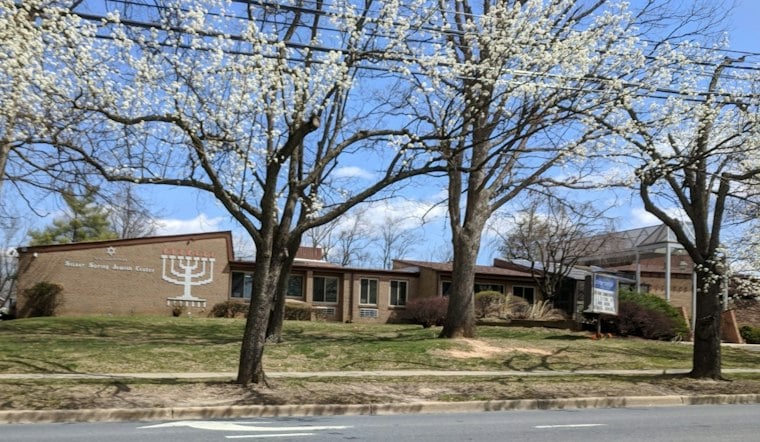
A federal judge has again ruled that members of a Silver Spring synagogue can carry firearms inside the building during services, but cannot carry them on the walk to get there, rejecting the congregation's latest bid to overturn Montgomery County's gun-free buffer zone around houses of worship. The ruling, issued Tuesday, leaves in place a split outcome that has frustrated the Orthodox synagogue and its lawyers for weeks.
U.S. District Judge Deborah Chasanow rejected the Silver Spring Jewish Center's request to reconsider and block Montgomery County's firearm restrictions within 100 yards of places of public assembly, according to JNS. As Washington Jewish Week reports, the decision keeps congregants barred from carrying firearms while walking to the Orthodox synagogue, which sits in Montgomery County and includes a school inside its building.
Chasanow found that the plaintiffs had established a religious obligation to defend themselves while inside the synagogue and a separate obligation to walk there on Shabbat and Jewish holidays, since observant Jews do not drive during those times. But she concluded, per the ruling, that they did not establish a religious mandate requiring them to make that walk while armed, drawing a line between the duty to attend services on foot and any duty to carry a weapon while doing so.
County's 100-Yard Rule at the Center of the Fight
Montgomery County's law bars possessing, selling, transferring or transporting firearms within 100 yards of a place of public assembly, including a house of worship, according to WTOP. The Montgomery County Council passed the measure on July 21 in a 10-1 vote, and County Executive Marc Elrich signed it on July 27, per the same account from Deseret News. The Silver Spring Jewish Center and Rabbi J. Menashe Shapiro sued the county on July 30.
Jacob Huebert, senior litigation counsel at the New Civil Liberties Alliance and an attorney for the synagogue, told JNS that Shabbat-observant congregants essentially cannot bring guns to services on the Sabbath and holidays under the court's framework. He argued the law prevents these congregants from fulfilling their religious obligation to defend themselves and other synagogue members, and said that obligation extends beyond the synagogue's grounds.
Huebert also pointed to what he called an inconsistency in the law: Montgomery County's restriction allows people in vehicles to have guns within 100 yards of places of public assembly, an exemption the plaintiffs argued discriminated against Shabbat-observant Jews, an argument Chasanow rejected. Huebert told JNS that most other religions do not require adherents to walk to worship, and that people walking to synagogue with family have the same obligation and at least as much need to protect themselves in public.
A Narrow Win, Not a Final Verdict
The preliminary injunction that first allowed indoor carry was limited specifically to the Silver Spring Jewish Center and did not broadly block enforcement of the 100-yard buffer zone, Washington Jewish Week reported in September. Bethesda Magazine similarly described the court's order as giving Shapiro and other licensed congregants the ability to carry a firearm within their house of worship, without shielding anyone else from the county's law.
Chasanow has not issued a final ruling on whether the law itself is unconstitutional, and the underlying case continues, according to The Reload. The Daily Record has described the dispute as having narrowed from a broad challenge to the county's entire firearm restriction into a plaintiff-specific fight over guns inside one house of worship and on the path to it.
Menashe Shapiro, a congregant and plaintiff in the case, told JNS that the county law unfairly and unduly burdens Jewish religious firearms carriers and violates both the First and Second Amendments. The synagogue's push for armed protection reflects, in part, continuing reliance on armed volunteer security alongside at least one hired guard, The Reload reported.
Other Legal Fights Over the Same Law
The New Civil Liberties Alliance had asked the court in September for a further preliminary injunction specifically allowing members to carry firearms while walking between their homes and the synagogue, according to a GlobeNewswire release from the organization. That release noted the court had already allowed firearms inside the synagogue while declining to enjoin the 100-yard restriction around places of public assembly more broadly.
Montgomery County's law has drawn additional legal challenges beyond the synagogue's case. Bethesda Magazine has reported that two other lawsuits have been filed in Maryland's federal district court over the same restrictions. The Daily Record reported that Chasanow separately denied a bid by Maryland Shall Issue, a gun-rights group, to obtain a broader preliminary injunction that would have blocked enforcement against any handgun permit holder, not just the synagogue's congregants.
A separate federal challenge brought by the Trump administration against the county law remains pending before U.S. District Judge Theodore D. Chuang, per The Daily Record.





