

























































A New Jersey developer has filed a fresh application to build 689 residential units, including 207 designated as affordable, on the sprawling former Hartford insurance campus along Hopmeadow Street in Simsbury. The filing arrives even as a court appeal over an earlier, smaller proposal for the same southern portion of the former Hartford campus remains unresolved, and after the town's own wetlands agency rejected a similar plan just a few months ago.
Silverman Group, the New Jersey-based firm behind the proposal, is pursuing redevelopment of roughly 12 acres within a much larger 124.6-acre parcel at 200 Hopmeadow St., according to CT Insider. The site once held a 645,000-square-foot office campus that The Hartford operated starting in the 1980s before closing it in 2013 as part of a broader consolidation that moved roughly 1,500 employees to Hartford and Windsor, according to the Hartford Business Journal. The old building was demolished in 2016, and Silverman Group bought the 172-acre parcel for $8.5 million in 2015, per the same CT Insider report.
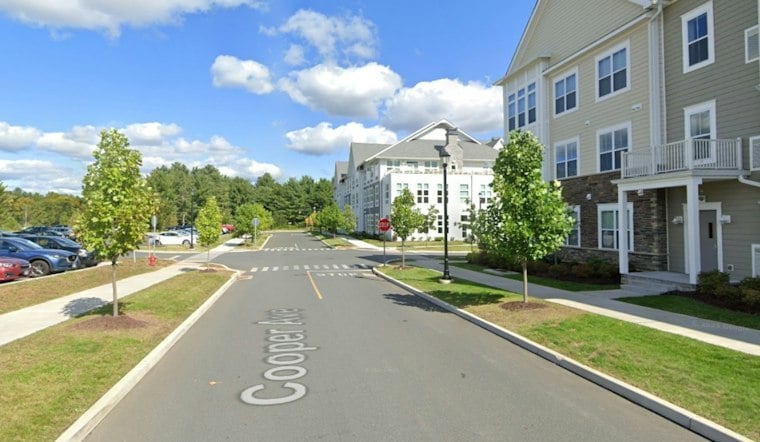
Part of that land has already become the 183-unit Ridge at Talcott Mountain apartment complex, and a separate developer built a 120-unit assisted living facility elsewhere on the property, the outlet reports. Silverman Group intends to call the new proposal Ridge at Talcott Mountain South. Site layout plans describe 63 buildings spread across the development: 17 apartment buildings of three to four stories holding 616 units, plus 54 duplexes and 19 single-family homes on a separate northern loop, accessible from an internal drive off Hopmeadow Street.
How the Affordable Units Would Work
Under the draft affordability plan, Silverman Group would designate 207 units, or 30% of the project, as housing opportunity units, according to the same CT Insider filing. Half of those units would go to households earning up to 80% of the area median income, and half to households earning up to 60%, available on a first-come, first-served basis. The affordable mix includes five studios, 99 one-bedroom units, 98 two-bedroom units, three three-bedroom units, and two four-bedroom units, with sample rents listed at $1,274 a month for a one-bedroom at the 60% income tier and $2,245 a month for a four-bedroom at the 80% tier.
The project narrative argues the development would diversify Simsbury's housing stock, expand the customer base for local businesses, and boost the town's grand list, per CT Insider's reporting. Those affordability commitments would not be temporary: Connecticut law requires Section 8-30g set-aside developments to keep income-qualified rental units deed-restricted for at least 40 years from each unit's certificate of occupancy, according to the Hartford Business Journal.
Why the Town Has Limited Leverage
Simsbury's housing stock sits well below the threshold that would let it sidestep this fight altogether. Only 4.69% of the town's housing, 472 of 10,057 units, met state affordability criteria as of the Connecticut Department of Housing's 2023 Affordable Housing Appeals List, far short of the 10% mark that exempts municipalities from Section 8-30g overrides, per the Town of East Lyme's compiled data.
That gap matters because of what Section 8-30g actually does. Enacted in 1989, the statute shifts the legal burden onto a town that denies a qualifying affordable-housing proposal, forcing officials to prove the rejection is necessary to protect public health or safety interests that clearly outweigh the community's need for affordable housing, according to the law firm Willinger, Willinger & Bucci. Statewide, more than 8,500 long-term affordable units have been built under the law since 1989, and courts have favored developers in roughly 75% of contested appeals, according to the Partnership for Strong Communities.
A Winding Road of Rejections and Revisions
This is not Silverman Group's first attempt at scaling this site. The developer initially filed for a 540-unit project with the zoning commission back in 2023, later revising it to 580 units and then scaling back to 432 units, CT Insider reports. The zoning commission rejected that 432-unit plan in a 5-1 vote in February 2024, citing incompatibility with the town's vision for the site. Silverman Group sued to appeal, but Superior Court Judge Claudia A. Baio dismissed that appeal in January 2026.
The developer then petitioned the Appellate Court to review the dismissal in March, and the court accepted that petition in May; the case remains pending. A motion filed on Silverman Group's behalf in July indicated the parties were close to settling but needed more time, and the developer has since requested an extension to file its brief until 45 days after a preargument conference scheduled for Oct. 22, per CT Insider's account.
Separately, the town's Conservation Commission/Inland Wetlands and Watercourses Agency unanimously voted 7-0 in July to deny a wetlands permit for an earlier version of the 689-unit proposal, citing environmental risks to local wetlands, vernal pools, and wildlife habitats, according to ctreal.estate. The agency's motion stated that feasible and prudent alternatives could reduce the project's footprint, pointing to earlier plans with fewer units. State law requires wetlands review to be completed before zoning approvals can be finalized, meaning this new 689-unit filing still faces that same environmental hurdle even as it heads toward the zoning commission.
Local Politics and a Statewide Fight
The zoning commission is slated to discuss the new application Monday night, though only for receipt and scheduling purposes, CT Insider notes. Simsbury officials have also considered requiring qualifying residential developments to include affordable units. The state has also invested directly in the town's existing affordable stock, finalizing financing in June to preserve and modernize 81 units at the Willow Arms complex as part of a $118 million initiative spanning nine municipalities, per Patch.
The Hopmeadow Street site has become more than a local zoning dispute. Republican gubernatorial candidate Ryan Fazio held a press conference in Simsbury in August, pointing directly to the 689-unit proposal to pitch a statewide housing grand bargain that would scale back Section 8-30g mandates while restoring local zoning authority, according to the CT Mirror. The dispute has effectively become a case study in Connecticut's broader argument over who controls suburban land use.
Investor interest in the area's rental market has only grown alongside the dispute. Out-of-state firm Eagle Rock paid $36.1 million, or about $189,000 per unit, for two nearby complexes, Hoodline previously reported, underscoring the demand regional buyers see in Simsbury's multifamily market regardless of how the Hopmeadow Street case resolves.





