

























































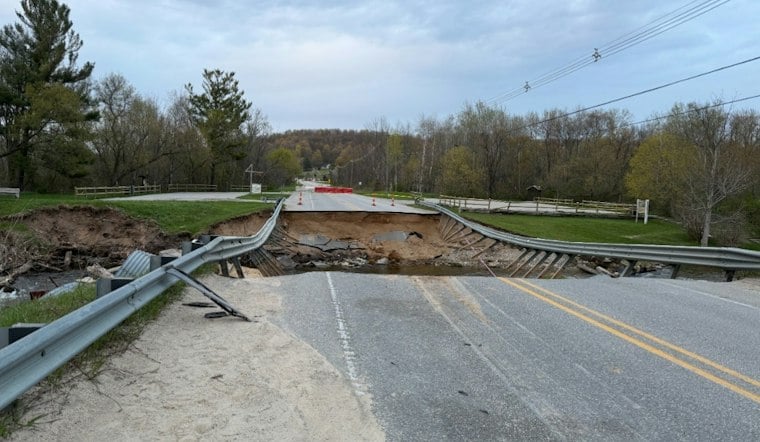
Six massive beams now stretch across the Boardman River near Traverse City, marking what officials call a major milestone in rebuilding the Beitner Road bridge that washed out during historic spring flooding. Crews installed the beams on October 13, and the Grand Traverse County Road Commission says the span is now on track to reopen by the end of 2026.
Dan Watkins, managing director of the Grand Traverse County Road Commission, posted an update about the construction on Facebook, noting that the beams arrived on time and now stretch across the river, according to MLive. The bridge, located near Chum's Corner south of Traverse City, serves as a key east-west corridor, and its collapse has lengthened commute times for area residents in the months since. Beitner Road remains closed between Williams and River roads while the rebuild continues.
Watkins also asked the public to stay away from the construction site to prevent safety hazards and project delays, per the same report. The Boardman River is closed to recreational watercraft at the construction site, with signs posted around the area and Shumsky Canoe Landing marked as the last exit point before paddlers reach the closed section.
A Flood That Shattered a 77-Year Record
The bridge's collapse traces back to April 15, 2026, when heavy rainfall and spring snowmelt caused the structure's culverts to fail and sent the roadway washing downstream, the outlet reports. The day before, the Boardman River at Beitner Road had reached 7.8 feet, part of a flood event that overwhelmed the region. Grand Traverse County had already declared a local state of emergency on April 14 after the rain and snowmelt triggered widespread road washouts, downtown sinkholes, and riverbank evacuations, according to The Ticker.
Upstream at a gauge near Mayfield, peak water flow on the Boardman River hit 1,120 cubic feet per second during the flood, blowing past the previous 77-year record of 583 cfs set in 2014 by 92 percent, per the City of Traverse City. The original Beitner Road bridge washed away during the flood.
Emergency Funds and a Fast-Tracked Timeline
Before its collapse, the bridge carried an estimated 18,000 to 20,000 vehicles per day, and its sudden loss forced traffic onto Cass and South Airport roads, creating significant regional commuter delays, according to Interlochen Public Radio. Replacement design work had actually been underway before the washout, since the project was originally slated for construction in 2027. Officials expedited that timeline once the flood hit, pushing design work forward and beginning construction in August 2026.
Federal emergency highway funds are covering 80% of the replacement cost, with the road commission responsible for the remaining 20% local match, The Ticker reported in July. The Michigan Department of Transportation, which managed contractor selection, awarded the job to Grand Haven-based Anlaan Corporation after the firm submitted the low bid of $3,738,880.47 among four competing proposals — a figure MLive now cites as roughly $3.7 million for the overall project.
Ahead of the main construction work, the road commission paid local contractor Molon $100,000 to clear collapsed bridge debris from the river channel, with plans to seek FEMA reimbursement. Commissioners also approved a $384,500 contract with OHM Advisors for construction engineering oversight, while Team Elmer's, a major Traverse City-area heavy construction firm, was brought on as a key subcontractor, per The Ticker.
Protecting a Designated Natural River
Because the Boardman-Ottaway River is one of 16 designated natural river systems in Michigan, the reconstruction required regulatory review under the state's Natural Rivers Program, alongside environmental permits from the Department of Environment, Great Lakes, and Energy, according to CNHI. Those added layers of review came on top of the accelerated schedule officials were already managing.
With six beams now in place over the water, officials have said they hope to reopen the bridge by the end of 2026 — later than the roughly six-month timeline officials initially hoped for after the washout. Until then, drivers in the Chum's Corner area will keep routing around the closed stretch of Beitner Road, and paddlers on the Boardman River will need to pull out at Shumsky Canoe Landing before reaching the active work zone.





