

























































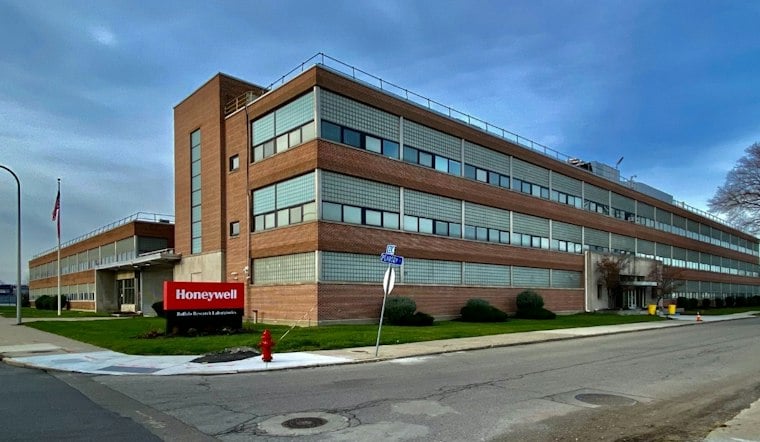
Solstice Advanced Materials is investing $49 million into its research and development facility in South Buffalo, a move that will create 10 new jobs at a site with an existing Buffalo workforce of about 180 employees. The company, spun off from Honeywell roughly a year ago, is pouring fresh capital into a lab with a long history of chemical innovation at the corner of Peabody and Elk streets.
The investment was first reported by Buffalo News reporter Matt Glynn, whose coverage lays out the scope of the project and the state incentives tied to it. Empire State Development is contributing up to $1.3 million through its Excelsior Jobs Tax Credit Program, an incentive structure tied directly to job creation, according to Empire State Development. Under the program, qualified companies can receive fully refundable tax credits worth up to 6.85% of wages per new job — or 7.5% for green projects — plus a 2% investment tax credit, dispersed over as long as 10 years contingent on meeting job and capital spending targets.
A Century of Chemistry at Peabody Street
The 9.1-acre site sits in a legacy industrial district along the Buffalo River corridor, a stretch of South Buffalo that has hosted heavy chemical research for generations, according to the New York State Department of Environmental Conservation. The property originally operated as the National Aniline Chemical Research Center before passing through Allied Chemical and then Honeywell International, per historical records preserved on Wikimedia Commons. It was known for years as Honeywell Buffalo Research Laboratories, and the site produced technologies that were later manufactured at large scale elsewhere, the Buffalo News reports.
That lineage matters because Solstice launched as an independent company with four R&D centers worldwide, roughly 4,000 employees and 24 manufacturing facilities globally, according to a release distributed via PR Newswire. The Buffalo lab is credited with developing Solstice HFO-1234yf, a refrigerant created to replace HFC-134a in automotive air conditioning with an environmental impact described as 1,300 times lower, according to the Asian and Pacific Centre for Transfer of Technology.
From Honeywell Spinoff to Standalone Strategy
Solstice became an independent, publicly traded company on October 30, 2025, when Honeywell distributed one share of Solstice common stock for every four Honeywell shares held and listed the new company on Nasdaq under the ticker SOLS, per the release carried by PR Newswire. The company focuses on environmentally friendly specialty materials spanning refrigerants, foam insulation, aerosols, energy storage materials, and data center thermal management, according to the Buffalo News. Commercially, Solstice organizes its business into two segments — Refrigerants & Applied Solutions, which covers low-GWP refrigerants and foam blowing agents, and Electronic & Specialty Materials, which supplies semiconductors, nuclear energy, and healthcare packaging markets, per Wikipedia.
Financially, the company generated $3.89 billion in net sales and $237 million in net income for the full 2025 fiscal year, and in July it raised its full-year 2026 net sales guidance to between $4.125 billion and $4.185 billion, according to Wikipedia. That growth trajectory comes weeks after Solstice and Element Solutions mutually terminated a proposed $14.5 billion merger agreement in August, following shareholder pushback, as reported by Morningstar. With that deal off the table, the Buffalo investment reads as part of Solstice's pivot toward standalone organic expansion rather than consolidation.
Part of a Broader Pattern of State-Backed Investment
Solstice says it plans to expand its Buffalo capabilities and use them to advance next-generation solutions that support customers and critical industries, while also backing job and investment growth in the region, per the Buffalo News account. The $49 million commitment follows another major round of state-incentivized manufacturing investment in the city: J.M. Smucker announced a $53M Milk-Bone renovation on Buffalo's East Side last year, which received up to $500,000 in Excelsior tax credits of its own.
Together, the two projects suggest Empire State Development's jobs-for-tax-credits model continues to draw sizable industrial commitments to Buffalo, even as the city's manufacturing base has shifted repeatedly in ownership and focus over the decades. For the Peabody Street lab, this latest round of funding extends a research legacy that stretches back to the days of the National Aniline Chemical Research Center, now reimagined under a newly independent, Nasdaq-listed parent company.





