

























































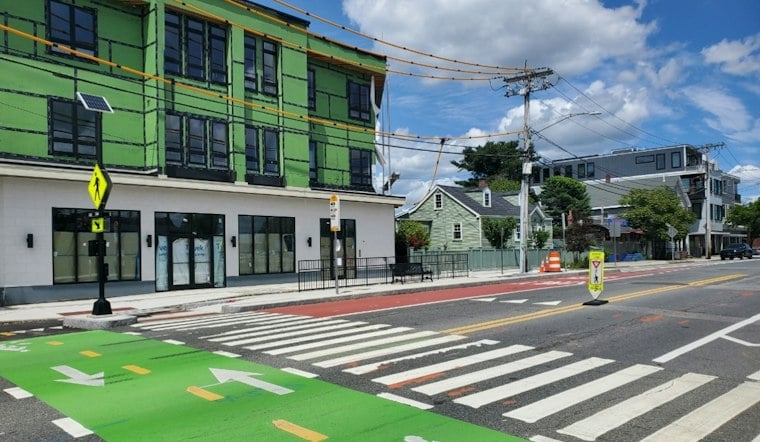
Safety measures across Somerville
Somerville has recorded a 50% decline in serious-injury crashes, no pedestrian fatalities since 2022, and three consecutive years without a traffic fatality, according to a decade-long assessment by the LivableStreets Alliance.
Pedestrian crash trends through 2022
Data from the Somerville Mobility Division and the MassDOT Impact Crash Portal reviewed in the city’s 2025 Anti-Violence Working Group report showed severe vehicular crashes declined from 2012 to 2022, while the data recorded one fatal crash each year from 2019 through 2022. The report also says pedestrian-involved crashes declined from 2012 to 2022, though more than 50 were reported in 2019. These cited findings run through 2022 and do not establish a post-2022 trend or a biking-specific change.
The city has developed more than 3 miles of Neighborways since 2014. Low-volume residential streets make up 59% of Somerville’s street network, according to Neighborways Design. The city’s 2025 Safe Streets Ordinance annual report says Somerville built more than 100 permanent traffic-calming features in 2024: 53 speed humps on 17 streets, 45 curb extensions, 12 raised crosswalks, and two raised intersections.
City traffic records cited in the original article show 508 street segments designated as 20 mph Safety Zones. The city lowered its default speed limit to 25 mph in 2016 and expanded 20 mph zones on residential streets by 2021.
Changes on Tufts Street
A city-run study cited in the article counted as many as 3,000 cars a day on Tufts Street, a residential block about 1,000 feet long. That traffic count provides context for the redesign’s traffic-calming measures, but does not by itself show vehicle speeds or crash conditions on the street. Community planning began in 2023, construction started in summer 2025, and the work is nearing completion. Patch reported that the city scheduled a ribbon-cutting for Tuesday at Leonard Grimes Park.
The street remains open to two-way travel. Its design uses pinch points—narrowed sections where opposing drivers may need to wait for one another—along with speed humps, signage, pavement markings, and curving curb sections. Patch’s account of the project and its timeline is available here.
What the available data can show
The project details cited here include a preconstruction count of as many as 3,000 cars a day, but do not give a Tufts Street speed measurement or state whether the city plans post-redesign speed or traffic-volume counts. These sources also do not establish before-and-after speed or volume results for other streets with traffic-calming measures. For broader context, The Christian Science Monitor reported 26 vehicle-pedestrian collisions in Somerville in 2025, compared with 40 in 2013. That citywide comparison does not show whether the Tufts Street redesign—or traffic-calming work on other streets—changed speeds, traffic volumes, or collision rates.
A larger change planned for McGrath
Tufts Street runs parallel to McGrath Highway. MassDOT’s planned $120 million McGrath Boulevard project is expected to begin as soon as 2028. The state’s project documentation describes removing the elevated McCarthy Overpass and replacing Route 28 with a surface-level boulevard that has fewer travel lanes and new signalized crosswalks.





