

























































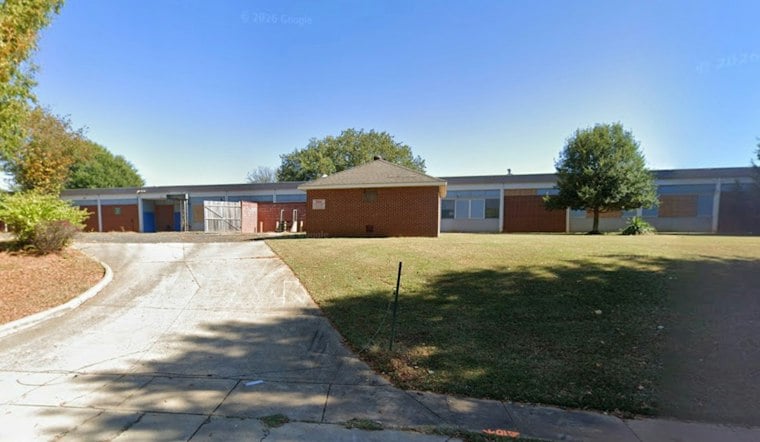
A crumbling brick chimney is the last thing standing between a flock of migrating birds and the wrecking ball in south Charlotte. The chimney, attached to the long-vacant Smith Family Center near Tyvola Road, has become a nightly roosting spot for chimney swifts, and conservationists are now pushing Charlotte-Mecklenburg Schools and Mecklenburg County to spare it even if the rest of the crumbling building comes down.
A Vacant Building, Competing Concerns
The abandoned former Smith Family Center sits about 40 feet from Collinswood Language Academy and shares the same parcel of land, according to WFAE. The building has sat empty since 2021, when CMS closed it over employee health concerns, and the district has said it is evaluating long-term options, including a future sale and demolition. The site has turned into what WFAE describes as a battleground involving the city, nature conservationists and local parents.
Parents near the K-8 magnet school have raised their own alarms, pointing to evidence of trespassing, drug use and a recent police call involving a gun as proof the site poses a danger to students, the station reported in March. That safety push toward demolition now sits uneasily alongside a very different kind of advocacy: the fight to save the one piece of the structure that migrating birds depend on.
Discovering the 'Swiftnado'
Celia Kaul discovered the Smith Family Center chimney while working to preserve nearby oak trees, and she has argued that saving chimneys like this one carries outsized impact because newer buildings so often lack them altogether. The North Carolina Wildlife Federation, Mecklenburg Audubon and Charlotte Wildlife Stewards gathered a crowd at the former Smith Middle School on Tyvola Road to watch the swifts' nightly roosting ritual, the station's report notes.
Among the onlookers was Alden Picard, who watched chimney swifts swarm over the former middle school and described the swirling cloud as a “swiftnado.” Avian activists want the chimney preserved even if the rest of the building is ultimately torn down, framing it as a small but meaningful concession in an otherwise fraught demolition decision.
Why a Single Chimney Matters
Chimney swifts historically rested inside hollow tree trunks in old-growth forests, adapting to chimneys as roosting and nesting sites only after that habitat disappeared. North Carolina today has only a few pockets of untouched forest remaining, and no official inventory of them exists, per the same reporting. Suitable chimneys are becoming scarce in their own right: newer buildings often use electric heat pumps that don't require venting, modern chimneys increasingly forgo brick in favor of concrete or clay, and building owners sometimes block chimney openings outright, eliminating potential nesting or roosting sites.
Chimney swifts breed in urban and suburban habitats and are most common in areas with a large concentration of chimneys for nest sites and roosts, according to All About Birds. During migration they forage in flocks over forests and open areas and roost in chimneys at night, which is precisely the behavior drawing crowds to Tyvola Road this fall. While the Smith Family Center chimney and similarly large structures are preferred, swifts will also rest and nest in small residential masonry chimneys, per WFAE's reporting.
A Population in Steep Decline
The stakes extend well beyond one Charlotte lot. WFAE reports the chimney swift population has declined by over half since the mid-1900s due to food and habitat loss, driven in part by pesticides and habitat destruction that have wiped out many of the insects the birds rely on for food. Climate reporter Sarah Gagné has said insect biomass has declined over the last several decades, compounding the pressure on the species.
Other measurements of the decline vary by source and time frame. Audubon has reported that chimney swift numbers in the United States fell 53 percent between 1966 and 2007, while All About Birds cites a North American Breeding Bird Survey estimate of a 2.3 percent annual decline from 1966 to 2023, amounting to a cumulative drop of 74 percent over that period. The 2025 State of the Birds report classified the chimney swift as an Orange Alert Tipping Point species after finding it lost more than 50 percent of its population in the past 50 years, according to All About Birds. The loss of suitable chimneys to capping and changes in construction style is a recurring culprit cited by Audubon North Carolina.
What County Officials Are Saying
Charlotte-Mecklenburg Schools and Mecklenburg County have agreed that the chimney will be preserved during demolition to the extent structurally feasible and safe to do so, the county's office of asset and facility management told WFAE. Officials said they are working to save the structure, but cautioned that we will not know if our efforts are successful until the contractor is onsite, meaning the chimney's fate hinges on an assessment that has not yet happened. If preservation does go forward, the county said, the chimney would remain in place to continue to serve as a nesting place for the birds.
How Other Cities Have Handled the Trade-off
Charlotte would not be the first place to wrestle with saving a chimney for migrating birds. In downtown Raleigh, the historic chimney at Transfer Co. Food Hall was preserved so swifts could keep roosting there every fall, according to Audubon. Wake Audubon spent three years and roughly $36,000 out of pocket, plus almost $50,000 in donations, to build a 30-foot brick roost structure at the North Carolina Museum of Natural Sciences' Ecostation in West Raleigh after an existing roost was lost.
Farther afield, Metrolinx postponed demolishing an apartment chimney blocking construction of Hamilton's $3.4 billion light-rail project specifically to preserve habitat for threatened chimney swifts, per The Hamilton Spectator. In Leamington, Ontario, a school redevelopment required a $640,000 plan to build replacement habitat for swifts nesting in that building's chimney, while Toronto's WoodGreen restored a 26-meter chimney at Evergreen Brick Works while converting a nearby church into 50 units of senior housing, according to CBC News.
Whether the Smith Family Center chimney joins that list remains an open question. For now, it stands as a kind of waiting room — host to the kind of nightly swirl that drew Picard and other bystanders to Tyvola Road, and a test case for whether a school district weighing safety, liability and demolition costs will carve out room for a species running out of places to land.




