

























































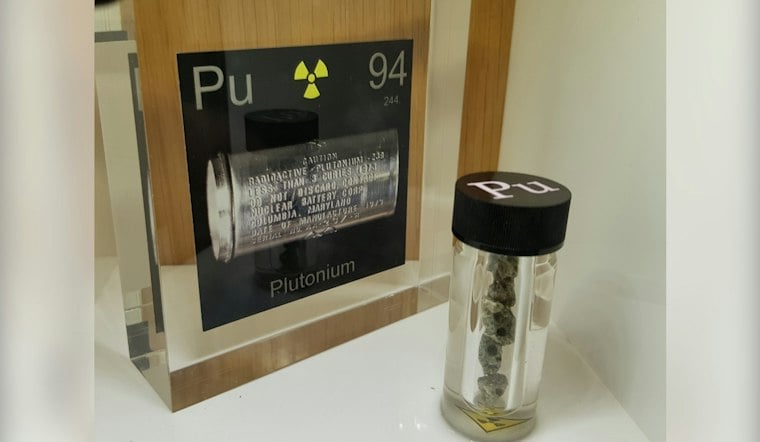
A 44-year-old Massachusetts man who ran an online shop selling samples of chemical elements has pleaded guilty to importing and selling plutonium smuggled from Russia, along with a string of other federal charges tied to a 2025 raid on his South Hadley home that turned up explosive powder, rifles, ammunition and child sexual abuse material. Jacob D. Miller admitted to illegally importing nuclear material without lawful authority, mailing hazardous materials, being a felon in possession of ammunition and explosives, and being a felon in possession of child pornography.
Miller entered the plea on Monday, according to the Boston Globe, which reported he sold and mailed highly radioactive plutonium to an estimated 67 customers in the United States and abroad between Dec. 30, 2020, and March 31, 2025. The Justice Department's Massachusetts office has said Miller pleaded guilty to illegally importing plutonium from Russia and selling the radioactive material along with other hazardous substances, though the full text of that announcement was not available for this report. Separately, as first reported by Boston 25 News, authorities said Miller also pleaded guilty to unlawfully possessing ammunition and explosive materials as a convicted felon and to possessing child sexual abuse material.
A Hobby Shop Hiding a Hazardous Business
Miller started the online business, called Collect the Periodic Table, in 2017, selling samples of the 118 chemical elements listed on the periodic chart, the Globe's report notes. But the same operation also sold plutonium and thallium samples, according to the outlet. Thallium, a highly toxic and hazardous substance, was mailed to about 71 customers between Oct. 12, 2017, and April 5, 2025, the report states, while plutonium itself is classified as a hazardous substance that is prohibited from being mailed.
Miller ran the business out of his home in South Hadley, per the seed facts in this case. According to Boston 25 News, he started the business after his release from a prior conviction — he was convicted in Massachusetts state court in February 2004 of possessing child pornography and possessing an explosive device, and was sentenced at that time to six months of incarceration followed by ten years of probation.
What the April 2025 Search Turned Up
A search of Miller's home on April 8, 2025, the day before his arrest, led to the seizure of numerous hazardous substances, bottles of explosive powder, and several rounds of ammunition, the Globe reported. The same search found alkali metals, acids, oxidizers, and arsenic in Miller's basement, according to the outlet's reporting.
FBI agents also confiscated six rifles during that search and discovered child pornography on Miller's laptop and cell phone, the Globe reported. Officers said Miller had accessed child sexual abuse material as recently as the day before the search warrant was executed.
Indictment, Custody and What Comes Next
Miller was indicted by a federal grand jury in Springfield on April 27, 2025, and has remained in federal pretrial custody since his arrest, per the seed facts. His sentencing date was set for Jan. 21, though the Globe's report does not specify the year.
Under federal law, no person may transfer, receive, deliver, acquire, own or possess covered special nuclear material in interstate commerce without a general or specific license issued by the Nuclear Regulatory Commission, according to 42 U.S.C. § 2077. The statute underpins the nuclear-material charge Miller admitted to in his plea.
How Rare Is Plutonium Trafficking?
Cases like Miller's are exceedingly uncommon on a global scale. The International Atomic Energy Agency has tracked 3,686 incidents of nuclear or radioactive material falling outside regulatory control since 1993, with only 290 of those involving a confirmed or likely act of trafficking or malicious use — and just two of those 290 cases involved plutonium specifically. In 2019 alone, the IAEA recorded 189 such incidents reported by 36 states, only six of which were tied to trafficking or malicious use, continuing what the agency described as a slight downward trend from a peak of about 20 such incidents roughly 15 years earlier.





