

























































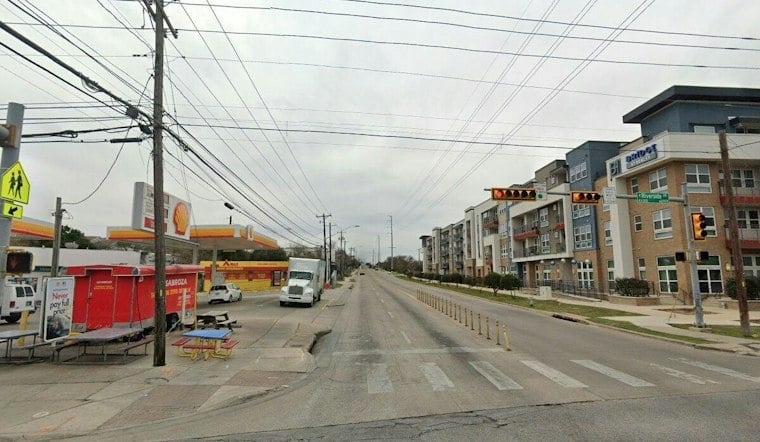
JD's Supermarket, a Hispanic and Mediterranean grocery store at the corner of Montopolis Drive and East Riverside Drive, says Austin's light rail plans could put its future at risk. Store representatives and community leaders gathered outside the store on October 9 to call on the Austin Transit Partnership to reconsider an eminent domain proceeding that could affect part of the property, according to the Austin Chronicle.
The dispute centers on a sliver of land occupied by a gas station affiliated with JD's. The Austin Transit Partnership, the agency building the rail system, has plans for a future station near Riverside and Montopolis — one of 15 stops along the line — though the exact location has not been finalized, according to KXAN. The portion of JD's property the agency may need is currently occupied by that gas station, the station reports.
Store risk manager Calixto told KXAN the stakes are existential. “Our gas station brings in 30% of our supermarket sales,” he said. “Losing that will cause us to enter survival mode and eventually we will close.” Per store representatives, the loss of gas customers could force the supermarket to shut its doors within a year or two.
A Building With Deep Roots in Montopolis
JD's Supermarket occupies a building that was formerly a church, and neighbors supported turning it into a grocery store because the community needed nearby fresh food and traditional Latino products, per the Austin Chronicle's reporting. The Riverside location has created 90 jobs since it opened, according to the company's website, and serves roughly 2,250 customers who use EBT benefits each month. It also doubles as a gathering place, with customers eating and socializing on the second floor during lunch.
Pedro Hernandez Jr., who has lived in the area since 1975 and has participated in discussion groups connected to the transit agency for about five years, said the store's accessibility matters to people without cars. “I, for example, don't have a car. So for me, it's easy to get there,” he said. Susana Almanza, executive director of People Organized in Defense of Earth and Her Resources who has lived in Montopolis since 1995, criticized what she described as a lack of communication from the agency's Montopolis neighborhood outreach team.
Tax Revenue and the Numbers in Dispute
JD's Supermarket generates $661,343 in tax revenue, of which the gas station accounts for a projected $64,600, KXAN reports. JD's representatives say a redesign could save the station, protect 90 local jobs and preserve what they call a vital community hub. The supermarket has identified nearby properties whose owners may be willing to sell as alternatives to acquiring the gas station site, though representatives say they still have questions about how much of the property could ultimately be affected.
The transit agency disputes claims that the project would displace JD's Supermarket. Agency spokesperson Jennifer Pyne said, “The Austin Light Rail design does not displace JD's Supermarket.” The agency notified JD's management in March that a portion of the property “will be needed for the proposed transit project” and that the occupant could be entitled to relocation assistance, per the same KXAN report. Store representatives say they met with the transit agency in June and again in September, and the agency says it has communicated with JD's representatives roughly 20 times over the past two years.
What the Current Design Would and Wouldn't Do
The transit agency says its January design does not require changes to the supermarket building, though a partial acquisition to move the sidewalk and overhead utility poles closer to the building along East Riverside Drive may still be required. The agency has said this would not block access to JD's Supermarket during or after construction or require acquisition of the building itself — though it has not addressed whether the gas station could continue operating under the same conditions it does today. The transit agency says it will keep looking for ways to reduce impacts on surrounding properties, and the current light rail design is not yet final.
The broader Project Connect plan could still reshape large swaths of the rail corridor. Reported estimates of potential displacement vary: KXAN has cited Project Connect documents identifying 68 total possible displacements, including 64 businesses and four residences, while Community Impact has reported the agency's estimate of 63 properties, or roughly 4% of those along the route. Separately, CBS Austin has reported the project could affect up to 71 businesses and require about 85 acres of land downtown, and Texas Standard has put the figure at up to 64 businesses and four single-family homes. It is not clear from available reporting whether these differing counts reflect different project stages or definitions. Texas Standard also reports that some properties could be seized through eminent domain in 2026 if the city receives final approval from the Federal Transit Administration, and that construction is expected to run from 2027 to 2033.
A State Lawmaker Weighs In
State Rep. Lulu Flores, who represents District 51 covering southeast Austin, attended the news conference outside JD's. “We need transportation that truly serves people, but not at the expense of other communities or the gentrification of our neighborhoods that have been here for years,” she said. Flores expressed support for public transportation generally while voicing concern about construction impacts on neighborhoods already facing displacement and gentrification pressures, and said her office would be involved in efforts to address residents' concerns.
For now, JD's Supermarket says it hopes to find an alternative that allows the light rail project to move forward without putting the store's future at risk. Austin Transit Partnership, for its part, says it may still need to purchase land or parts of properties along the proposed rail route as design work continues, and that final property impacts for the broader Project Connect corridor will not be settled until the agency issues its final environmental impact statement, according to KXAN.


