

























































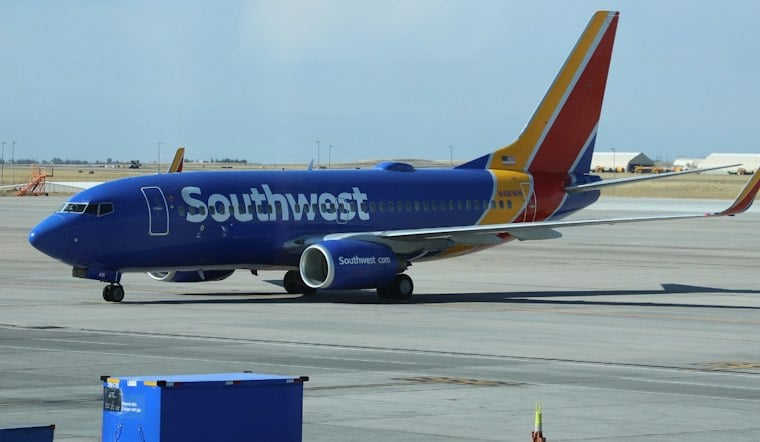
For Southwest, a move beyond its all-737 fleet would involve more than choosing an aircraft: it would require the airline to build capabilities for a type it has never operated. KSL reports that Southwest is leaning toward the Boeing 787 Dreamliner if it proceeds with long-haul international flights. No final decision has been made, and the board would ultimately have to approve an aircraft selection.
The possible 787 choice was first reported by KSL, citing sources familiar with the airline's planning. Those sources said Southwest has considered a fleet of dozens of 787s. The airline has also explored getting some aircraft through lessors or the secondary market, according to investing.com. No leasing arrangements have been confirmed, and the specific 787 variant under consideration is unknown.
Southwest has not publicly identified an aircraft for long-haul flying. In September, Chief Financial Officer Tom Doxey said the airline was considering long-haul international service among several options, while emphasizing that no decision had been made, per the same investing.com report. Boeing referred fleet-plan questions to Southwest. The airline said it had no fleet-plan news forthcoming.
A Turnaround Strategy Built Around More Than Jets
The aircraft question sits within a broader effort to change Southwest's business and attract more higher-spending travelers. CEO Bob Jordan told Reuters that long-haul international service is among the options being considered as part of the turnaround, but that the work remains at an early stage. Jordan has also said Southwest could begin with a narrowbody for long-haul service rather than immediately adding a widebody.
The carrier has introduced assigned seating and extra-legroom seats, and announced plans for airport lounges and a premium credit card, according to the same investing.com reporting. It is also seeking to strengthen Rapid Rewards and its co-branded credit-card business. The changes accompany less popular moves, including checked-bag fees and a basic-economy fare, Reuters reports.
Partnerships are another route to expanding international reach without adding a new aircraft type. Southwest has launched partnerships with Icelandair, China Airlines and EVA Air since February, per Reuters, allowing customers to book connecting itineraries that include Southwest flights. Those connections are currently limited to Icelandair and China Airlines, according to paddleyourownkanoo.com. The outlet has reported that Southwest is considering a broader network spanning Europe and Latin America, with Africa and Asia also under consideration.
Timing Questions and a Fleet Oversight Committee
The timeline for any service or aircraft decision remains uncertain. Investing.com, citing sources familiar with the plans, reported that long-haul flying had been discussed on a roughly three-year timetable, subject to aircraft availability. Jordan gave ch-aviation.com a longer estimate, saying a major fleet announcement would take at least three to four years.
Aircraft supply could affect that schedule: Boeing has said the 787 is sold out through the end of the decade, according to investing.com. Southwest formed a Fleet Oversight Committee in 2025 to guide its aircraft acquisition strategy, the outlet also reported.
Operating a new aircraft type would require additional work for an airline built around the 737. Southwest has said that could involve new maintenance and training programs, regulatory approvals, and negotiations with unions over pay and work rules, according to investing.com.
How Southwest has extended its reach
Southwest's earlier international reach relied on connections rather than its own widebody flying. Its 2011 annual report said customers could book international flights by connecting with Volaris, Mexico’s second largest airline. That record describes connecting service; it does not establish that Southwest's 2011 acquisition of AirTran involved adding a new aircraft type or Southwest-operated widebody long-haul flights, according to the Southwest Airlines 2011 annual report. Southwest's Hawaii service offers a separate precedent for longer 737 routes, not overseas widebody operations. The airline said in 2017 it would seek FAA ETOPS authorization, which it described as a regulatory requirement for mainland-to-Hawaii flights. It announced in 2019 that service would begin with Oakland–Honolulu on March 17, followed by Oakland–Kahului on April 7, according to Southwest and its 2019 announcement. For additional operating context, Southwest's 2025 results reported an average aircraft stage length of 780 miles; that figure describes the network but does not, by itself, determine whether a widebody program makes sense, according to Southwest's results.
Airbus Still Pushing for a Seat at the Table
Boeing is not the only manufacturer discussed. Airbus has pitched the A321XLR and A330neo for Southwest's long-haul needs, while the smaller A220 has been floated for other parts of its network, according to investing.com. Airbus said it does not comment on discussions with airlines.
Jody Reven, president of the Southwest Airlines Pilots Association, has said the airline discussed both a larger widebody and a narrowbody option for long-haul flying, according to KSL. His comments are consistent with Jordan's public remarks about weighing the two aircraft categories.
Southwest's fleet remains entirely Boeing 737s: 332 737-700s, 277 737-8s and 203 737-800s, according to data cited by ch-aviation.com. The carrier also has outstanding orders for 286 737-7s and 186 737-8s, per the same source. Jordan has said Southwest does not need a long-haul network comparable to Delta Air Lines, United Airlines or American Airlines, suggesting that 8 to 12 destinations could cover much of where its customers want to travel, according to investing.com. The scale of any expansion matters as Southwest's margins currently trail those of Delta and United, Reuters reports, and a widebody operation would be a substantial change for the carrier.





