

























































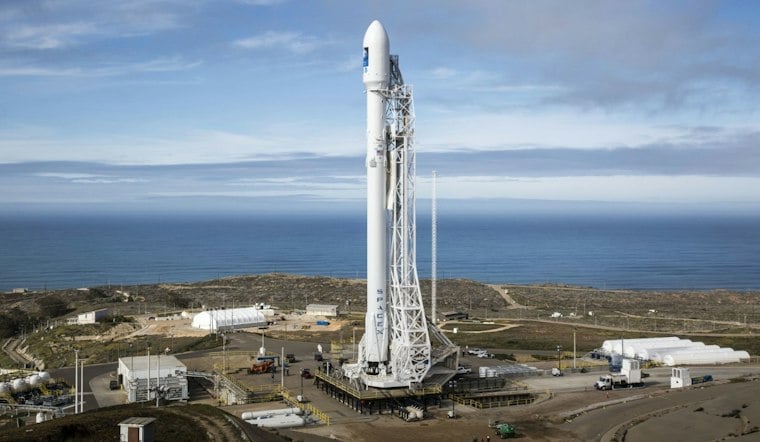
SpaceX is targeting a pre-dawn Falcon 9 launch from Vandenberg Space Force Base early Tuesday morning, Oct. 6, sending 21 military satellites into orbit while the returning booster could rattle windows from Santa Barbara to Ventura County with sonic booms. The mission is the latest step in a Space Development Agency program meant to knit together a constellation of satellites supporting military communications and missile tracking.
KEYT initially reported a 1:17 a.m. Monday liftoff, but after an auto abort scrubbed that attempt, SpaceX is now targeting Tuesday, Oct. 6. Air & Space Forces had listed the original launch window two minutes earlier, at 1:15 a.m. local time. The rocket will fly out of Space Launch Complex 4-East, located in Santa Barbara County, according to the Ventura County Star, whose reporting on the launch was originally carried by the Sacramento Bee.
Tucked inside the Falcon 9's payload fairing are 21 Tranche 1 data transport satellites built for the Space Development Agency, part of what KEYT describes as the fourth of nine planned Tranche 1 missions. Once in orbit, the new satellites will join 63 existing Tranche 1 satellites built by York Space Systems and Lockheed Martin, according to Air & Space Forces, which also notes this is the first Tranche 1 launch to carry satellites built by Northrop Grumman.
A Military Network Years in the Making
The Tranche 1 satellites are designed to form what Noozhawk describes as a mesh network of optically connected spacecraft in low-Earth orbit. The network is intended to support military communications and alerts. The broader program aims to field somewhere between 300 and more than 500 satellites, per KEYT.
The 21-satellite launch is one piece of a larger architecture: the Space Development Agency plans 126 Transport Layer satellites and 28 Tracking Layer satellites for Tranche 1, plus four missile-defense demonstration spacecraft. The transport satellites are designed to relay tactical communications, including Link 16, through optical links between spacecraft; the tracking satellites carry infrared sensors for missile warning and tracking. The agency says Tranche 1 is intended to begin providing initial warfighting capability in 2027. The agency’s Tranche 1 overview lays out those planned capabilities.
Previous Tranche 1 launches lifted off from Vandenberg in September 2025, October 2025 and July 2026, according to KEYT.
Booster Landing Could Trigger Sonic Booms
This will mark the sixth flight for this particular Falcon 9 booster, KEYT reports. After separating from the rocket's upper stage, the reusable first stage is expected to attempt a landing at Landing Zone 4 at Vandenberg roughly eight minutes after liftoff, allowing crews to recover it for future flights.
That return trip is the part likely to get noticed well beyond the launch pad. Rocket launches can produce sonic booms, and a booster landing back at Vandenberg tends to make those booms more noticeable near populated areas. SpaceX has said residents in Santa Barbara, San Luis Obispo and Ventura counties are most likely to hear them, and per Vandenberg, the booms can occur up to 10 minutes after liftoff. Areas closer to the base are expected to hear an initial low rumble as the rocket takes off.
The sonic-boom effects are also being studied locally. Since June 2024, Vandenberg has partnered with Brigham Young University and California State University, Bakersfield on ECOBOOM, a program that monitors boom events and their noise impacts. Monitoring stations are deployed across Santa Barbara and Ventura counties, including in Ojai. Vandenberg says the effort is intended to help assess impacts on nearby communities as launch and landing activity continues.
Weather and Viewing Conditions
Spectators hoping to catch the launch can watch from areas near Vandenberg, as well as from spots as far away as Palm Springs and Arizona.
The launch also comes amid a sharp rise in activity at Vandenberg. The base’s 2025 strategic plan said it oversaw 71 space launches and missile tests that year, the highest rate since the 1970s, and identified growing demand as a reason to expand capacity and infrastructure. That pace makes the community effects of launches and booster returns an increasingly regular consideration for the Central Coast. The base’s plan describes the operational growth and capacity challenges.
Monday's attempt was scrubbed after an auto abort, and SpaceX is now targeting Tuesday, Oct. 6.
SpaceX isn't done with Vandenberg after this mission. Noozhawk reports the company also has an additional Falcon rocket launch planned from the base for a Starlink mission, with that booster expected to land on a droneship on Oct. 10.





