

























































Nearly half of the patients who told researchers they were too scared to go to the emergency room ended up delaying treatment anyway, according to a new study surveying 345 patients across hospitals in Houston and San Francisco. The findings, drawn from emergency departments including Ben Taub Hospital in Houston, show Spanish-speaking Latino patients reported dramatically higher fear of seeking emergency care than English-speaking Latinos or non-Latinos surveyed at the same sites.
Researchers surveyed 345 patients at three hospital emergency departments in San Francisco and Houston, according to CIDRAP. The participants included 100 Spanish-speaking Latinos, 101 English-speaking Latinos and 44 English-speaking non-Latino people, who answered survey questions about anti-immigration rhetoric, enforcement activity and whether they felt safe seeking care. As the Houston Chronicle reports, the survey also asked whether patients believed providers treated noncitizens differently or reported them to immigration authorities, and it included statements tied to immigration policy under President Trump's administration.
The gap between groups was stark. Forty-three percent of Spanish-speaking Latino respondents said they were afraid to seek emergency care, compared with just 4.2% of English-speaking Latinos and 3.2% of English-speaking non-Latinos, per the CIDRAP summary of the findings. More than a third of both Spanish-speaking and English-speaking Latino participants said they knew someone who had avoided the emergency department out of fear of being identified as undocumented, according to the Houston Chronicle's reporting on the study.
Fear Translated Into Delayed Treatment
Nearly half of respondents who said they were afraid to seek care at the emergency department also reported delaying emergency treatment, according to Fierce Healthcare. Per the Houston Chronicle, Spanish-speaking Latino participants accounted for 12 of the 16 participants who said they delayed care, and more than a third of Spanish-speaking Latino respondents said they feared seeking emergency department care in the first place. Researchers interviewed study participants from July 2025 through January 2026, and the study was published in JAMA Network Open, the Chronicle reports.
Study author Dr. Melanie Molina, an emergency medicine teacher at the University of California, San Francisco who also works as an emergency physician at Zuckerberg San Francisco General Hospital, said patients feared potential encounters with immigration agents at hospitals, according to the Chronicle's reporting. Molina said Houston-specific survey data were not broken down further in order to protect patient privacy and prevent government targeting of clinical sites, the paper reports. She said she personally had not witnessed immigration enforcement incidents at her San Francisco hospital, where the city restricts employees from using public funds and resources to assist ICE as part of its sanctuary city policies.
Trump Administration Pushes Back
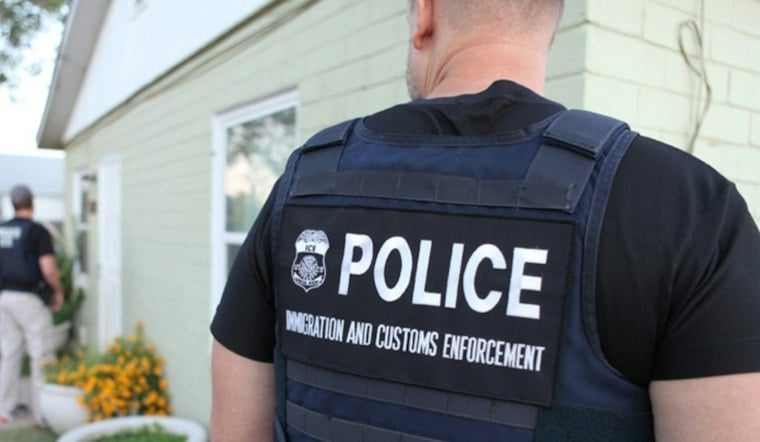
The Houston Chronicle reports that President Trump permitted ICE arrests in hospitals and other previously protected spaces after taking office, a shift reflected in federal policy. The Department of Homeland Security issued a directive effective January 20, 2025, titled Enforcement Actions in or Near Protected Areas, which superseded and rescinded a 2021 memorandum restricting enforcement near hospitals and similar sites, according to the U.S. Department of Homeland Security. U.S. Immigration and Customs Enforcement's own page on the policy confirms the same change.
The White House and DHS dismissed the study's findings, according to the Houston Chronicle's reporting, with both saying immigration enforcement authorities do not target hospitals. White House spokesperson Lauren Bis said ICE does not conduct operations at hospitals and blamed media falsehoods for instilling fear in immigrants seeking emergency care, the Chronicle reports. Bis also said assaults against ICE law enforcement officers had increased by more than 1,600%, according to the same reporting. An unnamed DHS spokesperson called the study a political stunt that created a false narrative and demonized law enforcement, while a DHS spokesperson separately said the administration would not restrict law enforcement from using judgment in public-safety situations, per the Chronicle. ICE directed questions about the research to DHS, the paper notes.
Federal Law Still Requires Treatment
Civil rights groups have raised concerns that ICE activity has a chilling effect on medical care, according to the Chronicle's reporting, which also notes that federal law requires emergency departments to evaluate and stabilize patients with emergency medical conditions regardless of immigration status or ability to pay. Harris Health, which oversees Ben Taub Hospital, deferred comment to Baylor College of Medicine, which did not immediately respond to a request for comment, the Chronicle reports.
The Chronicle's reporting also describes two Houston-area cases involving immigration enforcement and construction workers: ICE officers killed 52-year-old construction worker Lorenzo Salgado Araujo in Houston's East End, and ICE officers broke 48-year-old construction worker Miguel Parra-Hernandez's leg in a vehicle collision in west Houston, after which Parra-Hernandez was hospitalized for days while in ICE custody. Separately, ICE arrested an Ecuadorian mother and daughter at a hospital in Poinciana, Florida, after a car crash in August, according to The Guardian.
A Pattern Playing Out Nationally
The Houston and San Francisco findings echo a broader national pattern. A study of three Los Angeles County safety-net hospitals found fewer emergency-department visits among foreign-born patients after a federal immigration-enforcement operation, with reductions exceeding 20% during the first four weeks before roughly halving to about 10%, Fierce Healthcare reports. Neither that study nor the Houston-San Francisco survey identified participants' immigration status directly; both relied on proxies such as preferred spoken language, and the hospital study did not measure or account for the acuity of patients' encounters, according to Fierce Healthcare.
Other data points to similar strain elsewhere. The share of immigrant adults who skipped or postponed health care in the prior year rose from 22% in 2023 to 29% in 2025, according to a KFF survey conducted with The New York Times. Among likely undocumented immigrant adults, 48% said they or a family member had avoided medical care since January 2025 because of immigration-related concerns, KFF separately found. In Texas, ICE arrests of immigrants without criminal records surged during Trump's first year in office, and the Houston Chronicle's own tracking shows Texas accounted for roughly a third of all U.S. ICE arrests in July 2026, with just 26% of those arrested having an existing criminal conviction, down from 48% in February 2025.
Molina urged patients not to delay emergency care, warning that immigration-related fears could lead to serious health consequences, according to the Chronicle's reporting. She said that if ICE entered an emergency department, hospital protocols would involve notifying leadership and connecting patients to legal and social services, and she encouraged patients to contact community organizations for help understanding their health care rights. The study's authors recommended making emergency departments seem safe and accessible to reduce avoidance of care among Spanish-speaking Latinos, and they called for future research examining how that could be achieved, the Chronicle reports.





