

























































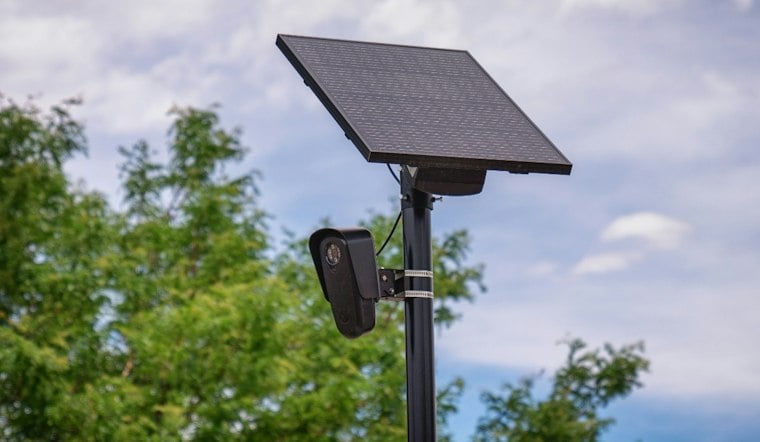
A carjacking victim’s stolen Honda sedan — spray-painted black in an apparent bid to dodge detection — was spotted by a Flock camera in a high school parking lot early Wednesday, leading Aurora Police to four male juveniles after the car fled a traffic stop, ran a stop sign, and crashed into another vehicle.
According to the Aurora Police Department
, officers responded to a reported carjacking just before 4 a.m. on September 29. The victim’s son told officers the suspect displayed a handgun, threatened the victim, and took off in the family’s Honda sedan. Police entered the car’s information into their system as stolen that same day.
The following day, a Flock camera positioned in a high school parking lot detected the Honda, even though the vehicle had reportedly been spray-painted black, per police observation, in what appeared to be an attempt to conceal it. Officers located the car near East Mississippi Avenue and South Chambers Road, but it fled during an attempted traffic stop, ran a stop sign, and crashed into another vehicle. No injuries were reported in the crash. Four male juveniles, described by police as students who attend the high school where the camera first flagged the vehicle, were taken into custody.
Police Point to Camera as Case-Closer
Aurora Police said the Flock camera helped prevent further victimization and allowed the case to close before anyone else was hurt, framing student safety as central to the technology’s presence on campus. The department also said it has built in safeguards meant to protect the privacy of students and the public, pointing to information it has published alongside the incident.
The episode is the latest flashpoint in a monthslong debate over Aurora’s expanding camera network. In September 2025, the department installed Flock automated license-plate readers at nine high schools spanning two school districts, but Cherry Creek Schools removed its four cameras in May 2026 after discovering former leadership had only given verbal approval, not a formal agreement, according to the Denver Gazette. That left five cameras operating at Aurora Public Schools high schools under a two-year contract at no cost to the district.
Cameras Feed Into Citywide Command Hub
Those school-based readers aren’t standalone devices. Aurora Police folded its school and citywide Flock network into a centralized Real Time Information Center in November 2025, merging plate readers, municipal camera feeds, and live drone video through Axon’s Fusus software — a setup Hoodline has previously detailed, allowing officers and analysts to track unfolding crimes in real time across city lines.
23rd Judicial District Attorney George Brauchler has publicly defended putting the cameras in school parking lots, calling the technology a “no-brainer” for regulating who enters campus and protecting students in a state with a history of school shootings, the Denver Gazette reported. Prosecutorial leadership has emphasized what it describes as a heightened government obligation to monitor access to public school property.
Civil Liberties Groups Push Back
Not everyone is convinced. The ACLU of Colorado and advocacy groups including Movimiento Poder criticized the high school installations in September, arguing that mass surveillance at majority-minority schools criminalizes young people and deepens anxiety tied to federal immigration enforcement, according to Sentinel Colorado. Opponents have noted the cameras remain in place at Aurora Public Schools, where many students are Black, Latino, or from immigrant families.
Those concerns surface against a backdrop of stalled statewide oversight. Bipartisan Senate Bill 26-070, known as the PEEPS Act, would have capped automated license plate reader data retention at 30 days and required warrants for location history older than 72 hours, but it failed to advance in April 2026 after law enforcement groups argued the mandates would hamper investigations, per the Boulder Reporting Lab. In the absence of LPR-specific rules, Colorado Revised Statutes § 24-72-113 still requires that passive government surveillance footage be destroyed within three years unless tied to an active criminal investigation.
The risks of automated misidentification aren’t purely theoretical. A single-character typo by Aurora Police — a number “1” entered instead of the letter “I” when logging a stolen vehicle in 2023 — led Jefferson County deputies to carry out an armed felony stop on an innocent driver after a Flock alert in August 2025, 9NEWS reported in April 2026. Sentinel Colorado has also pointed to an internal audit at the neighboring Thornton Police Department in April 2026 that found only 1% of one officer’s Flock searches were tied to specific case numbers, while a large portion lacked documentation; the audit found no evidence of misuse.
Citywide Numbers Police Cite as Context
Police leadership has tied the broader camera and drone push to citywide crime trends. Statewide, motor vehicle thefts fell 36% through May 2026 compared to the same period in 2025, with the Metro Denver region seeing a 39% drop, according to data released by the Colorado Department of Public Safety.





