

























































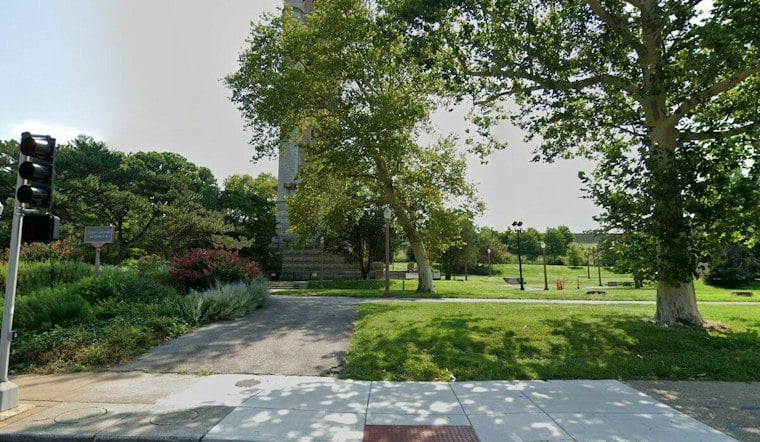
Vertical cracks are spreading across the limestone face of the Compton Hill Water Tower, letting water seep into a structure that has stood near Grand and Russell in St. Louis for 128 years. The 179-foot tower, open for tours every Saturday from April to November, is now the focus of an urgent campaign to raise roughly $8 million over three years before deterioration goes any further.
The effort is being led by the Water Tower & Park Preservation Society, the same volunteer-driven group that organized a $19 million restoration of the tower in 1999 after the city considered demolishing it, according to the City of St. Louis. That earlier rescue came after the tower sat unused since 1984, when asbestos was discovered in its interior tank wrapping. This time, as reported by St. Louis Magazine, the society hopes to recruit volunteers with experience in fundraising, grant writing, design, and construction to help make the case to neighbors, corporate donors, and public agencies alike.
Restoration will require a substantial fundraising effort and broad public support.
Cracks in the Tower’s Limestone
Vertical cracking in the façade allows water to penetrate the masonry. In winter freeze-thaw cycles, moisture trapped in the masonry can expand as it freezes.
Cracking remains a concern at the tower. Preconstruction expenses and construction documents would be needed before full restoration work could begin.
A Romanesque Landmark Built to Tame Water Pressure
Designed by architect Harvey Ellis, who also designed St. Louis City Hall, while working for George R. Mann's firm, the tower was built as an ornate Romanesque Revival masonry enclosure around an internal iron standpipe, according to the Water Tower & Park Preservation Society. Finished in 1898 at a cost of roughly $48,000, its rusticated Indiana limestone, buff brick, and Alabama terra cotta ornamentation wrapped a purely functional piece of 19th-century plumbing: the standpipe absorbed hydraulic pressure surges from reciprocating steam pumps, keeping water mains across south St. Louis from bursting. It was decommissioned from that role in 1929 once modern pumping equipment took over, and the St. Louis Water Division later used it for antennas until 1984.
The tower's 198 iron spiral steps once led the public to a top observation deck; during the 1904 World's Fair, more than 5,000 visitors climbed to the top to take in views over Reservoir Park, according to Atlas Obscura. The tower was designated a St. Louis City Landmark in 1966 and added to the National Register of Historic Places in 1972 for its architectural and engineering significance, per the City of St. Louis. It stands inside the 36-acre Compton Hill Reservoir Park, which still surrounds an active 28-million-gallon city reservoir and also holds The Naked Truth, a 1914 bronze memorial to German-American newspaper editors, according to Wikipedia.
St. Louis is home to three of the nation's seven surviving 19th-century standpipe water towers — Compton Hill, the 1871 Grand Avenue Water Tower, and the 1886 Bissell Street Water Tower — giving the city the highest concentration of these structures anywhere in the country, according to Distilled History. The other four remaining standpipes are in Chicago, Louisville, Milwaukee, and New York.
Building Support for the Restoration
The preservation society is seeking support from neighbors, donors, and public agencies for the tower's restoration.





