

























































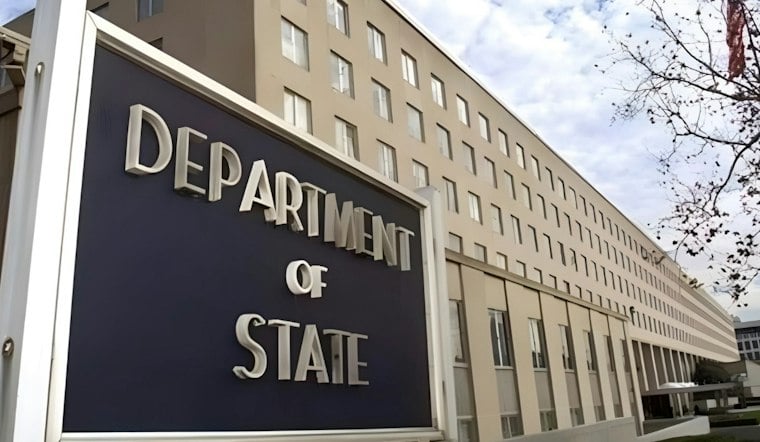
The State Department says it has taken steps to impose visa restrictions on more than 15 people accused of organizing, facilitating, or promoting recent migrant caravans working their way through Central America and Mexico toward the U.S. southern border. The announcement comes as a caravan calling itself Fe y Esperanza 2 continues moving along the Chiapas coast, weeks after an earlier group bearing a similar name was dispersed by Mexican authorities.
Visa Crackdown Targets Unnamed Organizers
According to the U.S. Department of State, the agency took steps during the previous week to impose the restrictions, saying investigations found that the targeted individuals had recruited, coordinated, and directed large groups of migrants. As reported by Newsweek, the department did not disclose the names, nationalities, or locations of those targeted, nor did it identify which caravans they were allegedly connected to. State Department spokesperson Tommy Pigott said in a statement that visa applicants or travelers covered by the restrictions may face additional scrutiny, which could include refusing or revoking their visas.
The department has not said whether the restrictions are connected to either of the two caravans that have drawn attention in recent weeks, or to other regional migrant movements, the same report notes. It also has not disclosed the evidence used to identify the targets or whether Mexican or Central American governments assisted in the investigations, leaving much of the action's scope undefined even as it takes effect.
From San Pedro Sula to Tapachula
The first of the two recent caravans, named Fe y Esperanza, left San Pedro Sula, Honduras on September 20 and traveled through Guatemala before reaching southern Mexico. More than 600 people were left in Tapachula, near the Guatemala border, by September 27, according to EFE as cited in the Newsweek report. Mexican immigration authorities intervened after the caravan reached Arriaga, Chiapas, near the Oaxaca border, and some members accepted transfer to Tuxtla Gutiérrez to complete immigration procedures — an intervention that, per La Jornada, effectively dispersed the group.
That dispersal fits a broader pattern described by regional researchers: about 20 caravans have tried to leave Mexico's southern border since President Claudia Sheinbaum took office in October 2024, according to La Jornada San Luis, but none had succeeded, having instead been broken up somewhere between Chiapas and Oaxaca. A separate La Jornada report also covered migrant caravans in Mexico.
A Second Group Forms and Renames Itself
A second caravan left San Pedro Sula on October 13 and began entering Mexico in separate groups two days later. An initial group of roughly 200 people crossed the Rodolfo Robles International Bridge from Guatemala into Suchiate, Chiapas, on October 15 and headed for Tapachula, with migrants initially calling the group Sin Fronteras. Another contingent, composed largely of Hondurans who had also traveled from San Pedro Sula, crossed into Mexico and joined the group in Tapachula on October 17, according to El Orbe. By October 18, roughly 400 people had gathered in Tapachula's Parque Bicentenario, and the caravan delayed its planned departure while awaiting additional migrants arriving from Guatemala, the same outlet reported.
The group ultimately left Tapachula on October 20 with more than 600 people, mostly from Central America, according to La Jornada, renaming itself Fe y Esperanza 2 and linking itself to the caravan that had departed Honduras the previous month. The group headed onto the coastal highway under the watch of state police, the National Guard, and Mexico's National Migration Institute, taking Highway 200 along the Pacific route, according to the Associated Press. Its first planned stop was Huehuetán, about 25 kilometers away, per La Jornada.
Numbers Shrink, Injuries Reported
By October 28, reports estimated Fe y Esperanza 2 had shrunk to around 500 members, according to La Jornada Estado de México, down from the more than 600 who had departed Tapachula. The outlet also reported that the caravan had accumulated at least four people injured in separate clashes along the Chiapas coast. Members have asked the Sheinbaum government for transit permits to travel by bus toward northern Mexico, the Associated Press reported, with some hoping to eventually reach the United States while others planned to remain in Mexico and seek work in Oaxaca and Monterrey.
The pattern of negotiated transfers has repeated itself with the earlier caravan as well. Mexico's National Institute of Migration offered members of that group transit permits and bus transfers toward northern Mexico, and more than 100 migrants accepted, traveling on five buses from Arriaga to Tuxtla Gutiérrez, according to the Observatorio de Política Migratoria y Derechos Humanos at El Colegio de la Frontera Norte. La Jornada reported that most migrants in that earlier group accepted a similar offer, while a small group pressed on independently.
A Policy Rooted in a 2025 Announcement
The visa restrictions trace back to a policy Secretary of State Marco Rubio announced on March 5, 2025, targeting foreign government officials and others accused of knowingly facilitating illegal immigration into the United States. That policy, per the State Department's own announcement, relies on authority to deem a foreign national inadmissible if their entry into the country would carry serious adverse foreign-policy consequences. It covers immigration and customs officials, airport authorities, and port authorities accused of failing to enforce immigration laws or of facilitating migrant travel toward the U.S. southern border, and can apply to people believed to knowingly organize, promote, support, or finance caravans that facilitate illegal immigration. The announcement does not define what counts as support for a caravan, including whether humanitarian or legal assistance could be covered.
The White House referred Newsweek to the State Department's announcement when asked for further comment, and Newsweek said it had contacted the State Department, the Department of Homeland Security, and U.S. Customs and Border Protection and was awaiting responses. DHS has previously told the outlet that U.S. Border Patrol monitors caravan movements and further developments.
Caravans Remain a Small Slice of Overall Migration
Caravans have become a recurring feature of regional migration, though researchers caution they represent only a fraction of the broader picture. A study from Rice University's Baker Institute for Public Policy identified 30 migrant caravans detected in Mexico between 2017 and the end of 2022, a number that grew sharply over time: one formed in 2017, one in 2018, three in 2019, three in 2020, eight in 2021, and 14 in 2022 alone. The same Baker Institute research found that caravan sizes have grown over the years, from smaller groups numbering in the hundreds to larger mass movements in the thousands, with most identified caravans originating in San Pedro Sula, Honduras, or in southern Mexico itself. Researchers noted that caravans became more frequent during the border surge that ran from 2020 through late 2024, and that punitive immigration policies may discourage caravan formation and movement while more permissive policies may encourage it.
Despite the attention caravans draw, Baker Institute researchers said they represent only a small share of overall migration, even amid significant political and media focus. They also noted that traveling in groups can offer migrants greater safety on journeys spanning hundreds of miles, a dynamic that helps explain why caravans keep forming even after previous attempts have been broken up along the same stretch of southern Mexico.





