

























































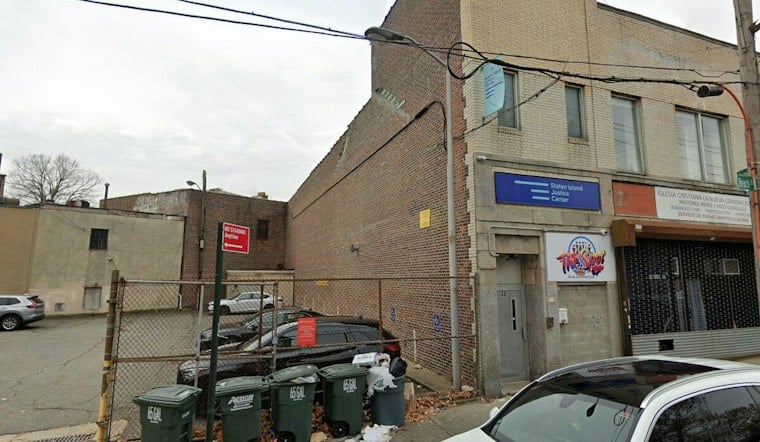
Staten Island is finally getting a community justice center of its own, with New York State committing $15 million to convert a century-old former courthouse in Stapleton into a hub for diversion programs, youth mentoring and social services. The announcement brings combined government investment in the project at 67 Targee Street to $20 million, layering the state's new funding atop a $5 million city capital grant secured two years earlier.
A Historic Courthouse Gets New Purpose
Governor Kathy Hochul announced the $15 million state allocation, according to amNewYork, which reported that the funding will transform the former criminal courthouse at 67 Targee St. into a permanent community justice center. The building dates to the 1920s and was originally erected as the Richmond County Criminal Courthouse, designed by the architectural firm Sibley & Fetherston, according to the NYC Department of Citywide Administrative Services, which notes the same firm designed Staten Island's Civil and Family Courthouses as well, with Sibley & Fetherston credited with three classically inspired courthouses built across the borough between 1920 and 1940.
The $5 million in city funding behind the project was secured by City Councilmember Kamillah Hanks from the city council, per amNewYork's reporting, with the combined $20 million commitment confirmed by NYC.gov. That earlier city allocation was celebrated by Mayor Eric Adams and Hanks in July 2024, well before the state money arrived this week to push the total funding package over the finish line.
Closing a Borough-Wide Gap
Staten Island has been the only New York City borough without a permanent community justice center, a gap that amNewYork's report underscores given the borough's roughly one-half million residents. Richmond County District Attorney Michael McMahon said Staten Island was the only borough without a community justice center underway, per the same outlet's account, and he commended Hochul for investing in justice and public safety strategies.
Before this funding came together, the Center for Justice Innovation was already running diversion and alternatives-to-incarceration programs on the borough from an interim office at 30 Beach Street in Stapleton, according to the Office of the District Attorney Richmond County. That interim site has offered short-term social service options, driver accountability programs and clinical assessments, the same office notes, meaning the new facility centralizes services that already existed rather than creating them from scratch.
What the New Center Will Offer
Once operational, the new community justice center will provide trauma-informed, culturally responsive screening, assessment, case management and referrals, per amNewYork's reporting, including referrals for mental health, substance use, housing and employment services. The center is also expected to serve as a permanent location for youth diversion, mentorship, violence prevention and victims services, bringing together government agencies and nonprofits under one roof.
That mission builds on three decades of work by the Center for Justice Innovation, which launched the nation's first community court in Midtown Manhattan in 1993 and opened the Red Hook Community Justice Center in Brooklyn in 2000, according to the organization's own account. Community courts of this kind combine multi-jurisdictional dispute resolution, social services and alternative sentencing focused on treatment, the group says.
Locally, the Center for Justice Innovation already supports “The Spot” Family Enrichment Center in Stapleton, a resident-led hub that provides emergency food, clothing and household goods to roughly 100 neighborhood families each week. The organization describes Family Enrichment Centers as operating outside traditional court frameworks to strengthen community-based support systems, a model it says complements the court-focused services planned for 67 Targee Street.
Officials React to the Funding
Hochul framed the investment around crime reduction, saying, “Public safety is my top priority. Keeping communities safe means ensuring that every corner of New York has the resources necessary to drive down crime,” according to amNewYork's report. The governor's office also credited State Senator Jessica Scarcella-Spanton and Assemblymember Charles Fall with leading legislative advocacy in Albany to secure the $15 million allocation for Staten Island's North Shore.
Scarcella-Spanton credited Hochul, McMahon and Hanks with advancing the project, and said it should include programming that addresses the root causes of public safety issues, per amNewYork. McMahon, for his part, said the $15 million state funding builds upon the city's earlier $5 million investment.
State judicial leadership has also been involved in reviving the long-vacant building. New York State Chief Judge Rowan D. Wilson joined McMahon and borough officials in June 2024 for a walkthrough of the then-vacant 67 Targee Street facility to highlight needed structural renovations, according to the District Attorney's office, a visit that brought together state judicial leadership, city agency officials and local representatives to build support across levels of government.
A Lower-Crime Borough Bets on Diversion
The push for court-based diversion programming comes as Richmond County's DA has emphasized the borough's public safety record. McMahon reported in 2025 that Staten Island consistently maintains the lowest major violent crime rates and shortest arrest-to-arraignment times among New York City's five boroughs, according to his office, with local prosecutorial strategy focused on early diversion and court-monitored intervention for nonviolent offenders.
Despite the funding milestone, several practical details remain unresolved. State executive announcements in October did not specify a construction start date, target completion timeline or operating budget for converting the 67 Targee Street building, according to the Utica Phoenix. The outlet notes that government capital grants typically require formal architectural design, bidding and extensive renovation phases before a facility like this one can open to the public.





