

























































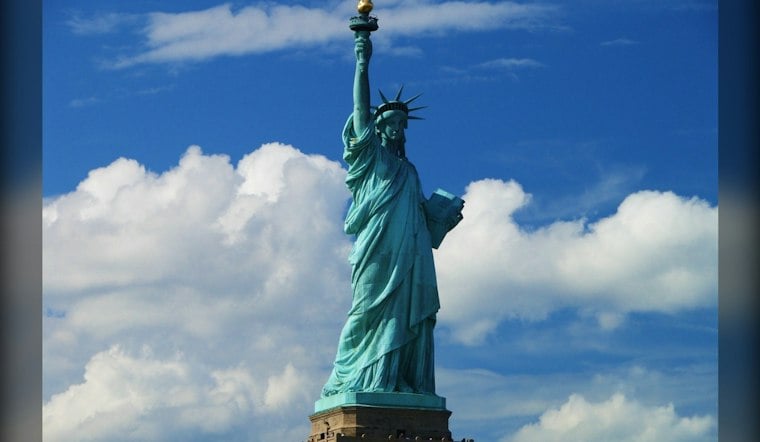
The Statue of Liberty marked 140 years since its dedication on Wednesday, a milestone for the copper-clad figure that has anchored New York Harbor since President Grover Cleveland presided over her unveiling on October 28, 1886. Designed by French sculptor Frédéric Auguste Bartholdi in collaboration with engineer Gustave Eiffel, the statue was a gift to the United States from the people of France, and it remains one of the world's most iconic landmarks.
That anniversary, as reported by Spectrum News NY1, carries extra weight for Peter Lehrer, who helped lead the statue's massive 1980s restoration. Lehrer has called the project the construction work he is most proud of, and he told the outlet that without the renovation, the statue might have suffered a catastrophic collapse.
Lehrer's firm received the contract to restore and repair the statue, a job the company's leadership once described, per Urban Omnibus, as “the job of a lifetime.” Lehrer McGovern won that contract in 1983, and the firm spent two years completely renovating the statue ahead of its 1986 centennial, according to the same account.
Rebuilding Without a Blueprint
There was no existing plan to follow, Lehrer said, so his team worked out how to proceed as they went. Inside the statue, the original iron ribs and armatures had deteriorated over time, and the restoration plan called for replacing them with stainless steel ribs fitted with copper saddles and rivets, according to Architectural Record.
Per the NY1 account of Lehrer's recollections, the statue contained roughly 1,700 steel bars intended to stabilize it, and the restoration team removed just three at a time to avoid destabilizing the structure. Workers built a small factory on the island and heated steel to mold exact replicas of the bars being replaced, the station reported.
Outside, crews had to erect scaffolding around the statue without touching it, since Lehrer said high winds could have caused the scaffolding itself to damage the monument. The restoration plan separately called for removing seven layers of paint from the copper using liquid nitrogen, Architectural Record reported, while NY1's account describes the team using liquid nitrogen inside the statue to remove a layer of paint and baking soda to remove tar that had built up behind it, after years of water damage. Almost 1,000 laborers ultimately took part in the broader restoration effort, according to the Statue of Liberty-Ellis Island Foundation.
A Personal Connection to the Harbor
For Lehrer, the project carried a family dimension. His father immigrated from Germany and arrived in the United States in 1913, more than a century before the article was published, and after the restoration was completed, Lehrer took his father to see the statue. His father was very proud, Lehrer said.
That kind of connection echoes the statue's broader role as a gateway for newcomers. About 12 million immigrants passed the Statue of Liberty on their way to Ellis Island between 1894 and 1952, according to the National Park Service.
Reagan's Rededication and a Modern Milestone
The restoration culminated in 1986, when President Ronald Reagan presided over the statue's rededication, according to the Smithsonian Institution. Reagan traveled to New York City to help light the statue's new torch, declaring, “We too dare to hope, hope that our children will always find here the land of liberty in a land that is free.”
Four decades later, the Statue of Liberty has anchored New York City for 140 years, a run that spans Lehrer's unplanned rebuild, Reagan's torch-lighting, and the generations of immigrants the monument has greeted since 1886.





