

























































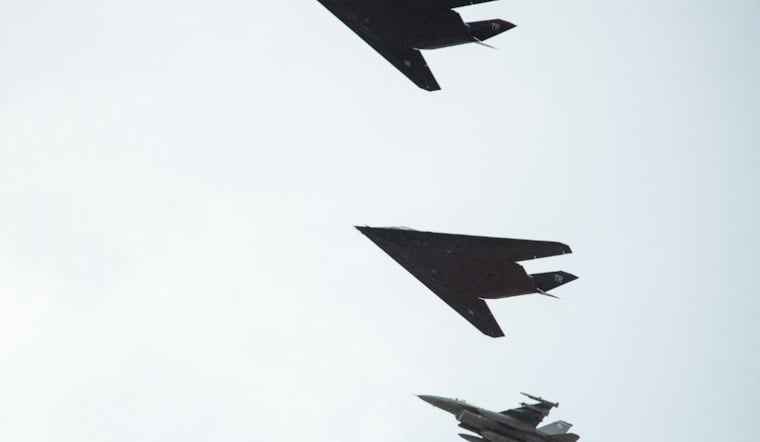
A boxy, all-black jet with a wide body and a V-shaped tail now sits permanently inside the Steven F. Udvar-Hazy Center in Chantilly, having flown combat missions long before most visitors walking past its display case were even born. The Lockheed F-117 Nighthawk, nicknamed The Overachiever, officially joined the Smithsonian's National Air and Space Museum collection this month, capping a journey that began in the California desert and ended with the jet stripped of its most secret parts.
From Skunk Works to the Smithsonian
The museum describes the F-117 as the world's first true operational stealth combat aircraft, according to the National Air and Space Museum. The aircraft now welcomed into the collection is the same jet nicknamed The Overachiever, and the museum says it was the only F-117 flown in all four major conflicts involving Nighthawk combat operations. The exhibit debuted at Udvar-Hazy on October 21, as reported by Air & Space Forces Magazine.
Getting it there was its own operation. An Air Force Reserve crew delivered the F-117A to the Smithsonian on October 6, according to WJLA. Per Northern Virginia Magazine, the jet was transported from Lockheed Martin's Skunk Works facility in Palmdale, California, loaded onto a C-5 Galaxy cargo plane, and flown to Dulles. WTOP News reports that Senior Airman Lucas Richard was part of the Air Force transport team and expressed happiness at being part of the crew that moved the aircraft.
Stripping Away the Secrets
Before the jet could go on public view, workers had to erase much of what made it a weapon of the Cold War. Lockheed Martin removed classified parts of the F-117 in California, and according to WTOP, the aircraft's radar-absorbing material coating remains classified to this day. Michael Hankins, a curator with the aeronautics department at the National Air and Space Museum, told WTOP that the coating had to be stripped specifically because it remains classified, even decades after the jet's combat service ended.
The same outlet notes the demilitarization process also involved removing classified technical components from inside the cockpit, a step the station's report says was necessary before the jet could be handed over for exhibition. Despite that stripping-down, about 95 percent of the avionics are reportedly still inside the aircraft. Northern Virginia Magazine adds that the radar-absorbent coating was sand-blasted off and that sharp edges were replaced with replica parts, even as the jet was retrofitted to look exactly as it originally did. The entire demilitarization effort took more than 10,000 hours, the magazine reports.
A Jet Built to Disappear
The F-117 traces its design back to the 1970s, when it was conceived to give the United States an edge against the Soviet Union, according to Air & Space Forces Magazine. WTOP reports the jet was designed as the first manned aircraft intended to go undetected by enemies, using a shape built from sharp lines and flat panels in geometric forms with almost no curvature, since its designers were limited by the computing power available at the time to model anything curved. That angular design let the aircraft absorb or deflect radar waves and make detection difficult, the station reports, and it went into service in the early 1980s without being officially acknowledged by the Air Force until 1988, per the same aviation trade outlet.
Hankins told WTOP that the aircraft's stealth design helped it enter heavily defended areas, destroy key targets, and reduce risk for less-stealthy aircraft flying alongside it. The Smithsonian's own account describes that same capability in similar terms, noting the jet could penetrate undetected into enemy territory and launch attacks on key strategic targets. WTOP reports the Nighthawk flew in four engagements stretching from Panama to Operation Desert Storm and back to Iraq in 2003.
Retirement, With a Few Loose Threads
Accounts differ on exactly when the F-117 fleet left service. Air & Space Forces Magazine reports the Air Force officially retired its F-117 fleet in 2008, while WJLA reports the aircraft retired in 2007. WTOP, for its part, reports the jet was retired from combat use in 2008.
This is not the only Nighthawk sitting in a museum case. Other F-117s are already on display at the Museum of the U.S. Air Force in Dayton and the Ronald Reagan Presidential Library and Museum in Simi Valley, according to Air & Space Forces Magazine. But The Overachiever's record as the only F-117 flown across all four of the aircraft's major conflicts gives the Chantilly jet a distinction none of its sibling airframes can claim, cementing its place as a centerpiece of the Udvar-Hazy Center's collection for visitors who want to stand in front of a machine once built never to be seen at all.


