

























































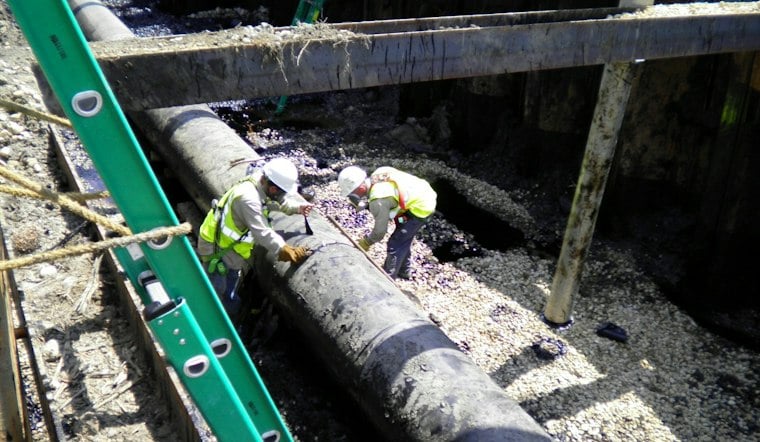
A crude oil spill at a commercial intersection in Sterling Heights has triggered a nationwide federal investigation into the safety of Energy Transfer's pipeline network, after regulators found the leak occurred at a repair sleeve the company could not produce records for. The spill, which seeped into a storm sewer near Mound Road and 18 Mile Road, prompted the federal Pipeline and Hazardous Materials Safety Administration to order Energy Transfer to shut down a 16-mile segment of pipeline and begin a sweeping review of repairs across its entire hazardous liquids system.
Accounts of the spill's size differ. According to Inside Climate News, the release totaled 600 gallons of crude oil, while C&G News reported a local estimate of around 100 gallons surfacing near the intersection. The pipeline involved is a 16-inch crude oil line running through the city, part of what Inside Climate News describes as a 59-year-old, 130-mile pipeline connecting Marysville, Michigan, to Toledo, Ohio, built in 1967. A member of the public spotted oil seeping into a storm drain and alerted the local fire department, which in turn notified Energy Transfer and the National Response Center.
City officials said at the time that the leak posed no danger to nearby residents and homes, and response crews worked to keep oil out of city and county storm drains, per the same account. The Michigan Department of Environment, Great Lakes, and Energy mobilized to the site and worked alongside the company and first responders on containment and cleanup. Crews later used a vactor truck to remove standing oil from the road and catch basins, and impacted soils were excavated and hauled to a landfill for disposal.
A Sleeve With No Paper Trail
PHMSA's investigation traced the failure to a steel encasement sleeve welded onto the pipeline in 2010 to repair a defect, and the agency said the spill evaded Energy Transfer's leak detection systems before a passerby noticed the oil. The federal order, signed by PHMSA official Paul Roberti on September 21, 2026, came three days after the spill was discovered and was issued without prior notice or a hearing opportunity because of the risk of serious harm, the report states. PHMSA directed Energy Transfer to shut down the 16-mile segment at the spill site; the line restarted the next day at reduced pressure.
What alarmed regulators most, according to the report, was that Energy Transfer could not locate the original records for the Sterling Heights sleeve, nor could it verify the integrity of 11 other sleeves along the same Marysville-to-Toledo pipeline. The company also told PHMSA it was unable to find records for four of the 45 repair sleeves along its separate Twin Oaks pipeline in Pennsylvania. PHMSA identified failures beneath at least two repair sleeves total, each showing indications of improper installation.
PHMSA's order now requires Energy Transfer to submit, within 90 days, a nationwide inventory of past repairs and a plan to remediate vulnerabilities across its roughly 20,000 miles of crude oil, refined product, and natural gas liquids pipelines, a figure the company cites on its own website per Inside Climate News. Within six months, the company must also deliver a plan to evaluate the integrity of every steel encirclement sleeve on the network and remediate any weaknesses found, with removal required for any sleeve whose integrity cannot be reasonably assured. The order applies broadly to any hazardous liquid pipeline facility owned or operated by Energy Transfer, its subsidiaries, and related entities. Energy Transfer has requested a hearing on the order, but none had been scheduled as of the report.
An Echo of a Pennsylvania Leak
The Sterling Heights failure is not an isolated case in Energy Transfer's portfolio. A similar encasement sleeve failure caused a jet fuel leak last year on the company's Twin Oaks pipeline in Pennsylvania, contaminating the drinking water source of a residential neighborhood north of Philadelphia. That Pennsylvania line had leaked for at least 16 months before it was discovered, according to The Philadelphia Inquirer, while residents reported a gasoline smell and taste in their water. Six wells tested above drinking-water standards for petroleum products, and five more showed detectable contaminants below statewide health standards, per the Inquirer's reporting. Sunoco reported to PHMSA that 156 barrels of jet fuel had leaked through a slow drip in the pipe before it was repaired with a sleeve.
Pennsylvania's Department of Environmental Protection ordered Energy Transfer to supply bottled water to affected residents and to install and monitor well filters, the Inquirer reported, and the state Attorney General's environmental crimes section opened an investigation into the spill. Separately, Bucks County Herald reported that Sunoco Pipeline LP won approval to drill recovery wells in Upper Makefield Township streets over the next decade to pull leaked jet fuel from the ground. Energy Transfer inherited both the Michigan and Pennsylvania pipelines in 2012, when it acquired Philadelphia-based Sunoco. The Inquirer also reported that Energy Transfer has been fined more than $48.1 million by Pennsylvania for violations tied to its Mariner East and Revolution pipelines.
Sleeves Under Scrutiny Nationwide
Type-A sleeves, the kind involved in some of these failures, remain a legal repair method, but PHMSA issued a nationwide advisory earlier this year warning that improperly installed or managed sleeves carry a heightened risk of corrosion and other integrity problems over time, the agency said in its bulletin. The advisory stopped short of restricting their use outright. The Sterling Heights order marks the only one of 23 corrective-action orders PHMSA has issued this year that addresses safety issues across an entire company's pipeline network, according to Inside Climate News, underscoring how unusual the agency considered this case.
Steel encirclement sleeves can also complicate the very inspections meant to catch problems like these, since magnetic flux leakage tools used in pipeline inspections are generally unable to assess defects hidden beneath the sleeves themselves. That blind spot is part of why missing installation records for aging repairs have drawn heightened attention from investigators working to understand how failures go undetected for years.





