

























































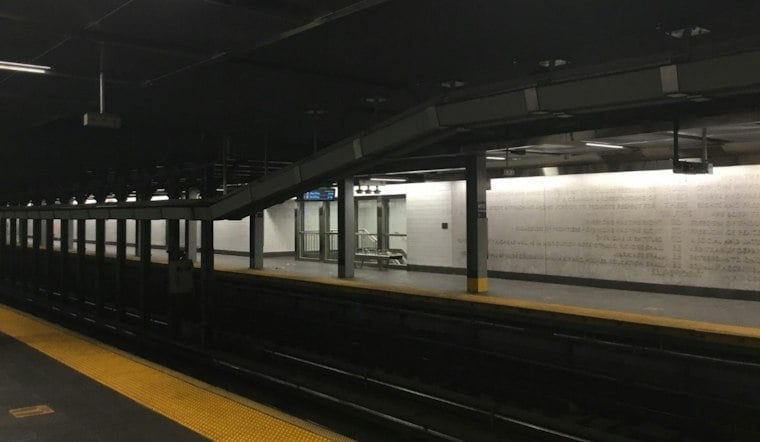
A 65-year-old man ended up on the subway tracks at the World Trade Center station in Lower Manhattan Saturday morning, and it was a handful of ordinary straphangers, not an elaborate rescue operation, who got him out before a train arrived. His foot had become wedged between the rail and the ground, leaving him stuck as a train approached the platform.
Jack Shanley, 27, told the New York Daily News he was waiting for the Uptown No. 1 train at the station around 11:30 a.m. when he spotted the man on the tracks and immediately called 911. As reported by the New York Daily News, Shanley said roughly five riders worked together to signal the incoming train operator to stop, and the train halted about 50 to 60 feet from where the man was trapped.
With the train stopped short, two people climbed down onto the tracks to help free the man, who could not get himself unstuck. Others then had to lift him back up to the platform because he was unable to climb out on his own, according to the same account relayed by Shanley.
Confusion in the Moment
Police said it was not immediately clear how the man ended up on the tracks in the first place. Shanley said the man appeared unaware that he had even fallen, telling bystanders he could not see what was going on around him.
“It was sort of crazy,” Shanley said. “It felt a little intense at the moment, but everyone sort of came together and saved the day, I guess.” Shanley, who was ultimately headed home to the Upper West Side, said the group's quick coordination was what kept the situation from turning dangerous.
A Recurring Scare Beneath the Streets
Saturday's rescue is the latest in a string of track incidents that have rattled New York subway riders in recent months. In late August, a woman was reportedly pushed onto the tracks in the Bronx, and a stranger stayed with her until FDNY and police arrived, according to NBC New York. Weeks later, two people were killed by a train in Lower Manhattan after one fell onto the tracks and the other tried to help, as the New York Daily News also reported.
Bystander rescues on subway tracks are not new to the city. Back in 2007, a 50-year-old construction worker jumped onto the tracks to save a man as a train approached, according to The New York Times, and in 2021 a passenger who collapsed on the tracks was pulled to safety moments before a train arrived, per Sky News.
MTA Pushes Barriers and AI Detection
The repeated close calls come as the MTA ramps up efforts to keep people off the tracks altogether. The agency had installed platform barriers at 158 subway stations by the end of June, adding 43 stations during 2026 alone, according to an MTA policy brief. At stations with barriers, accidental or unintentional track trespassing incidents have dropped by 11%, the agency reported.
The stakes for keeping riders off the tracks go beyond safety alone. The MTA's brief found that track-trespassing incidents this year have delayed customers a median of eight minutes, but incidents where someone was struck by a train delayed riders by more than an hour and 15 minutes on average, over nine times longer.
Track intrusions remain a persistent problem systemwide. The MTA recorded 1,297 unauthorized track entries in 2025, a 22% jump from 1,062 in 2019, and about 6% of all subway delays last year were blamed on a person or debris on the tracks, according to thecityreporter.nyc. Still, the outlet noted there were 491 track intrusions in the first four months of 2026, down slightly from 505 over the same stretch in 2025 and well below the 537 recorded in early 2022.
To address the problem with technology, the MTA is seeking a contractor to design, build and test an artificial intelligence-supported track-intrusion detection system at one underground and one elevated station, the same report states. The proposed two-year pilot at those two stations is estimated to cost between $10 million and $50 million.





