

























































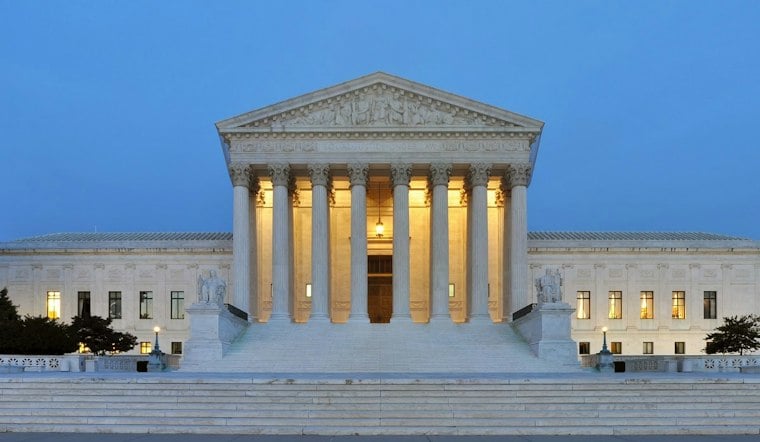
The U.S. Supreme Court has refused to revive an $8.2 million defamation verdict that Roy Moore, the former Alabama chief justice, once won against a Democratic-aligned super PAC over a 2017 Senate campaign advertisement. The decision leaves intact an appeals court ruling that wiped out the jury award entirely, closing the book on a years-long legal fight rooted in one of Alabama's most explosive political campaigns.
According to Sun Sentinel, justices declined to hear Moore's appeal, a move that keeps in place the decision by the Eleventh U.S. Circuit Court of Appeals erasing the jury's verdict. A federal jury had sided with Moore in 2022, awarding him $8.2 million in damages after finding he had been defamed by the ad. The appeals court later vacated that verdict after finding Moore failed to prove Senate Majority PAC acted with malice, according to the same report.
Senate Majority PAC funded the advertisement at the center of the case, along with a group called Highway 31, which ran an advertising blitz against Moore during his 2017 Senate race. Moore's attorneys argued the ad falsely implied he had been accused of soliciting sex from young girls at a shopping mall, through what NBC News described as the juxtaposition of statements and partial quotes from news articles. Moore's attorneys called the accusation a fabricated claim never made by any reporter, and they reported that the ad was broadcast into Alabama homes 533 times in the final days of the election, per Courthouse News.
How the Eleventh Circuit Undid the Jury's Verdict
The Eleventh Circuit's three-judge panel vacated the defamation verdict and ordered the trial judge to enter summary judgment in favor of Senate Majority PAC, NBC News reported. The panel found the PAC had made a “negligent error at best,” but added that such an error “is not a basis for a finding of actual malice” — the legal standard required in defamation cases involving public figures. Senate Majority PAC had argued throughout the litigation that the advertisement was truthful.
Moore sought emergency relief from the Supreme Court in June, asking justices to pause the Eleventh Circuit's decision while he pursued further review, but the court rejected that request at the time, according to Sun Sentinel's reporting. Monday's denial of certiorari closes off his remaining path to reinstating the verdict. The underlying Supreme Court order simply states that the petition for a writ of certiorari is denied.
The Allegations That Fueled the 2017 Campaign
The advertisement dispute traces back to accusations that first surfaced during Moore's 2017 Senate campaign. Leigh Corfman said Moore sexually touched her in 1979, when she was 14 and he was a 32-year-old assistant district attorney in Alabama; Moore has denied her accusation. Other women said separately that Moore dated them or asked them on dates when they were older teens, per NBC News. Moore, who has supported public displays of the Ten Commandments and opposed same-sex marriage, ultimately lost the 2017 race to Democrat Doug Jones, as The Hill noted.
The case's path — from a $4 million advertising blitz funded through Highway 31, as reported by NPR, to a jury verdict, to an appellate reversal, to the Supreme Court's refusal to intervene — spans nearly a decade of litigation. As KXAN Austin reported, the Associated Press credited Lindsay Whitehurst with contributing to its coverage from Washington on the ruling's final chapter.





