

























































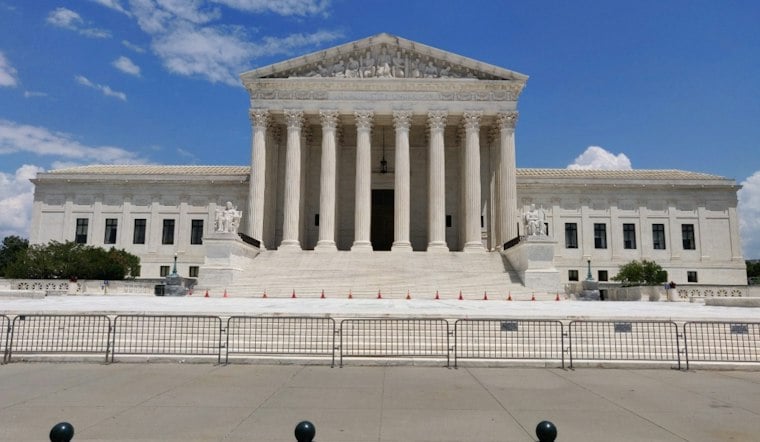
Ohio consumers could soon have far easier access to wine from out-of-state retailers after the U.S. Supreme Court declined to hear the state's appeal of a lower court ruling that struck down its shipping restrictions. The high court's order, issued Tuesday, leaves in place a Sixth Circuit decision finding that Ohio's rules unfairly favored in-state wine sellers over out-of-state competitors.
The case traces back to July 2020, when Ohio wine consumer Kenneth Miller and Chicago-area retailer House of Glunz Inc. sued the state over regulations that barred out-of-state wine retailers from shipping directly to Ohio consumers while allowing in-state retailers to do so, according to Cleveland.com. Miller later replaced original plaintiff Derek Block as the lead consumer in the suit, which named Ohio Division of Liquor Control Superintendent James Canepa as the defendant, per Courthouse News.
At the heart of the dispute were two Ohio rules: one barring out-of-state retailers from shipping wine directly into the state, and another capping how much wine a resident could personally transport in from elsewhere. Under Ohio Revised Code Section 4301.20(L), residents were limited to bringing in just six bottles of out-of-state wine every 30 days, while the same consumers could transport far larger quantities purchased from Ohio sellers, according to the Sixth Circuit's own opinion as cited by Justia Law. Out-of-state wineries, by contrast, were already permitted to ship up to 288 bottles a year to Ohio households under separate winery permits, a disparity the appeals court said undercut the state's reasoning.
How the Sixth Circuit Ruled
In May, the Sixth U.S. Circuit Court of Appeals ruled that the restrictions violated the dormant Commerce Clause, reversing U.S. District Judge Sara Morrison's 2022 decision that had sided with Ohio. Morrison had originally reasoned that controlling alcohol distribution and curbing over-consumption were legitimate state interests under the Twenty-first Amendment, a conclusion the Sixth Circuit rejected, as detailed by Courthouse News.
The appeals court found that Ohio failed to justify its restrictions with concrete public health or safety evidence, noting the state's own enforcement records showed only eight arrests and one citation for illegal alcohol transportation between July 2017 and July 2020 — and all of those involved spirits, not wine, according to the Libation Law Blog. Judges also pointed out that Ohio already allows various forms of direct wine shipments from out-of-state wineries, undermining the state's claims about product safety, tax collection, and preventing underage drinking. The panel directed Morrison to enter judgment for the plaintiffs and remanded the case so the district court could determine the appropriate remedy.
The Sixth Circuit's decision leaned on the U.S. Supreme Court's 2019 ruling in Tennessee Wine & Spirits Retailers Association v. Thomas, which held that state alcohol regulations violating the Commerce Clause cannot be shielded by the Twenty-first Amendment unless backed by real health and safety evidence, as explained in historical context from Casemine. That case built on the Supreme Court's 2005 decision in Granholm v. Heald, which first established that states cannot let in-state wineries ship directly to consumers while blocking out-of-state wineries from doing the same.
A Circuit Split the High Court Left Unresolved
Former Ohio Attorney General Dave Yost filed the Supreme Court appeal on his final day in office before leaving for a private organization, with successor D. Andrew Wilson left to oversee the state's petition through its conclusion, according to Wine-Searcher. The Supreme Court's October 13 order denying review means the Sixth Circuit's ruling stands, but it does not settle a broader national disagreement: other federal appeals courts have previously upheld state physical-presence requirements and shipping bans for out-of-state wine retailers, creating a direct circuit split that legal observers had expected might draw Supreme Court attention.
National Association of Wine Retailers Executive Director Tom Wark expressed disappointment that the national split remains unresolved, even while acknowledging that consumers across the Sixth Circuit's footprint — Ohio, Michigan, and Kentucky — will now gain broader access to out-of-state wine merchants, per the same Wine-Searcher report. Because the high court declined to step in, the fight over direct-to-consumer alcohol sales is likely to keep playing out state by state across the country.
What Comes Next for Ohio
With the case now back in the hands of the district court, Ohio faces a choice that industry watchers describe as leveling up or leveling down. The state could establish a permit system allowing out-of-state retailers to ship directly to Ohio consumers, extending the same privileges currently reserved for in-state sellers, or it could eliminate direct-to-consumer retail wine shipping altogether to equalize treatment.
Either way, Ohio must now treat in-state and out-of-state interests equally under the ruling. It remains an open question whether the Ohio General Assembly will pass new permitting legislation or whether the Division of Liquor Control will instead alter its administrative rules to comply, a question Wine-Searcher's coverage flagged as still unresolved heading into the district court's remedy process.





