

























































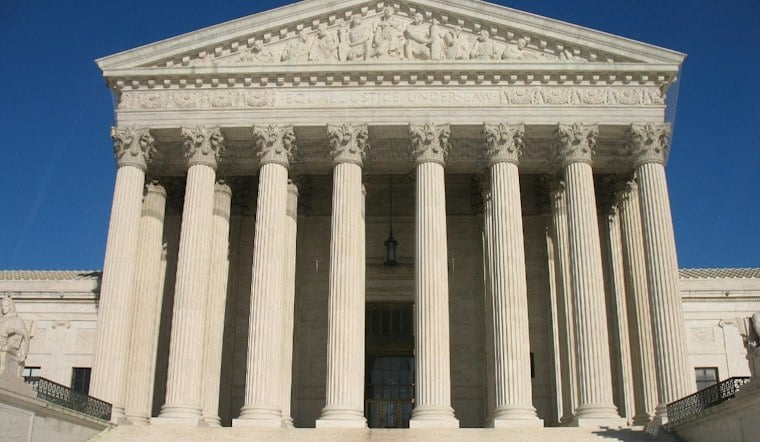
The U.S. Supreme Court has agreed to take up a case that asks a stark question: does being forced at gunpoint to cook roughly 8,000 meals for an armed group count as material support for terrorism? The man at the center of it, Nigerian citizen Izuchukwu Ozurumba, was already deported back to Nigeria last year even after a federal appeals court sided with him.
The Trump administration is appealing a ruling that found Ozurumba's cooking for a group called the Unknown Gunmen did not amount to material support for terrorism under U.S. immigration law, according to the Fort Worth Star-Telegram. The Supreme Court is expected to hear arguments and rule by the end of June 2027, per the same report. Solicitor General D. John Sauer represents the government in the appeal, while David Meir Zionts of Covington & Burling LLP serves as counsel of record for Ozurumba, according to the Supreme Court of the United States docket.
A Job Tip That Led to a Nightmare
Ozurumba traveled to a remote camp outside Lagos in 2022 after receiving a tip about a job, according to court papers cited by the Star-Telegram. He was hired to cook for members of the Unknown Gunmen at the camp — a group court papers describe as likely associated with Nigerian separatists. His lawyers say he noticed that the young men's movements from the camp coincided with news reports of murder and arson in the region, a pattern consistent with security assessments describing the Unknown Gunmen as a faction frequently associated with splinter elements of the Indigenous People of Biafra, which Nigerian authorities proscribed as a terrorist organization in 2017, according to a UK government report.
Ozurumba's lawyers say he was forced to stay at the camp without pay. He escaped after six months while on an outing for supplies, then fled to Venezuela after enduring beatings and death threats, the Star-Telegram reports. He entered the United States illegally at the southern border in July 2023 and applied for asylum and other protections from deportation.
An Immigration Judge Rules Against Him
An immigration judge deemed the Unknown Gunmen a terrorist organization and found that Ozurumba's cooking rendered him inadmissible, denying him protection from deportation. The judge concluded that cooking helped the group accomplish its goals by satisfying its basic human needs and considered it irrelevant that Ozurumba had worked under duress, according to the Star-Telegram's account of the case. Ozurumba was deported to Nigeria while his case remained on appeal.
Court filings reviewed in the appeal show Ozurumba prepared approximately 8,000 meals for leaders of the Unknown Gunmen using supplies the group purchased directly, all while held as an unpaid captive laborer, according to Justia Law. The filings indicate he attempted to quit once he realized the group was committing violent acts, but was forced to remain under threat of death.
4th Circuit Breaks With Precedent
In September 2025, the 4th U.S. Circuit Court of Appeals in Richmond, Virginia, ruled 2-1 that Ozurumba's cooking did not constitute material support for terrorism. The panel found that his work provided nothing the organization could use or readily divert to plan or carry out terrorist activities, and that he had been a captive laborer rather than a willing participant. Circuit Judge James A. Wynn authored the majority opinion, joined by Judge Nicole Berner, while Judge Julius “Jay” Richardson dissented — writing, in a characterization Justia Law's case record attributes to the dissent, that an army marches on its stomach.
The appeals court explicitly broke from the Board of Immigration Appeals' 2018 precedent in Matter of A-C-M-, which had held that even de minimis forced assistance — such as cooking or washing clothes for insurgents under death threats — triggers the terrorism bar, as detailed by legal analyst Sabrina Damast's review of the ruling. In its place, the 4th Circuit set a new standard: material support must be assistance that is sufficiently substantial standing alone to help a terrorist organization accomplish its terrorist activities, a higher evidentiary threshold than the BIA's prior approach, Damast's analysis notes.
The court leaned on the Supreme Court's 2024 ruling in Loper Bright Enterprises v. Raimondo, which eliminated Chevron deference across federal agencies, to conclude that federal courts no longer must defer to the Board of Immigration Appeals' interpretations of immigration law, according to a review published by Scholars Crossing. The 4th Circuit declined to order the government to return Ozurumba to the United States while the case proceeds, the Star-Telegram notes, leaving him in Nigeria even as he won on the merits.
The Government's Argument
The Justice Department has argued that providing meals to a terrorist organization's members is no less material support than providing gasoline for its vehicles, and has said that letting the lower court's ruling stand would substantially increase the burden on the government in excluding people with links to terrorism, per the Star-Telegram's reporting on the administration's appeal.
Underlying the dispute is a gap in the law itself: under the Board of Immigration Appeals' 2016 decision in Matter of M-H-Z-, the relevant immigration statute, 8 U.S.C. § 1182, contains no statutory duress exception for people coerced at gunpoint into aiding foreign terrorist groups, according to the National Immigrant Justice Center. That leaves coerced workers like Ozurumba dependent on a narrow discretionary path: Section 212(d)(3)(B)(i) of the Immigration and Nationality Act lets the Department of Homeland Security and State Department grant case-by-case exemptions for terrorism-related grounds, but DHS only adjudicates duress waivers after an immigration judge has already issued a final deportation order, according to USCIS guidance on the exemption process.
The case now heads to the Supreme Court with Ozurumba still outside the country, a Nigerian cook forced into a militant camp now at the center of a fight over how far the United States' terrorism bar can reach. The Reuters report that broke the news of the high court's decision to hear the case was authored by Andrew Chung, reporting from New York, and edited by Will Dunham.





