

























































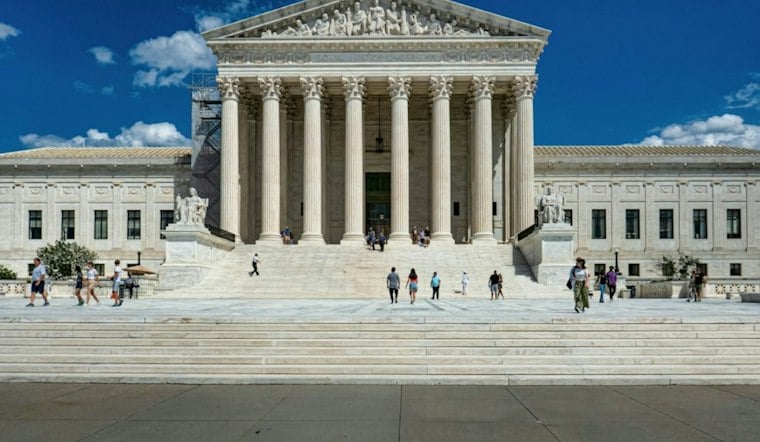
The Supreme Court agreed to hear full oral arguments in the long-running fight over whether the U.S. DOGE Service has to turn over records under the Freedom of Information Act, setting up a final ruling by summer 2027 on one of the most consequential transparency disputes of Donald Trump's second term. The case, U.S. DOGE Service v. U.S. District Court for the District of Columbia, will determine whether the cost-cutting unit once fronted by Elon Musk counts as a federal agency bound by public records law or an exempt presidential advisory body.
According to CBS News, the justices will hear arguments in early 2027, with a decision expected by summer of that year. It marks the second time the high court has intervened in the case, which was originally brought by the watchdog group Citizens for Responsibility and Ethics in Washington, known as CREW. As WBAL News Radio reports, the court previously narrowed particular discovery requests, especially those involving internal recommendations, and sent the case back for further proceedings; CREW says the rest of the discovery order remained intact.
How the Legal Fight Reached the Nation's Highest Court
Cooper first ruled in CREW's favor in March 2025, finding that DOGE was likely subject to FOIA and ordering expedited processing of the group's records request, a decision detailed by Citizens for Responsibility and Ethics in Washington. That ruling set off a cascade of appeals from the Trump administration, which argues DOGE is exempt from FOIA as a presidential advisory body rather than an independent agency. An appeals court panel later sided with CREW again, and the Trump administration claims that panel ignored the Supreme Court's earlier direction to weigh separation-of-powers concerns and intruded on presidential advisors' autonomy and confidentiality.
Justice Department attorneys wrote that subjecting advisory bodies to intrusive discovery triggers the very concerns Congress sought to avoid by excluding presidential advisory bodies from FOIA's reach, per the WBAL account. The administration also says the appeals court authorized a sworn deposition of DOGE administrator Amy Gleason, according to Forbes.
The Legal Standard at the Center of the Case
Whether DOGE must comply with FOIA hinges on a specific legal test. Under federal law and the D.C. Circuit's precedent in Meyer v. Bush, entities within the Executive Office of the President are subject to FOIA only if they exercise what courts call substantial independent authority beyond simply advising and assisting the president. CREW attorneys wrote that public-record facts, including statements by the president, confirmed DOGE wielded enormous independent authority across the federal government, according to the WBAL report.
CREW narrowed its requests, and the D.C. Circuit modified the discovery order after the Supreme Court's earlier decision. DOGE itself was established through an executive order Trump signed on his first day back in office, renaming and reorganizing the U.S. Digital Service, a White House tech initiative originally created under President Barack Obama, according to Holland & Knight. That same order embedded teams of at least four people across federal agencies to review technology and spending systems.
A Pattern of Emergency Rulings Favoring DOGE
In June 2025, the court issued a 6-3 decision setting aside parts of a lower-court order and narrowing discovery about internal recommendations. CREW said the rest of the discovery order remained intact, and discovery was stayed while the D.C. Circuit modified it. On that same day, the justices also ruled 6-3 in Social Security Administration v. AFSCME to allow DOGE personnel access to restricted Social Security Administration databases, over dissents from liberal justices concerned about exposing private citizen records to unvetted personnel.
By December 2025, federal agencies including Defense, Agriculture and the EPA were citing embedded DOGE teams when executing budget cuts, contract cancellations and workforce downsizing across government, per USAFacts. CREW points to that reach as evidence DOGE exercised broad independent authority, even though DOGE's own temporary charter, established under Executive Order 14158 for an 18-month mandate, was scheduled to sunset on July 4, 2026.
Watchdogs Warn of a Broader Precedent
The watchdog group American Oversight has filed court briefs arguing that allowing DOGE to direct agency decisions while claiming advisory immunity under FOIA would set a precedent letting future administrations shield major government operations from public oversight simply by housing them inside the White House. The group's brief, filed with the Supreme Court, contends that functional power, not formal titles, should determine whether an office must comply with public records law.
The case arrives amid a string of related disputes over DOGE's footprint in government data and operations. With oral arguments now set for early 2027, the question of whether DOGE operated as a shielded advisory body or a FOIA-covered federal agency is headed for a final answer by next summer.





