

























































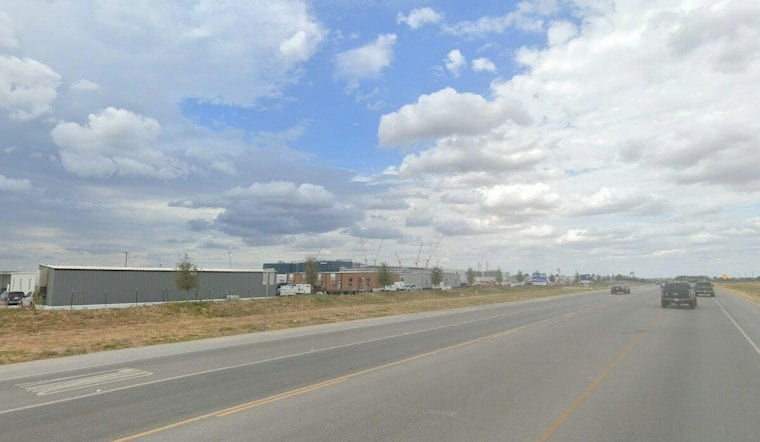
Taylor, Texas is bracing for a growth spurt that could reshape the small Williamson County city for decades, with officials projecting the area could gain more than 100,000 additional residents over the next 24 years. That expectation is driving an urgent push to line up water, wastewater, roads and workforce programs before the next wave of industrial tenants arrives.
The scale of that challenge was the subject of a recent roundtable hosted by the Austin Business Journal, co-moderated by market president and publisher Abby Mellott and Ben White, president and CEO of the Taylor Economic Development Corp. The panel included Jinesh Gandhi, founding partner of Bull Creek Equity Partners and developer of Taylor Industrial Park; Cody Poteat, vice president of RCR Rail; Zane Cole, senior managing director and industrial division co-lead at JLL; and Alexander Pease, business development manager at iMarketAmerica/iMarketKorea. Their discussion, framed around how infrastructure, workforce and investment are shaping the city's future, laid out both Taylor's selling points and the constraints standing between the city and that projected growth.
Samsung's Supply Chain Keeps Expanding South
Samsung, described in the roundtable as a large semiconductor company driving activity in Taylor, has pulled a web of suppliers and service providers toward the city since its plant arrived. Among them is iMarketAmerica, the U.S. subsidiary of publicly listed Korean company iMarketKorea, which supports procurement for Samsung and works with thousands of suppliers in Korea, according to the roundtable. That relationship led iMarketAmerica to expand into Taylor and develop Gradiant Technology Park, a 212-acre industrial and office campus at 112 FM 427, according to the Taylor Press.
The Taylor Economic Development Corporation announced in November 2025 that iMarketAmerica had officially broken ground on Phase 1 of the project, with a performance agreement outlining a minimum investment of $50 million into that first phase alone. The size of that phase is described differently across sources: the Taylor Economic Development Corporation puts Phase 1 at more than 350,000 square feet with full buildout anticipated at approximately 2.2 million square feet, while the Taylor Press reports the first phase will include 783,000 square feet across seven buildings, ready for tenants in fall 2026, with the full park eventually totaling nearly 2.3 million square feet. iMarketAmerica has prepared infrastructure and future-proof plans at the site and is finishing two buildings with eight-inch slabs, according to the roundtable.
South Korean investment in Texas has tripled annually from 2022 to 2024, reaching $780 million in 2024, the Taylor Press reports. Officials cited at the roundtable said 300 Korean companies are coming to Texas overall, while roughly 145 Korean firms tied to Samsung's semiconductor foundry were considering Central Texas locations. Taylor, positioned toward the middle of what's known as the Texas Triangle, is positioned to attract not just semiconductor suppliers but also defense tech, aerospace, AI, data center and advanced manufacturing businesses, the panel said.
Rail Access Becomes a Selling Point
Not every Taylor-area project is chasing Samsung business directly. RCR Rail operates what Poteat called one of the only rail-served sites in Central Texas and the closest rail-served park to Austin. The RCR Taylor Logistics Park offers dual Class I rail service from Union Pacific and BNSF alongside non-rail commercial sites for manufacturing, distribution and logistics, according to RCR Rail Co.
RCR Rail operates its own crews and locomotives and serves customers from Bastrop to just north of Temple and Waco, with transloading available to companies within 50 to 60 miles of the site. The company estimates dual rail access can cut transportation spending by 30% to 35% over roughly a decade, and notes a single rail car can move the equivalent of about four truckloads. Poteat told the roundtable that semiconductor freight doesn't fit rail traffic as neatly as bulk volumes do, but said overall demand has roughly tripled since earlier in 2026.
Gandhi's company builds facilities between 50,000 and 100,000 square feet, primarily for advanced manufacturing, filling a niche distinct from the bigger industrial users eyeing Taylor. Those larger tenants vary widely: some industrial requirements commonly run from 250,000 to more than 300,000 square feet, the panel said, while certain users want 600,000 square feet plus 20 acres of outside storage. Power needs stretch even further, with data centers potentially requiring 100 megawatts or more and advanced manufacturers typically seeking a minimum of 15 to 20 megawatts.
Beyond Samsung, Other Industrial Parks Rise
Gandhi's Taylor Industrial Park sits on roughly 20 acres less than five miles from the Samsung plant and could eventually add buildings totaling roughly 200,000 square feet, according to the Williamson County Economic Development Partnership. No tenants had signed on as of that report, which also noted plans for a $6.5 million, 51,000-square-foot office-warehouse building at 1901 Industrial Drive. Other developers working on projects in the area include iMarketAmerica, RCR Rail Park Development Co. and additional firms, broadening the city's industrial offering well beyond Samsung's direct supply chain, the same account notes.
Taylor's appeal, according to the roundtable, has rested partly on cost: the city has been more cost-effective relative to other Austin-area communities, while sitting near U.S. 79, State Highway 130 and I-35. But that affordability comes with a catch. Large companies often want existing buildings rather than wait six months for new construction, and Taylor competes for those deals against Hutto, Georgetown, Round Rock and the broader I-35 corridor. The panel said Taylor has lost some deals to Dallas and Houston when companies judged its workforce insufficient for their needs.
Roads, Water and Workforce Race to Keep Pace
Williamson County is expanding the Samsung Highway and the East WilCo Highway, with road projects also including the A2 and A3 corridors and the Chandler Road extension, according to the roundtable. Separately, Samsung Semiconductor Global says the company supports a proposed Williamson County road bond intended to deliver safer, more reliable routes near its Taylor site. Once complete, the East WilCo Highway is meant to connect SH 130 to Highway 79 between Hutto and Taylor, easing traffic on Highway 79; the first segment of that highway cost $13.6 million, funded through the county's voter-approved 2019 Road Bond. The Southwest Taylor Improvements are part of a broader long-range county transportation plan built to address both current and future growth.
On the utilities side, Taylor needs water line extensions and is improving its wastewater and water infrastructure, the panel said. The Taylor Economic Development Corporation has separately committed to extending wastewater service to the Gradiant Technology Park site, supporting a new traffic signal at Carlos G. Parker Boulevard and East Walnut Street, and making a one-time payment to remove the Gradiant property from the Manville CCN, according to the organization's announcement. The city has also sped up its approval and permitting turnaround through an expedited process, though it still faces constraints from finite developable land, topography, and limited power, wastewater and water capacity.
Workforce development is getting attention too: Taylor now has a new University of Texas campus spanning 68 acres, along with a UT program supporting familiarity with the city and a Korean-language program at the local high school. Industrial development, the roundtable noted, can in turn support the population growth and retail demand that Taylor is projecting — but only if the city manages to coordinate that growth across power, water, sewer, and residential and commercial development all at once.





