

























































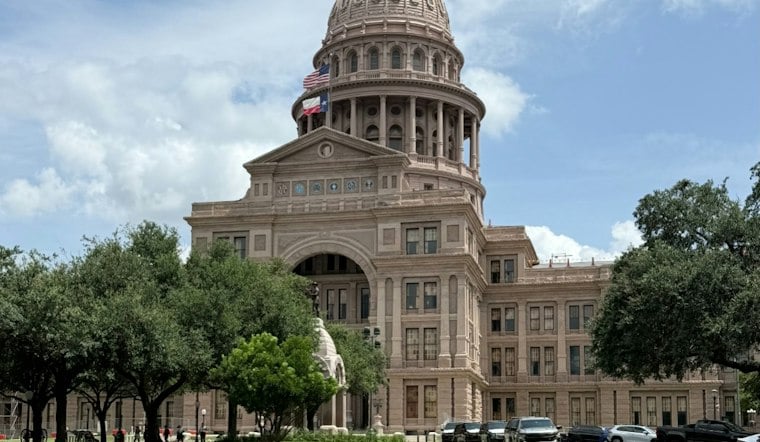
Law enforcement thwarted a planned attack on the Texas State Capitol in Austin, arresting a suspected ringleader early Wednesday morning hours before the attack's scheduled date of October 1. The Texas State Capitol complex remains under heightened security following the arrest, according to officials tracking the case.
The attack had been scheduled for October 1, a date confirmed by state Senator Paul Bettencourt (R-Houston), according to News Radio 1200 WOAI. Bettencourt, a long-serving lawmaker who authored major housing, tax, and election administration legislation in recent sessions, represents District 7 in Harris County and is regarded as a high-profile Republican leader in the Texas Senate, according to The Texas Tribune.
The suspected ringleader was identified as Benny Caldera, Jr.; details on the motive and any co-conspirators have not been released, and it remains unclear what specific weapons or methods the plot involved. The station's report identifies the arrest as occurring early Wednesday, just ahead of the planned attack date.
Who Actually Guards the Capitol Grounds
Unlike municipal property governed by the City of Austin, the 22-acre Capitol complex falls under the Texas Department of Public Safety's primary law enforcement authority, as discussed in a bill analysis from the Texas Public Policy Foundation. That jurisdiction stems from Texas Government Code Section 411.062, which handed DPS primary law enforcement authority over the Capitol grounds by legislative mandate back in 1991.
CAST itself just marked five years of operations in September, a tactical unit built specifically to respond rapidly to armed attacks and complex threats within the Capitol complex, according to the Texas Department of Public Safety. DPS also made 275 drone flights near the Capitol between January and March of this year, 102 of which involved calls for assistance from Austin police, as Hoodline previously reported on the DPS drone program.
A Pattern of Threats at the Capitol
This is not the first time the Capitol has faced a credible threat forcing law enforcement into action. In June 2025, the Capitol was evacuated and a suspect was taken into custody by DPS troopers following a credible security threat directed at state lawmakers preparing to attend a protest at the building, according to The Guardian. Two months later, DPS ordered a public evacuation of the complex during an evening session after a shooting threat was made while state Representative Nicole Collier was demonstrating inside, as reported by Newsweek.
The heightened posture also traces back to a January 2025 directive from Governor Greg Abbott, who ordered DPS to expand Joint Terrorism Task Force operations with the FBI and conduct comprehensive security assessments of the Capitol complex against mass attack tactics, including vehicle ramming, according to the Office of the Governor of Texas. The Texas State Preservation Board and DPS have also layered in physical security controls across the complex, including automated entrance bollards and prohibitions on combat gear such as improvised shields, gas masks, and metal tools.
What Charges the Suspect Could Face
Under Texas Penal Code Section 15.01, a conviction for criminal attempt requires proof of specific intent and an act amounting to more than mere preparation, with penalties typically classified one category lower than the targeted crime, according to Justia Law.
Those two statutes set very different evidentiary bars for prosecutors. A terroristic threat charge hinges on words and intent to intimidate, while a criminal attempt charge demands proof of concrete steps taken toward carrying out the planned attack, not just planning or preparation. Which charges prosecutors ultimately pursue against the suspected ringleader, and whether any additional co-conspirators face state or federal charges, remains to be seen.
The arrest adds to a string of recent cases involving threats and confrontations at government buildings nationwide, including an incident at Minneapolis City Hall last month in which a truck drove toward a crowd, a case Hoodline previously covered in detail. Closer to home, Hoodline also reported in June on a Texas courthouse agitator arrested over a chilling threat made toward a case involving Karmelo Anthony, part of a broader pattern of terroristic threats directed at Texas public institutions.





