

























































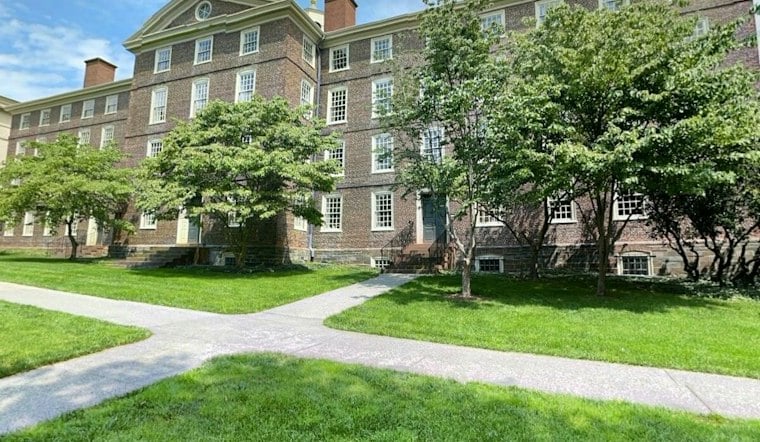
A Brown University committee charged with reaffirming the value of liberal arts education has drawn sharp criticism from faculty after it emerged that no one on the panel comes from the Division of Arts and Humanities. The seven-member working group includes Nicolas Fawzi, Joseph Hogan, Alice Paul, Daniel Ritchie, Melvin Rogers, Brenda Rubenstein and Robert Self, but not a single professor from a division that houses 29 of Brown’s roughly 80 undergraduate concentration programs.
The gap has become a flashpoint just as Dean of the Faculty Leah VanWey and Dean of the College Ethan Pollock have asked faculty to weigh in on what the university is calling its Reaffirming the Liberal Arts and Sciences Initiative. According to the Brown Daily Herald, faculty can weigh in through 20-person discussion sessions and a faculty feedback form, but several professors say that process does not make up for the absence of a humanist voice in the room where decisions are shaped.
Comparative literature professor Thangam Ravindranathan pointed out that the group lacks representation from the arts and humanities in part because history, one of the disciplines often associated with humanistic inquiry, is housed within Brown’s social sciences division rather than arts and humanities, the Herald reports. English professor Kevin McLaughlin went further, saying the committee should include faculty from literary studies or the arts, and that inviting open feedback is not the same as having someone from that perspective actually sitting on the committee.
Faculty Say Concerns Are Widespread
Classics professor Johanna Hanink reported that faculty concerns about the working group’s composition are widespread, not limited to a handful of vocal critics, per the same Herald account. German studies professor Gerhard Richter was more blunt, saying the university’s call for input now is too little, too late, and that treating disciplines traditionally associated with a liberal arts core as secondary is itself a problem worth naming.
Not everyone on the committee agrees with that critique. Brenda Rubenstein, a member of the working group, said she disagrees that the panel lacks humanist representation, noting that it includes historians, a sociologist and social scientists from the School of Public Health. Fellow committee member Nicolas Fawzi said the goal was broad university representation, which he acknowledged a small group cannot fully achieve regardless of its makeup.
Dean VanWey, who also holds an appointment as a professor of Environment and Society and Sociology, has said representation from different academic fields was not a key factor in how members were appointed. She told the Herald that the group was instead assembled for intellectual curiosity, humility and listening skills, along with varying levels of undergraduate advising experience. Dean Pollock said the lack of humanities faculty was not an intentional exclusion and that other faculty will have future opportunities to engage with the initiative as it develops.
What the Working Group Is Actually Discussing
VanWey has said that faculty and students have experienced changes in advising and college life, concerns that helped prompt the broader initiative. Pollock described the process as just beginning, noting the group has already done preparatory work, including focusing early discussion on Brown’s liberal learning goals and how they align with the university’s open curriculum. The initiative overall is meant to prompt faculty conversations about how to provide the best possible undergraduate education, according to the Herald’s reporting.
Once faculty feedback has been gathered, the working group plans to develop concrete recommendations touching on advising and liberal learning goals. VanWey said she would consider months of sustained discussion, paired with the addition of more first-year advisors, to be a valuable outcome regardless of what else the group ultimately proposes.
Part of a Broader Reckoning Over the Humanities
Fears over the future of humanities departments have spread amid layoffs and restructurings at scores of public and private universities, as the Guardian has reported, with more than 9,000 higher-education jobs cut in a single recent year, including positions in the sciences. The same reporting notes that public confidence in higher education has collapsed over the past decade, from 57 percent in 2015 to 36 percent in 2023.
Other campuses have taken far more drastic steps. Indiana lawmakers passed legislation forcing the state’s public universities to cut or consolidate roughly 400 academic programs, nearly 20 percent of the system’s degree offerings, most of them in the humanities and social sciences. The University of North Carolina is planning to close six centers dedicated to geographical area studies, while the University of Chicago has paused graduate admissions for nearly all of its humanities programs. Portland State University cited an $18 million budget deficit when it laid off 17 non-tenure faculty members, 15 of them from its college of liberal arts, and students at Montclair State University held a mock funeral to protest a plan to consolidate humanities and social-science departments into four thematic schools, though Montclair’s administration said that reorganization would not involve layoffs and that faculty would remain the stewards of the curriculum.
Brown’s own posture has been more ambiguous than outright cuts. The university listed supporting the humanities among its academic priorities for the 2024-25 academic year, and in July the Cogut Institute for the Humanities established a new Center for Environmental Humanities to advance interdisciplinary humanistic inquiry, according to Brown’s provost office. VanWey has described the university as leaning into and investing in its liberal arts mission, pointing to trends toward more global humanities scholarship and arts departments that increasingly blend the making of art with theorizing about it.
Yet Brown has also been drifting toward a different institutional identity for decades. The Brown Daily Herald has reported separately that the university has increasingly repositioned itself as a leading research institution rather than a liberal arts college, with graduate and medical student populations in 2024 more than double and quadruple their 1973 levels, respectively. Brown’s 2022 Operational Plan for Investing in Research aimed to double internal research funding within five to seven years of its release, a goal that sits uneasily alongside the university’s stated commitment to undergraduate liberal learning.
For now, the working group’s composition remains the most tangible flashpoint. Whether the feedback sessions and faculty survey can satisfy critics like Richter and McLaughlin, or whether the eventual recommendations on advising and liberal learning goals win over skeptics, will likely shape how faculty judge the initiative once it produces concrete proposals.



