

























































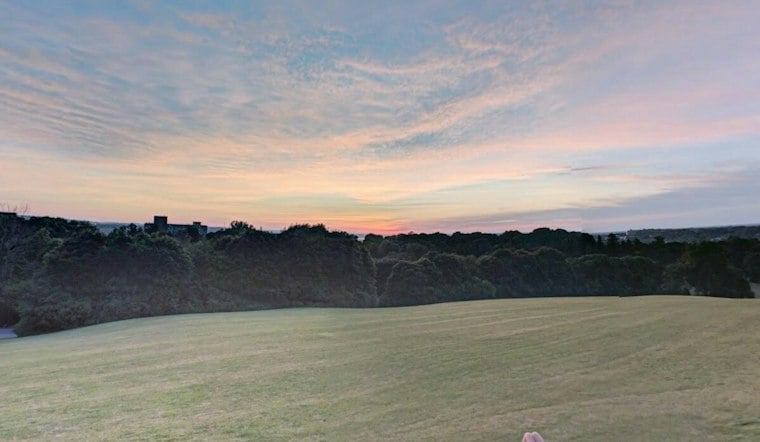
Two massive willow boulders and a winding grass path have taken root near the base of the water tower in Thornden Park, the product of more than 300 hours of hand-weaving by artist Sydney Schultz and a summer of careful mowing by collaborator Laura Reeder. The piece, called “The Paths We Weave,” isn't a maze meant to trick visitors — it's a single continuous walk the two artists designed to feel more like a meditation than a puzzle.
Schultz built two sculptures shaped like boulders entirely out of willow branches, sticking each base deep into the ground before weaving the rest by hand, according to syracuse.com. The willow itself was donated and harvested from a field owned by SUNY College of Environmental Science and Forestry, giving the project a distinctly Central New York set of raw materials. Reeder, meanwhile, took a grass whip to the surrounding meadow, carving a rough, winding route around the boulders that she then mowed regularly to keep its shape — a path wide enough for two people to walk side by side.
A Landscape Shaped by Sisyphus and Local Drumlins
Both artists said the installation draws on the Central New York landscape itself, alongside the ancient Greek myth of Sisyphus, the king condemned to forever push a boulder uphill only to watch it roll back down. Reeder said the pathway's design was directly inspired by that image of pushing boulders uphill, and she described the result as a labyrinth specifically because it offers a continuous walk rather than a dead-end maze. The goal, per the same account, was a peaceful experience rather than a trick.
The meadow surrounding the sculptures wasn't mowed flat beforehand — the artists let it grow wild for several weeks in early summer before cutting the path through it, leaving tall grass, chicory, asters and delicate white flowers framing the route. Schultz said visitors can experience the winding pathways while considering both the willow material itself and its environmental impact. Reeder added that she simply hopes people will go outside, walk, and pay closer attention to where they live.
Grant Funding Brought the Vision to Life
The project marks the first collaboration between Schultz and Reeder, and it came together with backing from several local institutions. The Thornden Park Association and Syracuse's Parks, Recreation and Youth Programs department support the installation, with that city department also working alongside Reeder to help select the site near the water tower. Financial support came from CNY Arts, the Westcott Area Cultural Coalition and Tomorrow's Neighborhoods Today - East Side.
That CNY Arts funding traces back to a broader regional grant cycle: in July, the organization awarded $228,089 total to 113 artists, organizations and educators across Onondaga, Oneida, Oswego, Madison, Cortland and Herkimer counties, as syracuse.com reported at the time. Individual awards in that Statewide Community Regrant cycle ranged from $800 to $4,000, and Schultz received the top amount of $4,000 specifically to create “The Paths We Weave.” At that point, the project was still described as something that would debut later in the summer — it has since taken shape as the walkable installation now standing in the park.
Room to Grow, With No Promises Yet
For now, the installation includes just two boulders, though Schultz may add more in the future — the dossier of plans leaves open the possibility without confirming where or when additional pieces might appear. Schultz and Reeder both said they hope “The Paths We Weave” remains in Thornden Park for years to come.
Reeder isn't new to this kind of work. She has a similar installation at Stone Quarry Art Park in Cazenovia, a 104-acre conserved landscape with more than four miles of trails, according to iloveny.com. That park is dedicated to showcasing work by emerging and established artists within a natural setting, and it offers a free audio tour guiding visitors past its sculptures and meadows. Reeder is also listed as a teaching artist with Stone Quarry Hill Art Park, where she's described as investigating how people learn from each other and from the earth — a theme that carries directly into her work shaping the grass path through Thornden Park's meadow.





