

























































On the morning of Dec. 21, 1832, farmer John Durfee found a woman's body hanging from a fence post near a haystack on his property in what was then Tiverton, Rhode Island. The woman was Sarah Maria Cornell, an unmarried factory worker who had recently moved to a boarding house in Fall River, Massachusetts, to work in the weaving room at the Fall River Manufactory. Tucked in her belongings was a note that would upend the case: if she went missing, people were instructed to ask after a Methodist minister named Rev. E.K. Avery.
A Note That Changed Everything
Cornell's body was suspended by a loop of marlin twine, and she was still wearing the calash and cloak she had put on the previous evening, according to The Providence Journal, which reconstructed the case from court testimony, 1833-era books, contemporary newspaper accounts and historical and genealogical records. A note in her bandbox named “Rev. Mr. Avery, Bristol” as the person to ask if she disappeared, the paper reported, while NPR notes the note itself read: “If I am missing, enquire of the Rev. E.K. Avery.” Investigators who examined her remains noticed scratches, abrasions, skinned and grass-stained knees, and bruises along her back — details that pointed away from a quiet suicide, per the same NPR account.
An autopsy performed by Foster Hooper and Thomas Wilbur found Cornell was pregnant, roughly halfway through gestation, carrying a girl. The examination also turned up bruises, other signs of violence, and evidence of an attempted abortion, according to the Journal's reporting. The initial investigation had ruled her death a suicide, but a coroner's jury later concluded suicide was unlikely and ruled instead that she had been strangled — implicating Avery. A second coroner's inquest reached the same dramatically different conclusion, rejecting the original suicide finding, according to East Bay RI. Her body was later exhumed and eventually moved from Durfee's Tiverton farm to Oak Grove Cemetery in Fall River.
A Minister With a History of Trouble
Ephraim Kingsbury Avery, 34 at the time, was a married Methodist minister who had known Cornell since July 1830, when he was assigned to a church in Lowell, Massachusetts, where Cornell had sought employment at his house, according to Encyclopedia.com. Avery lived in Lowell with his wife, Sophia, their three young children, and Sophia's chronically ill niece, Betsey Hills, per the Journal's account. He had already been stationed in more than half a dozen towns across Connecticut, Rhode Island and Massachusetts, and the church had moved him several times before to avert lawsuits and scandals, the paper reported.
Sophia Avery grew suspicious of her husband's private meetings with young women in his study, and the couple's son, Edwin, reportedly told his mother that his father had kissed Cornell during a carriage ride. Sophia said she would not allow Cornell to remain in the house. In August 1830, Cornell visited Dr. William Graves for abdominal discomfort, and Graves diagnosed her with a venereal disease, then told Avery about her condition, the Journal reported. Cornell was later expelled from the Methodist church and moved to Dover, New Hampshire, before writing to Avery confessing further indiscretions. In 1832, the church moved Avery from Lowell to Bristol, Rhode Island.
The Final Weeks Before Cornell's Death
Cornell and Avery met again at the Thompson camp meeting campground in August 1832, two months before Cornell's later visit to physician Thomas Wilbur, where Avery allegedly directed her to meet him in nearby woods. Cornell told Wilbur, a Quaker physician, that Avery had nearly forced himself on her, and she became pregnant following the encounter, with conception believed to have occurred around August 1832. She also confessed to indiscretions with a married man during the camp meeting, per the Journal's account.
Physician John McLellan advised Cornell to move to Rhode Island to simplify establishing paternity, and in October 1832 she relocated from Woodstock, Connecticut, to Fall River, Massachusetts. She told Wilbur she suspected she was pregnant. Avery reportedly offered her financial support for herself and the child if she kept his name out of it, and advised her to take oil of tansy in doses of 30 drops. Wilbur warned her that dose could kill her, and Cornell refused to take it. Wilbur separately advised Cornell to meet Avery only in Fall River and to request $300 from him.
The Night Before the Discovery
On Nov. 27, 1832, Avery asked John Orswell, an engineer on the King Philip steamboat that ran between Fall River and Providence, to deliver a letter to Cornell. The letter proposed meeting in Bristol on Dec. 18 or 20 at 6 p.m., offered alternative sites at the Methodist meeting house in Somerset or a spot behind the Fall River meeting house, and instructed Cornell to wear a calash rather than a plain bonnet, according to the Journal. Cornell and Avery ultimately scheduled their meeting for Dec. 20, 1832, at 6 p.m. in Fall River.
That night, witnesses reported seeing a six-foot-tall man in an overcoat and broad-brimmed hat moving through the area. Peleg Cranston saw such a man crossing the stone bridge, and George Lawton saw a similarly described man walking quickly toward Fall River. Jeremiah Gifford said a familiar nighttime traveler sought a ferry crossing to Bristol shortly before 10 p.m. that evening. Witnesses later identified that traveler as Avery, the Journal reported.
Flight, Arrest and a Historic Indictment
Three men from Fall River filed charges against Avery in Bristol, but two justices of the peace dropped the charge for insufficient evidence — with one justice describing Cornell as “an undoubted prostitute,” according to the Journal's account. A preliminary hearing lasted two weeks, and newspapers covered the discovery of Cornell's body, Avery's preliminary examination, and his eventual flight. Citizens of Fall River and Tiverton decided new charges should be brought against Avery in Newport County. Threatened with arrest, Avery fled Rhode Island, as noted by Brown University Library, which also details his capture.
Fall River deputy sheriff Harvey Harnden searched for Avery across Rhode Island and Massachusetts before tracking him into New Hampshire. Joined by a posse of six, Harnden captured Avery at Simeon Mayo's home in Rindge, New Hampshire. Avery was indicted for murder by the Newport County grand jury on March 8, 1833, and pleaded not guilty, per Encyclopedia.com. He is believed to have been the first minister charged with murder in U.S. history, the Journal reported.
A 27-Day Trial That Gripped the Nation
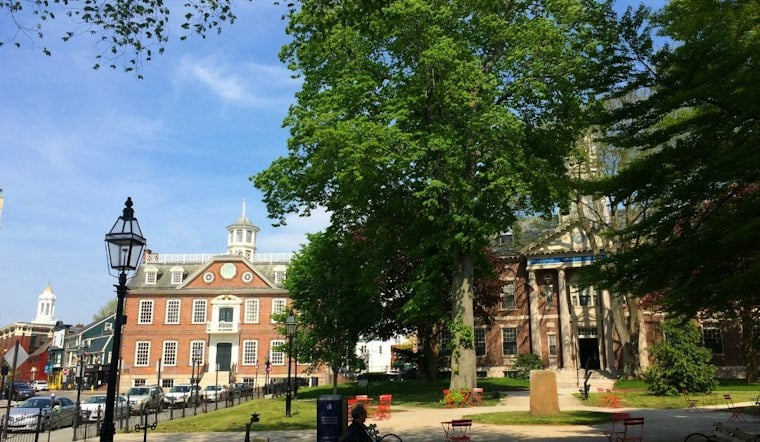
The trial opened in Newport on May 7, 1833, according to the Journal, though Encyclopedia.com dates the start to May 6, and accounts describe the proceedings before the state's three-member Supreme Judicial Council as lasting 27 days, or by another account four weeks, at the Newport Colony House. The case drew enormous public attention: a crowd of about 2,500 people gathered outside the courthouse before noon on verdict day, representing more than a quarter of Newport's population at the time, the Journal reported. The scale of coverage reflected sweeping social changes underway in New England — industrialization, the growth of women's mill employment and the expansion of Methodism — that pushed the Avery case into national headlines, according to Encyclopedia.com.
No witness testified to actually seeing Avery kill Cornell, and the prosecution lacked anyone who placed him with her on the night she died, per East Bay RI and the Journal's reporting. The defense, led in part by attorney Richard K. Randolph, told the jury it would present 14 years of Cornell's history of what it characterized as lewdness and misconduct, using a strategy that portrayed her as promiscuous. The defense itself lacked a solid alibi for Avery, and Avery did not take the stand in his own defense, the Journal reported.
Acquittal and Unanswered Questions
The jury deliberated for 16 hours, and reports indicate 10 of the 12 jurors were initially ready to convict when deliberations began. Avery was acquitted of Cornell's murder on June 5, 1833, according to Small State Big History, which called it one of the longest and most sensational trials in Rhode Island history. Public interest was so intense that the New York Evening Post gave its entire front page to trial coverage, the site noted.
A Methodist church tribunal later cleared Avery of blame for Cornell's pregnancy and death, and he returned to his ministry. He later moved to western Massachusetts and worked as a carpenter before retiring to Ohio, where he died in 1869. But suspicion dogged him for the rest of his life, according to The Herald News, which noted that the true circumstances of Cornell's death, and the reason behind her note, remain unknown to this day.
The Case Still Draws Interest
Author Catharine R. Williams attended the trial, interviewed witnesses, and published a book on the case in 1833 titled “Fall River: An Authentic Narrative,” per NPR's reporting. Nearly two centuries later, the story still resonates locally: the Bristol Historical and Preservation Society has planned a historical reenactment titled “Bad Character: The Death of Sarah Maria Cornell,” set to run Nov. 13 through 15, 2026, at the Bristol State House, according to East Bay RI. Reported age discrepancies for Cornell — described in various accounts as either 29 or 30 at the time of her death — and differing estimates of how far along she was in her pregnancy remain unresolved in the historical record.





