

























































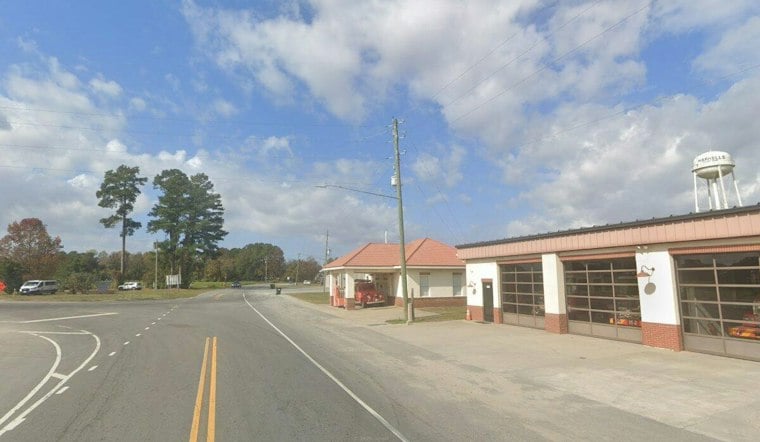
A tornado warning went into effect for Sampson County Sunday afternoon, with the National Weather Service tracking a severe thunderstorm near the small town of Harrells that forecasters said could produce a tornado and widespread significant wind damage. The warning ran from 1:20 p.m. to 1:45 p.m., giving residents across the rural county a narrow window to seek shelter before the storm moved through.
According to the Charlotte Observer, NWS Raleigh placed the warning on a storm located near Harrells, about 11 miles southwest of Wallace, moving northeast at 25 mph. Forecasters said the tornado could affect Harrells around 1:25 p.m., with the tornadic thunderstorm cluster also capable of reaching Ivanhoe. The National Weather Service warned that flying debris would endanger anyone caught without shelter and could damage mobile homes, roofs, windows, vehicles, and trees, the same report notes.
The warning zone sits in one of North Carolina's most geographically spread-out counties. Sampson County covers 945.9 square miles, making it the state's second-largest county by land area, with an estimated 61,931 residents as of 2026, according to World Population Review. That vast rural footprint means a single radar-indicated warning can affect widely scattered communities at once, from county-seat Clinton down to crossroads towns like Harrells.
Why Mobile Homes Face the Highest Risk
Housing vulnerability is a central concern in storms like this one. Mobile and manufactured homes make up roughly 34% to 35% of Sampson County's total housing stock, and occupants of those structures face a mortality risk 15 to 20 times higher during tornadoes than residents of permanent, site-built homes, per Arborlook. Harrells itself, the community named in the warning, contains 90 housing units, nearly 19% of them manufactured homes, with a median structure built back in 1984, according to Point2Homes.
The National Weather Service recommended that people indoors move to a basement or an interior room on the lowest floor of a sturdy building, staying away from windows, the Observer's report states. People caught outdoors, in mobile homes, or in vehicles were advised to move immediately to the closest substantial shelter. Indoor occupants were told to bring pets along if time allowed, and those in vehicles were advised to drive to the nearest shelter or, if unable to do so, to crouch down in the car or take refuge in a ditch or ravine.
Why Phone Alerts Alone May Not Be Enough
Not every tornado warning automatically reaches a cell phone. Standard radar-indicated tornado warnings do not trigger Wireless Emergency Alerts unless storm threat levels reach “Destructive” criteria under NWS guidelines updated in 2021, according to prior Hoodline coverage of a similar warning in New Hanover and Pender counties. That's part of why the National Weather Service continues to urge residents to stay informed through local news broadcasts or a NOAA Weather Radio rather than counting on a phone buzz alone, the Observer notes. Workers and students were advised to follow tornado drill protocols and avoid windows and large open rooms.
Sampson County has a documented history with violent tornadoes outside that spring window too, including an F4 that tore through the county on March 28, 1984, as part of a Carolinas outbreak that killed 42 people and injured more than 800 statewide, according to NWS records. More recently, the April 14–16, 2011, outbreak produced 30 confirmed tornadoes in North Carolina.
Building a Disaster Kit Before the Next Storm
Sunday's tornado warning followed a separate round of severe weather earlier in the year, when heavy thunderstorms dropped 1 to 3 inches of rain on Sampson County in May, turning Highway 24 into a flooded waterway and triggering flash flood warnings for Clinton, Roseboro, and Salemburg. The Federal Emergency Management Agency recommends that households keep a basic disaster kit on hand year-round, with at least one gallon of water per person per day for three days and a three-day food supply, the Observer reports.
FEMA's recommended kit also includes a charged cell phone with chargers and a backup battery, a battery-powered or hand-crank radio, a flashlight, a first-aid kit, a whistle, and a dust mask. Additional items on the agency's list include plastic sheeting and duct tape, moist towelettes, garbage bags, plastic ties, a manual can opener, and local maps. Earlier that morning, NWS Raleigh issued a tornado warning for Montgomery and Moore counties as part of the broader system moving across central North Carolina, Hoodline previously reported.





