

























































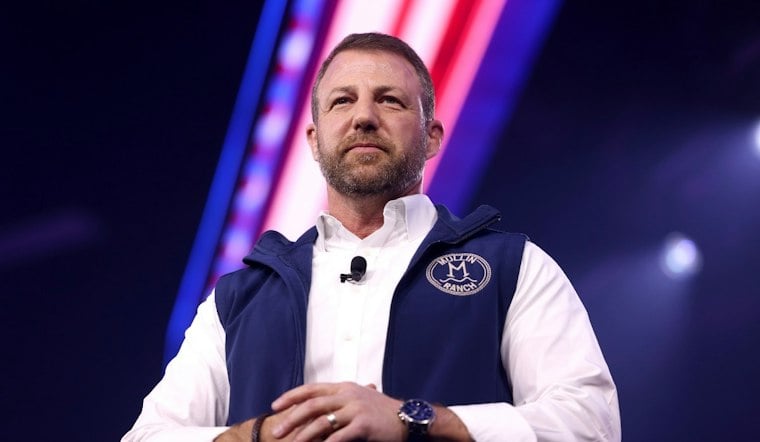
Homeland Security Secretary Markwayne Mullin landed in Lumberton this week alongside Republican Senate candidate Michael Whatley and U.S. Rep. David Rouzer, part of a late push to energize GOP voters in a North Carolina Senate race where recent polling shows Republicans trailing badly with Election Day less than two weeks away.
Mullin, Rouzer and Whatley were joined by members of the Lumbee Tribe during the visit, according to WRAL, which reported the stop came days after appearances in the state by President Donald Trump and Vice President JD Vance. The timing underscores how much is riding on Robeson County, a longtime Trump stronghold that the president carried with 63.4% of the vote in 2024, up from 58.9% in 2020 and 50.8% in 2016, according to the same report.
Mullin told Lumbee tribal members gathered in Lumberton that they deserved federal recognition, saying simply, “You deserved it,” per WRAL's account of the press event. He praised Whatley's role in securing Trump's support for the tribe's recognition, with Rouzer crediting Mullin, outgoing Sen. Thom Tillis and Whatley for helping push the effort behind the scenes.
A 137-Year Fight Finally Ends
The Lumbee Tribe, the largest tribe east of the Mississippi River per WRAL's reporting, received full federal recognition in December after a struggle that began with its first petition to Congress in 1888 — a 137-year effort detailed by NPR. Trump signed the measure at the White House, and NPR reports the tribe's roughly 55,000 members span Robeson, Hoke, Cumberland and Scotland counties in southeastern North Carolina.
The Lumbee Fairness Act, according to the bill text on congress.gov, extends federal recognition and makes tribal members eligible for the same services and benefits available to other federally recognized tribes. A companion Senate measure specifies that North Carolina must continue exercising jurisdiction over criminal offenses and civil actions on Lumbee-owned or trust lands unless jurisdiction is transferred to the federal government under a tribal-state agreement, per the Senate bill summary.
Mullin, who is a member of the Cherokee Nation, discussed challenges Native American families face in housing, healthcare and law enforcement during the Lumberton stop, WRAL reported. He stressed that strong relationships with the Trump administration would be necessary to turn recognition into lasting benefits, telling attendees the tribe needs a strong congressional delegation behind it. Federal recognition is expected to bring federal funding for Lumbee healthcare, education and other services, and it also opens the possibility of casino gambling — Lumbee tribal leaders approved a gaming ordinance the week before the visit that could pave the way for a casino along Interstate 95, though the proposal still requires additional tribal approval, according to WRAL.
Cooper Holds a Commanding Lead
The political backdrop for Mullin's visit is grim for Republicans. The final Elon University poll before Election Day found Democrat Roy Cooper favored by 52% of likely voters compared with 39% for Whatley, a 13-point lead in the race to replace retiring Sen. Thom Tillis. An AARP poll gave Cooper an 11-point edge, and the Cook Political Report has shifted its rating of the race to “leans Democratic,” according to The Guardian.
Money has followed the polling. The Guardian reported that the Senate Leadership Fund withdrew its North Carolina ad spending to redirect support to other Republican candidates, and WRAL noted the Whatley campaign itself stopped airing television ads earlier in October after national groups shifted their spending elsewhere. Federal filings cited by WRAL show Cooper had raised $47.2 million and had $12.5 million on hand entering October, compared with Whatley's $13.4 million raised and just $916,000 in cash as of September 30.
Whatley, the former chairman of the North Carolina and national Republican parties, has campaigned as a close ally of Trump and his agenda. At the Lumberton event, Mullin criticized Cooper over immigration enforcement and accused state leaders of insufficient cooperation with federal deportation efforts, per WRAL. A spokesperson for Cooper called the attacks false, saying Whatley was using heinous crimes to deceive North Carolinians, while arguing Cooper has plans to lower costs compared with Whatley's support for benefits aimed at billionaires.
Trump's Approval and the Economy Loom Large
A WRAL/WSOC News Poll found that 60% of likely North Carolina voters disapprove of Trump's job performance, a headwind for Whatley's Trump-aligned campaign. The Elon poll also found that 43% of registered voters said a Trump endorsement would make them less likely to vote for a candidate, versus 25% who said it would make them more likely — even as such an endorsement could still help mobilize the Republican base. Voters ranked the economy as their top concern, with the Elon survey finding 37% cited economic issues, including inflation, cost of living, and jobs, as the single most important factor in the election.
The pressure is visible elsewhere on the ballot too: WRAL reported that several incumbent Republican U.S. House members in North Carolina, in seats previously considered safe, have begun running television ads of their own.
Early Voting Trends Favor Democrats
North Carolina's early-voting numbers add to the Republican unease. About 1.3 million ballots had been cast as of last Thursday, with roughly 42% coming from registered Democrats, 34% from unaffiliated voters and 23% from Republicans, according to state data cited by WRAL. Statewide early in-person turnout was up 36.9% compared with the same point in the 2022 midterms, per that same state data — though The Assembly put the comparable increase at more than 38%, and a separate WRAL report on the early-voting period found the statewide vote total was running almost 48% ahead of 2022's pace by the end of the second day.
The Assembly's analysis found unaffiliated voter turnout up 62% over 2022 while Republican turnout was down nearly 5%, and reported that through the previous Monday, 14.1% of registered Democrats had cast ballots compared with just 6.5% of Republicans — a gap the outlet calculated at 175,960 votes. The same analysis found Black North Carolinians' early turnout up 70% over 2022, compared with a 24% increase among white voters. Early voting continues in North Carolina through October 31, ahead of Election Day on November 3 — the first election since the Lumbee Tribe secured its federal recognition.





