

























































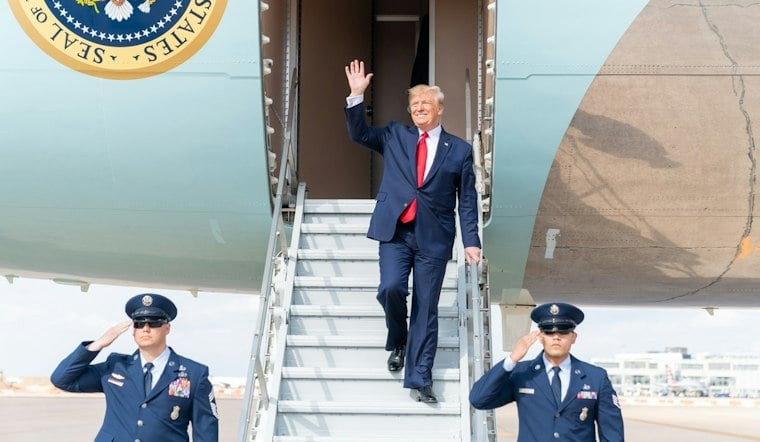
Donald Trump's flagship super PAC, MAGA Inc., has spent more than $277 million over the final six weeks of the midterm campaign trying to keep Republicans in power, pouring money into Senate races in Texas, Michigan and Ohio as the party braces for the November elections. The group had roughly $164 million left in the bank last week after that spending spree, according to figures reported in the final stretch of the campaign.
According to the Washington Post, MAGA Inc. had about $164 million remaining last week after spending $277 million to boost Republicans in the midterms. Separately, CNBC reported that newly released Federal Election Commission filings showed $300.5 million in disbursements through October 14, with $164.3 million in cash on hand — figures that do not fully line up with the Post's tally, underscoring how fluid and fast-moving the group's spending has become in the campaign's closing weeks. CNBC's review of the filings found $75.5 million of that spending came in just the first two weeks of October alone.
Trump himself said Tuesday that his political operation would spend more than $400 million by Election Day, per the same CNBC report. MAGA Inc. has already sent $200 million to the allied No Going Back PAC and another $25 million to the Safety & Affordability PAC, the vehicles doing much of the on-the-ground work in contested Senate and House races. One disbursement that caught attention was a $16.2 million payment on October 8, labeled simply “voting education” in the filings.
Money Flowing Into Texas, Michigan and Ohio
MAGA Inc. directed the bulk of its Senate-race spending toward Texas, Michigan and Ohio, according to the seed reporting from Reuters, as Republican candidates in those states were trailing Democratic challengers in most polls based on federal election data. Reuters, whose reporting first tied together the scale of the group's final-stretch spending, noted that Reuters found PACs supporting Texas Senate candidate Ken Paxton had spent more than $36 million on that race, while PACs backing Mike Rogers in Michigan spent $30.1 million and those supporting Jon Husted in Ohio spent more than $28 million.
Trump attended a campaign rally for Paxton at Freeman Coliseum in San Antonio on October 7, part of a broader push to shore up the embattled Texas Attorney General's Senate bid. MAGA Inc. had already donated $10 million directly to Paxton's campaign back in September, according to USA Today. The pro-Paxton Lone Star Liberty PAC separately launched a $15 million advertising effort, as reported by Axios. Politico has reported that MAGA Inc. and its affiliates were expected to spend near $45 million on direct mail, television and digital advertising in Texas through October 12, and that the team was still assessing how much more to send in the final weeks. The Washington Examiner described the overall push to defend Paxton as an astonishingly fast ramp-up in spending once his Democratic challenger closed the gap.
A Late Advertising Surge Worries Some Republicans
MAGA Inc. delayed ramping up its advertising until the last few weeks of the campaign, a timing decision that left some Republican leaders concerned, per the Reuters account. The group has raised roughly $450 million during the campaign cycle, according to Reuters, though the New York Times put the figure at about $473 million raised since Trump's election — a discrepancy that may reflect different accounting windows. The New York Times also reported that Trump's three allied super PACs held about $181 million on hand as of October 14, and that the groups started running advertisements in 24 states around Labor Day while drastically increasing their spending through Meta and Google.
Major donors have kept the money flowing. Las Vegas casino mogul Steve Wynn gave $8 million in September, Blackstone's Stephen Schwarzman donated $5 million, and roofing-supply billionaire Diane Hendricks contributed $5 million that month on top of $30 million she has given MAGA Inc. so far this year. Smaller but notable checks came from Bijan Tehrani and Konstantin Sokolov, who each gave $1 million in September and have donated $2 million apiece to the group overall. Super PACs like MAGA Inc. may accept and spend unlimited amounts on campaigns with few restrictions, a structure the Federal Election Commission confirms allows hybrid PACs' non-contribution accounts to solicit unlimited sums from individuals and corporations alike.
Spending Spreads Beyond the Core Battlegrounds
Money from No Going Back PAC has reached well beyond Texas, Michigan and Ohio. The group spent nearly $30 million in Michigan, $27.8 million in Ohio, $11.8 million in New Hampshire and $9.9 million in North Carolina, per CNBC's review of the filings. It also spent roughly $5 million each in Republican-held Michigan's 4th District and North Carolina's 11th District, two of the House seats now drawing outside money despite being held by the GOP.
An earlier CNBC report from September found No Going Back PAC had reported roughly $21 million in independent expenditures across competitive Senate and House races, including nearly $6.7 million spent against Sherrod Brown in Ohio, $3.8 million against Abdul El-Sayed in Michigan, $2.9 million against Roy Cooper in North Carolina, $1.8 million against Chris Pappas in New Hampshire and about $780,000 against Jon Ossoff in Georgia. The New Republic reported that MAGA Inc. and its affiliated organizations are targeting 27 House districts in total, 20 of them Republican-held and 26 of them carried by Trump in 2024 — a sign of how much GOP-friendly territory is suddenly considered at risk.
Why Safe Seats Are Suddenly in Play
Elections analyst David Wasserman told the New Republic that Republicans have lost ground among independent voters, leaving districts that ordinarily would vote handily for Trump and Republicans now in play. The same report tied some of the newfound competitiveness in Texas to Trump's dramatic slippage among Latino voters, and noted that some forecasters have pushed Democratic odds of winning the Senate to their highest point yet. Of the 21 House races rated toss-ups by the Cook Political Report, CNBC noted that 16 are currently Republican-held and five are held by Democrats — a lopsided split that explains why so much GOP money is playing defense rather than offense.
Elon Musk's America PAC, a separate outside group also aligned with Trump-world spending, was authorized to spend as much as $120 million on its own midterm effort, according to CNBC's September report. Republicans currently hold a 53-47 Senate majority, and Democrats need to flip at least four of the 100 seats to take control, per the Reuters figures. Nate Silver's latest data, as cited by Reuters, estimates Democrats' chance of winning the Senate at over 77 percent and projects a 53-47 majority in Democrats' favor, while giving Democrats more than a 94 percent chance of winning the House with a projected 240-195 majority. Whether MAGA Inc.'s late and expensive push changes that trajectory will not be clear until votes are counted in November.



