

























































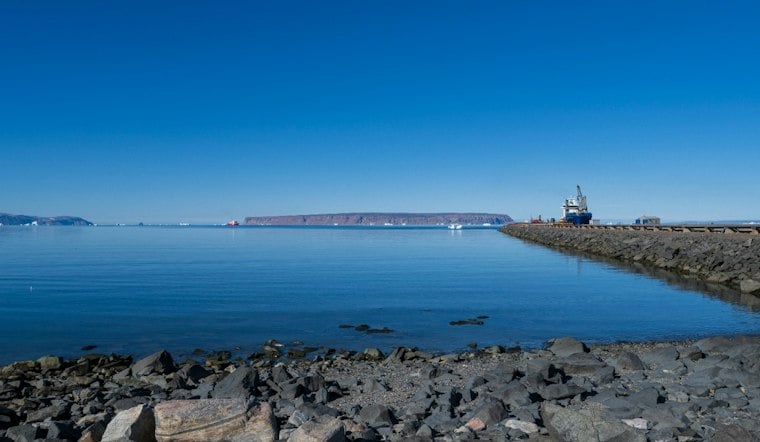
President Donald Trump declared early Wednesday that massive oil, gas and mineral exploration was about to begin in Greenland, posting the claim on Truth Social after a campaign rally in Wasilla, Alaska, the night before. The problem: Greenland's own government banned new oil and gas exploration licenses back in 2021, and a separate law that same year outlawed uranium mining and any mineral deposit exceeding a strict radioactivity threshold.
A Truth Social Post Meets a Legal Wall
Trump made the post after campaigning for Republican U.S. Sen. Dan Sullivan, who is seeking a third term representing Alaska in a race against former Democratic Congresswoman Mary Peltola, according to ClickOnDetroit. What exact U.S. exploration plans Trump was referring to remained unclear from the post itself, the Associated Press report carried by the outlet noted. Greenland is a self-governing territory of Denmark, not part of the United States, and representatives for Denmark and Greenland's leaders did not immediately return requests for comment Wednesday.
The legal reality on the ground is considerably more complicated than a social media post suggests. Greenland's government officially suspended all new oil and gas exploration in July 2021, declaring that the environmental and climate risks of extraction outweighed potential financial gains, according to PBS News. That same year, Greenland's Parliament passed Act No. 20, banning the prospecting, exploration and mining of uranium along with any mineral deposits containing more than 100 parts per million of uranium, according to the Library of Congress.
Billions in Buried Resources, Decades of Dead Ends
The resources at stake are enormous on paper. A 2007 U.S. Geological Survey assessment estimated Greenland's offshore waters hold roughly 17.5 billion undiscovered barrels of oil and 148 trillion cubic feet of natural gas, concentrated mainly in the North and South Danmarkshavn basins, per Earth.Org. Those deposits are covered by Arctic ice, and decades of offshore exploration dating back to the 1970s never produced commercially viable results even before the 2021 ban took effect.
Greenland also holds large deposits of rare earth minerals — the kind needed for computers, smartphones, batteries, and solar and wind technologies — but they remain encased in rock, and China currently dominates the world's supply of those critical minerals, a dynamic the Trump administration has said it wants to change. Yet the uranium ban has already blocked one of the world's largest undeveloped rare earth deposits. Australia-based Energy Transition Minerals' Kvanefjeld project, which contains an estimated 300 parts per million of uranium, well above the legal limit, has triggered an $11.5 billion arbitration and court challenge against Greenland and Denmark, according to NucNet.
American Drillers Already Hit a Permit Snag
Even projects with U.S. ties have run into Greenlandic regulators this year. In August, Greenlandic authorities issued a formal warning to Texas-based Greenland Energy Company and halted its drilling timeline after the firm landed heavy equipment in the Jameson Land Basin without the required permits, as reported by TIME. The company had been attempting to explore under pre-2021 permits held by its British partner, 80 Mile plc.
The following month, Greenland Energy and 80 Mile amended their agreement, pushing the target deadlines for two planned exploration wells in the Jameson Land Basin all the way to December 31, 2028, while environmental impact assessments remain ongoing, World Oil reported. The Jameson Land Basin is undrilled onshore Arctic territory that requires extensive environmental baseline data before any well can move forward — a timeline that leaves little room for the kind of immediate exploration Trump described.
Defense Deal Grants Access, Not Extraction Rights
Trump has pointed to a September agreement he signed with Denmark and Greenland's leaders as evidence of expanding American reach on the island, and Hoodline previously covered the defense pact's signing. That agreement, an update to the 1951 Defense of Greenland Agreement, expands U.S. military access and lets Washington block non-NATO military sites and sensitive investments — but it grants the U.S. no special exploration rights, limits investment by non-NATO countries in strategic sectors, and paves the way for additional U.S. bases rather than mineral leases. The pact would also apply if Greenland eventually chooses independence, according to analysis from the Center for Strategic and International Studies.
Trump has argued the island's value is primarily strategic rather than economic. He has said Greenland is “second to none” in its defense and offense value for the U.S. and Europe, claiming future attacks on the United States would have to cross Greenland, where defenses could knock down incoming weapons, and that the territory offers time, location and sightline unavailable elsewhere. The U.S. military presence in Greenland has shrunk dramatically since 1945, from thousands of soldiers across 17 bases and installations to roughly 200 troops today. The main remaining installation, Pituffik Space Base in northwest Greenland, supports missile warning, missile defense and space surveillance operations for the U.S. and NATO; the U.S. Space Force renamed it from Thule Air Base in 2023 to honor local Greenlandic language and culture.
Independence Dreams Collide With Arctic Reality
Trump said last month that the U.S. would immediately begin developing a larger military presence in appropriate locations, including two major bases — a separate claim from Wednesday's exploration announcement. He has expressed a desire to acquire Greenland since 2019 and threatened to seize it from Denmark during his second term, ambitions Danish leaders have repeatedly rejected, as Hoodline reported when Denmark's prime minister pushed back at a NATO summit.
For Greenland, the stakes extend well beyond any single U.S. company's drilling timeline. Denmark provides Greenland with an annual block grant of roughly 3.4 billion Danish kroner, or about $500 million, which covers more than half of the territory's public budget, per PBS News. Greenlandic leaders have long eyed offshore oil as a path toward economic independence from Denmark, yet as of early 2026, the territory has only two active mining operations across its entire land mass, following the 2023 shutdown of its ruby and sapphire mining, according to CSIS. Arctic sea ice, a harsh climate and the absence of deep-water port infrastructure continue to make commercial extraction exceptionally difficult, regardless of what gets posted on social media.





