

























































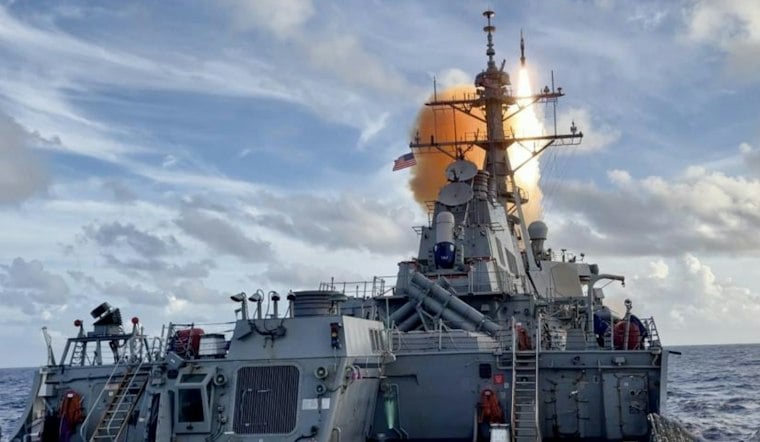
The U.S. Navy has handed RTX Corporation a contract worth up to $24.4 billion to ramp up production of the Standard Missile-6, a weapon the service relies on to knock down enemy aircraft, missiles and ships from Aegis-equipped warships. The five-year deal, which includes an option for two additional years, marks the second multibillion-dollar Pentagon award RTX has pulled in within a single week.
Acting Secretary of the Navy Hung Cao signed off on the award under the Navy's Portfolio Acquisition Executive Munitions initiative, a program built to expand manufacturing throughput for critical weapons, according to the U.S. Navy. Navy leadership has framed the move as essential to fleet combat credibility, arguing that defense suppliers need long-term demand stability to justify expanding magazine depth. As reported by Bloomberg, the Navy said the contract is specifically aimed at boosting supplies of the SM-6.
Just days before the SM-6 award, on September 25, the U.S. Department of War awarded Raytheon a separate five-year contract worth up to $20.7 billion to accelerate production of Advanced Medium-Range Air-to-Air Missiles, with a goal of reaching an annual output of at least 1,900 missiles. The Department of War's own release on the deal notes that the AMRAAM serves as the primary interceptor for the NASAMS air defense system and operates across 14 different air and ground platforms. Bloomberg's reporting on the SM-6 deal confirms it represents RTX's second major Defense Department contract of the week.
Why the Navy Considers the SM-6 Irreplaceable
The SM-6 stands apart from most of the Pentagon's missile inventory because of its range of jobs. Per Raytheon's own technical specifications, it is the military's only combat-proven weapon capable of performing anti-air warfare, anti-surface warfare, and terminal ballistic missile defense, all from shipboard Aegis systems. The missile blends a time-tested Standard Missile airframe with active radar guidance technology borrowed from air-to-air missile design.
The Navy has also pushed the SM-6's reach beyond the deck of a ship. An air-launched variant known as the AIM-174B, nicknamed Gunslinger, has been integrated onto carrier-based F/A-18E/F Super Hornets to give the fleet long-range air-to-air intercept capability in the Indo-Pacific, according to The Aviationist. That variant was unveiled operationally during RIMPAC 2024 and gives carrier strike groups an ultra-long-range aerial engagement option not seen since the retirement of the AIM-54 Phoenix, the outlet reported.
Part of a Bigger Pentagon Pattern
The SM-6 and AMRAAM awards follow a $58.62 billion seven-year Patriot PAC-3 MSE missile contract that Lockheed Martin secured in July, a sign of a broader Pentagon push toward multibillion-dollar multiyear agreements meant to restock depleted U.S. weapon reserves, according to Army Times. U.S. missile stockpiles have faced severe strain from military operations in the Middle East and ongoing equipment transfers to Ukraine, the outlet noted. The SM-6 and AMRAAM contracts together form part of the Department of War's Arsenal of Freedom policy push, which pairs multi-year procurement commitments with executive pressure on defense primes to prioritize factory output over corporate share buybacks.
Raytheon's missile production footprint spans facilities in Tucson, Arizona; Huntsville, Alabama; Andover, Massachusetts; and Diné, New Mexico, with Tucson and East Camden, Arkansas carrying major shares of SM-6 production, per The Defence Blog. The company has invested nearly $900 million over three years across its primary missile facilities to support expanded production lines, the outlet reported. Hoodline previously covered how Raytheon landed $1.3 billion in Pentagon deals tied to Tucson-built SM-3 and TOW missiles.
A Funding Catch Congress Hasn't Resolved
Despite the headline-grabbing contract ceilings, a key constraint looms over the deal. Reuters reported that while the Pentagon has granted multi-year provisional contract ceilings to RTX, Congress has not yet appropriated full funding, meaning contractors may face limits on up-front capital investments until lawmakers act. Multi-year contract awards send long-term demand signals to industry, but actual spending remains subject to annual congressional defense appropriations.
RTX's missile business sits inside a much larger corporate structure. The company recorded total corporate sales exceeding $88 billion for 2025 and maintains a global workforce of more than 180,000 employees across its Raytheon, Pratt & Whitney, and Collins Aerospace divisions, according to Investing.com. Raytheon functions as RTX's primary defense technology and missile manufacturing unit within that broader portfolio.
The SM-6 contract also connects to a separate radar deal that underpins how the missile gets aimed in the first place. In July, Raytheon secured a $1.8 billion contract extension, with options totaling up to $3.3 billion, to supply SPY-6 naval radars that provide the threat-tracking data ships need to fire SM-6 interceptors, according to Naval News. Those radars are scheduled for deployment on more than 50 U.S. Navy ships over the next decade.
For now, the dollar figures attached to both the SM-6 and AMRAAM contracts represent maximum ceilings stretched over as many as seven years, not guaranteed cash already in hand. Real-world production speed will hinge on annual legislative budget cycles and how quickly RTX's supply chains can ramp up to meet the Navy's and the Department of War's targets.


