

























































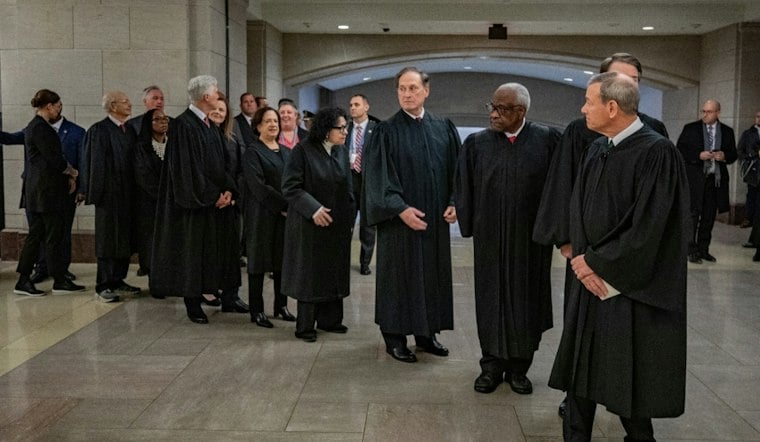
The Supreme Court announced this week that it could not hear a music copyright case because four of its nine justices had recused themselves, leaving the bench without the six members required to conduct business. The case, BMG Rights Management v. Vetter, involved a songwriter seeking to reclaim worldwide rights to a song, and with the quorum gone, federal law directed the Court to simply affirm the lower court’s judgment without issuing any opinion or setting precedent.
Four Justices Step Aside Without Explanation
According to NPR, Sonia Sotomayor, Neil Gorsuch, Amy Coney Barrett and Ketanji Brown Jackson all stepped away from the case, and the Court did not explain why. The order itself, dated Monday, stated only that the Court lacked a quorum, per the Supreme Court’s own order list. The timing and the parties involved made the silence conspicuous: BMG Rights Management is owned by Bertelsmann, the German media conglomerate that also owns Penguin Random House, as Bloomberg Law reported.
As The New York Times detailed in reporting by chief legal correspondent Adam Liptak, four justices likely recused themselves because they had published books with Penguin Random House imprints — and the publisher shares a parent company with a party in the case. Seven of the nine justices have published or are developing book projects, and the Times reporting noted that the justices have collectively made more than $13 million from books, according to a tally by Fix the Court.
A Watchdog Calls the Arrangement Unsustainable
Gabe Roth, executive director of Fix the Court, argued that justices should recuse themselves whenever they have an economic stake in a matter before them, and he told the Times the current situation is not sustainable. Renee Knake Jefferson has proposed that justices place book advances and royalties into an inaccessible account until they leave the bench. Supreme Court ethics rules currently cap outside teaching earnings at roughly $35,000 annually but place no such limit on book income, the Times reported.
This is not the first time the Court has lacked a quorum. In a 2008 appeal brought by more than 50 companies doing business in apartheid-era South Africa, the Court again lacked a quorum, per the Times account.
Why Citizens United Keeps Coming Up
The quorum controversy has renewed scrutiny of the Supreme Court’s 2010 ruling in Citizens United v. FEC, which held that limits on independent political expenditures by corporations, unions and other groups violate the First Amendment. The Court, split 5-4 with Justice Anthony Kennedy writing for the majority, found that corporations have First Amendment rights to spend money supporting or opposing candidates, according to Justia’s case record. The case began when Citizens United sought to promote its documentary Hillary: The Movie on television and through on-demand streaming via DirecTV ahead of the 2008 elections, then lost a related suit against the Federal Election Commission over video-on-demand distribution.
The debate over Citizens United has also resurfaced amid discussion of Elon Musk's political spending. The legal arc runs back to Buckley v. Valeo, the 1976 decision that struck down limits on political spending by individuals while upholding contribution limits as constitutional, per the Brennan Center.
The Money Behind the Debate
The numbers since 2010 are substantial by any measure. Super PACs spent roughly $6.4 billion on federal elections from 2010 through 2022, and the Brennan Center’s research notes they set a fresh record of at least $2.7 billion in the 2024 election alone. Dark-money spending climbed from less than $5 million in 2006 to more than $1 billion in the 2024 presidential race, the same report found.
Separately, OpenSecrets has tracked outside spending rising from $574 million in 2008 to nearly $1.3 billion in 2012, then $3.3 billion in 2020 and close to $4.5 billion in 2024. Super PACs alone spent just $62.6 million in 2010 before super PAC and hybrid PAC spending surpassed $4.1 billion in 2024, according to OpenSecrets’ analysis. The same tracking found that the share of federal election spending from the top 100 individual donors climbed sharply through 2016 and has since settled in the 14 percent to 16 percent range.
Court watchers caution that disentangling Citizens United from everything that followed is not straightforward.
For now, the unresolved question hanging over the Court is less about campaign finance doctrine than about its own internal conflicts. With a majority of justices now holding book deals tied to major publishers, Roth’s warning — that the current arrangement is not sustainable — points to a recusal problem that quorum rules were never designed to handle.


